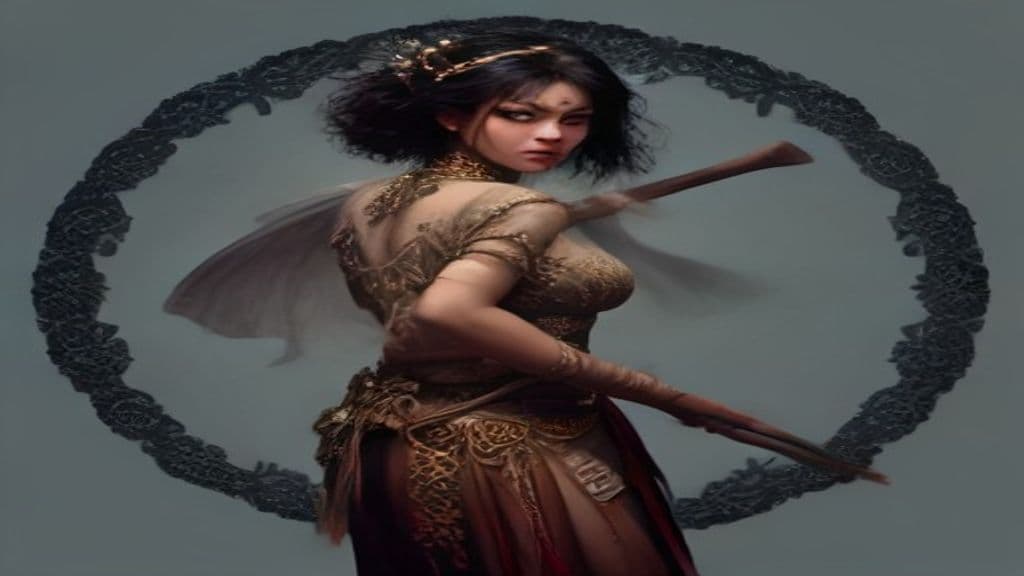
In the Kapampangan account, Bathala the creator left no explicit will, and his children Apolaki and Mayari contended for sole rulership of the world. They fought until Apolaki struck Mayari in the face, blinding one of her eyes. Moved with pity, Apolaki agreed they would rule the world at different times: Apolaki by day and Mayari by night. Mayari's lost eye is presented as an etiological explanation for why the moon's light is dimmer than the sun's.
Mayari is described as a beautiful woman who wears intricately designed clothing and is adorned with beads and jewelry. She is often depicted carrying weapons associated with Filipino martial arts—such as baston, yantok, and fighting sticks. One of her eyes is sightless and scarred from her fight with Apolaki, while the other is described as glowing more brightly.
Mayari functions mythologically as the moon deity who rules the world during the night through an alternating agreement with her brother Apolaki. Sources associate her with beauty, war, revolution, strength, weaponry, and the hunt. The primary mythic action recorded is her combat with Apolaki over rulership, resulting in her losing sight in one eye and the subsequent division of day and night.
Maugrim
Maugrim is a fictional Talking Animal — a large, sentient Narnian wolf — who serves as the Captain of the White Witch's Secret Police in C. S. Lewis's The Lion, the Witch and the Wardrobe. He functions as an armed enforcer of the Witch's tyranny, is described as very large and fearsome, and is ultimately killed in single combat by Peter Pevensie.
Mavka (Nyavka)
A female forest spirit in Ukrainian folklore, the mavka (also nyavka) represents the soul of a girl who died prematurely or unnaturally. Mavkas are ambivalent: various accounts portray them as alluring, dangerous seductresses who may lure men to death, while other local beliefs credit them with tending cattle and protecting flocks.
Mavroneri
A metaphorical entity associated with the River Styx, serving as a boundary between the mortal world and the underworld. (Note: 1. Power tier is incorrect; Primordial is typically associated with cosmic entities, but Mavroneri's abilities are related to a specific geographical location (the River Styx) rather than cosmological)
Mavuika
Mavuika is a fictional, in‑world divine figure in the video game Genshin Impact who functions as Natlan's Pyro Archon. Presented as a formerly mortal warrior who gained the Archon office, she drew on the power of the Ruler of Death to sacrifice herself to postpone a war for 500 years and is later resurrected in the game's current timeline.
Maximón (San Simón)
Maximón is a syncretic Maya folk deity and folk saint venerated in the Guatemalan Highlands (notably Santiago Atitlán and Zunil). He is an ambivalent, worldly figure—commonly represented by household or community effigies—that receives offerings (cigars, liquor, flowers, bread) and serves as a local mediator for petitions and favors. His identity and stories vary by town and combine pre-Hispanic Maya elements with Christian saint imagery, sometimes including associations with Judas Iscariot or Saint Simon.
Maya Hero Twins (Hunahpu and Xbalanque)
Central culture-hero brothers of the Kʼicheʼ Popol Vuh and Classic Maya iconography, Hunahpu and Xbalanque undergo trials, avenge earlier wrongs, defeat the lords of Xibalba by trickery and a ballgame, transform other beings, and are finally transformed into celestial bodies associated with sun and moon. They mediate between human society, the maize cosmos, and the underworld and appear in both colonial textual tradition and Classic Maya art.
Mayasura
Mayasura (Maya, Mayāsura, Maya Danava) is a legendary master‑builder and king among non‑Vedic supernatural lineages in Hindu narrative tradition, famed as the architect of the Mayasabha (Hall of Illusions) and the three cities Tripura, and as a transmitter/possessor of specialised astronomical knowledge in late mythic accounts.
Maymun
Maymun (Maymun Abanuch / Maymun al‑Shahabi / Abu Nuh) is presented in Islamic folkloric and occult sources as the last of the seven kings of the jinn, a powerful wind‑jinn king associated in those traditions with Saturday, the planet Saturn, the color black, and gold. He appears both as a fearsome, martial, abducing jinn in manuscript imaginaire and as a venerated saintly figure in North African local cults (Sidi Mimun / Lalla Mimuna).
Mayūrabhaṭṭa
Mayūrabhaṭṭa (Sanskrit: मयूरभट्ट) is a 7th‑century Sanskrit poet and Hindu scholar traditionally credited with composing the Sūryaśataka, a one‑hundred‑verse hymn to the Sun (Sūrya). In the narrative preserved in later tradition he performed a vowlike penance at the Sūrya temple in Deo, tied one hundred threads to a peepal tree and composed one verse per day; according to the account, this devotional composition is said to have cured his leprosy and liberated a Brahmarākṣasa that haunted the tree.
Mazu
Mazu (媽祖) is a deified female protector of seafarers originating in Fujianese popular religion as the historical/legendary Lin Moniang. Venerated across Chinese folk religion, Taoist and Buddhist registers, and in coastal and diasporic Chinese communities (notably Taiwan), she functions as a tutelary sea goddess whose cult includes temples, imperial honorific titles, and large popular pilgrimages.
Mazzikin
In Jewish mythology, mazzikin are described as invisible demons that can cause harm or danger to individuals. (Note: - Power tier: change to Lesser (mazzikin cause "minor annoyances") - Weaknesses & Wards: list should be more specific, e.g., "Incantation bowls made by Aramaic-speaking inhabitants of Mesopotamia and )
Mañjuśrī
Mañjuśrī is a central Mahāyāna bodhisattva who personifies transcendent wisdom (prajñā). He appears as an authoritative figure in sutras, in esoteric mantra/dharani collections, and widely in Buddhist art and temple ritual contexts across South, Central and East Asia.
Community Record
- [1]Mayari. Wikipedia, entry 'Mayari' (Kapampangan mythology section)wiki
- [2]Episode 81: Bathala and His Daughters — Spirits (podcast listing). Podcast episode listing referencing the division of reign between siblingsother
- [3]Mayarí (Wikidata entry for non-mythic place name). Wikidata (listed to disambiguate non-mythic uses of the name)other