In Hesiod's theogonic account the Meliae are earth-born nymphs produced when Cronus castrated Uranus and the drops of Uranus's blood fell upon Gaia; Hesiod groups them with other beings born of that event, such as the Erinyes and the Gigantes. This locates their origin in the foundational, chthonic moment of Greek cosmogony. Later traditions record additional localized episodes (for example, Callimachus describes Meliae nursing the infant Zeus in the Cretan Dikti mountains), but the primary origin narrative tying them to Uranus's blood on Gaia is Hesiodic.
The supplied sources do not provide a standardized physical description or iconography for the Meliae. They are characterized in the literary tradition as nymphs of the ash tree (i.e., tree-nymphs/dryad-like beings), which implies an association with ash trees and the general class traits of nymphs in Greek poetry (female, tree-associated nature-spirits), but no specific attributes of size, color, or costume are given in the cited sources. Individual figures called Melia appear in varying genealogical contexts (for example a Theban Melia in Callimachus), which reflects the fluidity of nymph taxonomy rather than a fixed iconography.
The sources attribute to the Meliae chiefly ontological and social functions rather than explicit magical powers. Hesiod presents them as born from Uranus's blood on Gaia and (via Hesiod's interpretation of 'ash trees') as linked to the origin of Hesiod's Bronze Age of men — i.e., ash trees are said to have been the progenitors of that human generation. Callimachus records a caretaking role: the Meliae are nurses of the infant Zeus in the Cretan Dikti mountains, feeding him on Amalthea's milk and honey. Mythographic traditions also present individual Melia figures as mothers of named semi-divine persons (e.g., a Melia mothering Tenerus and Ismenus in Callimachus; a Meliae as mother of Pholus in Apollodorus). The supplied material does not ascribe other specific powers (such as shapechanging, curse-working, or hostile magic) to the Meliae.
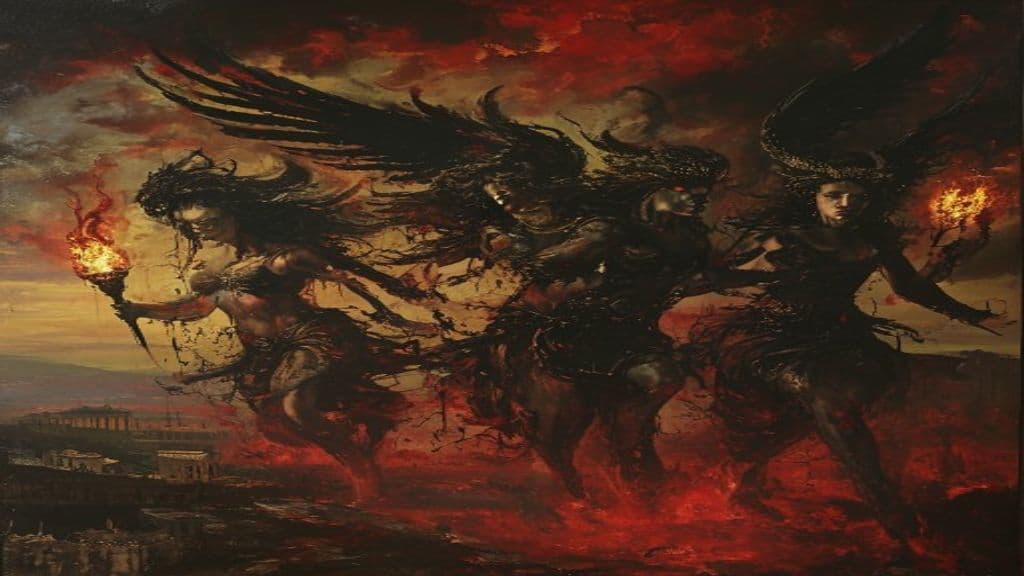
Erinyes
The three avenging Furies of Greek myth — Alecto, Megaera, and Tisiphone — who pursued and tormented those guilty of crimes against blood kin, especially murder of family members.
Gigantes
In Greek myth the Gigantes (Gigantes) are a race associated with great strength and aggression who wage war against the Olympian gods in the Gigantomachy. Classical summaries (via Hesiod as reported in standard reference summaries) present them as offspring of Gaia born from the blood of Uranus after his castration by Cronus and as cosmological antagonists whose defeat helps establish Olympian order.
*Péh₂usōn (reconstructed)
Péh₂usōn is a hypothetical Proto‑Indo‑European pastoral guardian reconstructed by comparative scholars from parallels in Greek and Vedic traditions. Proposed as a Graeco‑Aryan ancestor‑figure, the reconstruction describes a protector of flocks, roads, and travellers rather than an attested historical cultic personality.
Aba (disambiguation / name-form)
Aba is a polyvalent name-form attested across many unrelated contexts (place names, personal names, animal names, and brief mythological listings). The provided sources do not support a single, coherent supernatural entity called "Aba" and offer no descriptive or ritual material for such a being.
Abarbarea
Abarbarea is a name attested in classical Greek and Roman sources for freshwater nymphs (naiads). The name appears for at least two individual mythic figures — a naiad wife of Bucolion and a naiad counted among ancestors of the Tyrians — and Hesychius records plural forms that may indicate the name was also used as a class-name (Abarbareai / Abarbalaiai).
Abas
Abas (Ancient Greek: Ἄβας, gen.: Ἄβαντος) is not a single mythic being but a recurring personal name borne by multiple mortals and minor mythic figures in Greek epic and genealogical traditions — kings, founders, seers, warriors, attendants, a centaur, and a youth transformed by a goddess. The name is glossed in the sources as 'guileless' or 'good-hearted' and appears across Argive, Theban, Trojan, Euboean, and other local cycles.
Abderus
Abderus (Ancient Greek: Ἄβδηρος, romanized Ábdēros) is a mortal heroic figure in Greek myth closely associated with Heracles, remembered as the youth left in charge of the Mares of Diomedes who was killed by them. He functions as an eponymous local/divine-hero ancestor for the city of Abdera and received funerary commemoration and athletic agones at his tomb.
Abomination of Desolation
An apocalyptic prophetic phrase originating in the Book of Daniel designating a profaning thing or act that renders the Jerusalem Temple cult desolate; later reused in the Synoptic Gospels as an eschatological sign prompting urgent flight. The term denotes ritual/cultic impurity (Hebrew shiqquts) and is variously interpreted as pagan offerings or altar, a foreign cult statue, or (in some New Testament readings) an acting agent.
Absyrtus
Absyrtus (Ancient Greek: Ἄψυρτος) is a Colchian prince in the Greek Argonautic cycle, son of King Aeëtes and brother or half-brother of Medea. He appears in variant traditions either as a companion taken by Medea during her flight with Jason and murdered/dismembered to delay pursuit, or as a pursuer sent by Aeëtes who is overtaken and slain by Jason; his death functions as a key narrative device in the escape from Colchis.
Acacallis
Acacallis (Ancient Greek: Ἀκακαλλίς; also Acalle) is a mythological princess of Crete in Greek tradition, daughter of King Minos and Pasiphae. She functions primarily as a dynastic and etiological figure: in varying accounts she is mother, by gods such as Hermes (Mercury) or Apollo, of eponymous or founder-figures like Cydon (founder of Cydonia), Miletus, or Lydon/ Lydus.
Acacus
Acacus (Ancient Greek: Ἄκακος) is, in Arcadian Greek tradition, a mortal eponymous founder-king of Acacesium and is remembered as the foster-father who reared the infant Hermes (Mercury) in that local tradition. He is presented in genealogies as a son of Lycaon and functions as a local ancestral/onomastic figure rather than a supernatural spirit.
Academus
Academus (Greek: Akádemos / Hekádemos) is an Attic hero-eponym tied to a sacred grove (Akademeia) on the Cephissus near Athens. In myth he revealed where Helen was hidden to the Dioskouroi, an act said to have saved the city, and the place bearing his name became a long-lived sacred precinct, later the site of Plato's Academy.
Acamas
Acamas (Ancient Greek: Ἀκάμας) is a personal name recurrent in ancient Greek narrative traditions applied to multiple human characters (warriors, princes, suitors), once to a Cyclops, and once as a hound's name. Rather than a single supernatural entity, bearers of the name appear episodically across the Trojan War, Theseid, and Theban cycles as mortal actors whose deeds intersect with gods and fate.
Acantha
Acantha (Ancient Greek: Ἀκάνθα, 'thorn') is a late or secondary mythological figure known from modern retellings as a nymph transformed into the acanthus plant. The tale that she scratched Apollo and was changed into a spiny-leaved plant is not attested in surviving classical corpora and appears to be a modern compilation or invention rather than a firmly documented ancient myth.
Community Record
- [1]Meliae — Wikipedia. Wikipedia, 'Meliae' article (summary of Hesiod, Callimachus, Apollodorus traditions)wiki
- [2]Hesiod — Theogony; Works and Days (summary as cited). Hesiod, passages cited in secondary summaries: Meliae born from Uranus' blood on Gaia; ash trees linked to progenitors of Bronze Age men (Works and Days / Theogony)literary
- [3]Callimachus, Hymn to Zeus (summary as cited). Callimachus, Hymn to Zeus — Meliae as nurses of the infant Zeus in the Cretan Dikti mountains and a Melia as mother of Tenerus and Ismenus (as reported in supplied notes)literary
- [4]Apollodorus (summary as cited). Apollodorus (mythographic summary) — a Meliae named as mother of Pholus by Silenus (as reported in supplied notes)literary
- [5]Archive video synopsis (secondary summary of Hesiodic grouping). Archive video synopsis summarizing Hesiod's account that drops of Uranus' blood give rise to the Gigantes, the Erinyes, and the Meliaeother