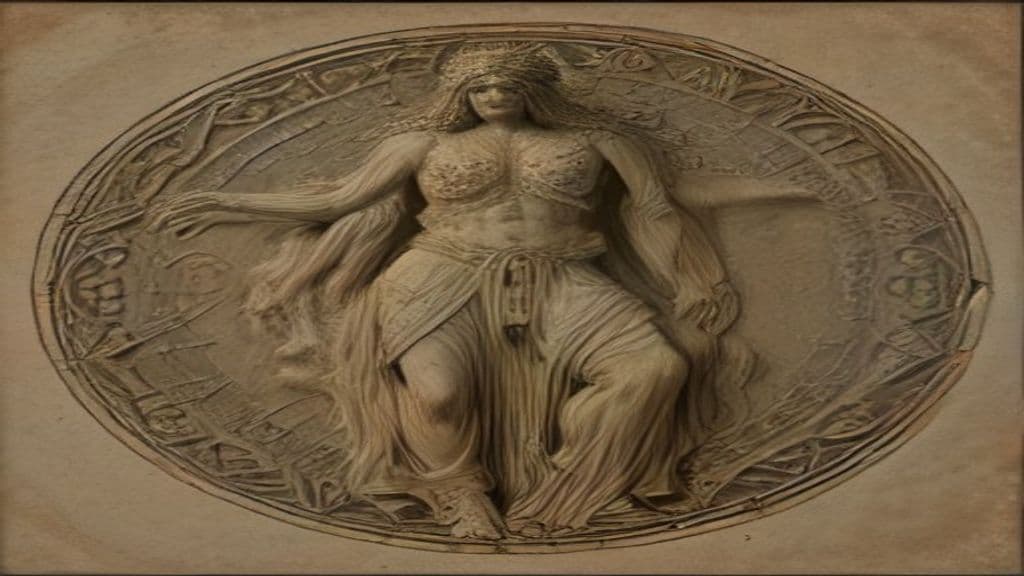
In Greek mythic genealogies Mopsus is presented as a member of a hereditary line of seers: commonly as the son of Manto (herself daughter of the blind prophet Tiresias), while alternative accounts make him a son of Apollo, indicating divine sanction for his prophetic office. These mythic accounts place Mopsus within the poetic and dramatic tradition of archaic Greece (Hesiodic fragments, Callinus, later allusions), where prophetic authority is an inherited and sometimes contestable quality. Separately, in an historical-epigraphic register the same name (rendered Muksa / M-p-š in Luwian and Phoenician) appears in Early Iron Age inscriptions (notably the Karatepe bilingual and related Çineköy and İncirli material) as an eponymous ancestor invoked in royal dynastic formulae — the “house of M-p-š / Muksa” — showing how a personal or legendary name was mobilized to legitimate rulership in Cilicia/Pamphylia in the 8th–7th centuries BCE. Scholarship therefore treats Mopsus both as a mythic seer-figure embedded in Greek literary tradition and as a name preserved in Anatolian/Phoenician inscriptions associated with historical dynastic identity.
Classical and epigraphic sources do not record a consistent supernatural physical description for Mopsus; he is represented as a human seer or poetic persona rather than a monstrous being. In Greek literary traces the name functions as that of a prophetic figure or poetic speaker (for example Virgil uses the name as a pastoral singer in his Eclogues), but no canonical attributes of clothing, stature, or other distinctive marks are preserved in the cited materials. The extant evidence therefore treats Mopsus as a human actor in myth and politics—an oracular personality whose presence is attested through literary voice and onomastic occurrence in inscriptions rather than iconographic description.
Primary sources and modern summaries present Mopsus as a celebrated seer and diviner: he issues prophecies, participates in contests of prophetic authority (most famously as a rival of the seer Calchas in poetic tradition), and occupies the institutional role of vates/prophet whose insight may derive from hereditary descent (Tiresias → Manto → Mopsus) or from divine parentage (Apollo). Literary fragments and later poets place him among archaic prophetic traditions (Hesiodic fragments, Callinus, Aristophanic allusion) and the scholarly literature records a specific motif, "The Divination Contest of Calchas and Mopsus," attesting to competitive prophetic performance as a recurring behavioral setting. In the epigraphic/historical register the name Muksa functions as an eponymous founder whose authority is invoked to legitimate dynastic rule, so his "ability" in that context is genealogical and political: to serve as ancestral patron and source of legitimacy for ruling houses recorded in Karatepe and related inscriptions.
Monopod
A class of mythological humanoid peoples described in classical, medieval, Chinese, and Norse sources as having a single central leg with a very large foot. Treated in literature and maps as a wondrous race inhabiting the margins of the known world rather than as a lone monster.
Monotheism in pre-Islamic Arabia
Followers of Abrahamic faiths, such as Christianity and Judaism, who believed in a single all-powerful God in pre-Islamic Arabia. (Note: * Power tier: Lesser (not Greater) - monotheistic beliefs were not limited to powerful regional deities but had a relatively local presence in pre-Islamic Arabia. * Origin story: The exact timing is u)
Monster (tradition)
A broad cultural category for imagined creatures that transgress natural and social norms. In literature, mythology, religion, and popular culture, monsters mark otherness, danger, or omenatic significance rather than denoting a single, uniform being.
Monster Slayer (Nayenezgani)
Within the limited sources supplied, 'Monster Slayer' is used as an English label on a Wikipedia disambiguation page to refer to Nayenezgani, identified there only as "a character from the Navajo creation myth." The provided materials contain no narrative, descriptive, or ritual information about this figure beyond that single listing.
Moon Rabbit (Maya Tradition)
A mythical figure associated with lunar mythology, said to pound elixir or medicine for mortals and occasionally foodstuffs. (Note: 1. Power tier: Downgrade to Ancient, as while it's associated with lunar mythology, its abilities are not cosmic in scope. 2. Abilities: Add that the contents of the mortar differ among cultural tradi)
Moon god (lunar deity)
A lunar deity is a divine figure representing the Moon or aspects of it; across cultures such deities personify the Moon, its phases, and its governance of the night and may perform varied functions depending on local tradition.
Morana (seasonal goddess)
A pan-Slavic female figure personifying the death of winter whose ritual demise at winter's end is linked to the rebirth of spring goddesses such as Kostroma, Lada, or Vesna. Sources treat her as an ancient goddess associated with seasonal rites and with dreams.
Morax
Morax is a named spirit in demonological listings described in secondary sources as a high-ranking infernal officer—styled a Great Earl and President of Hell—who commands many legions and is said to teach astronomy and the liberal sciences. The figure is also reused in diverse modern fictional and occult contexts where attributes are adapted.
Morgan le Fay
A mutable figure of the Arthurian tradition variously portrayed as an enchantress, healer, fairy-queen, or human noblewoman. Early accounts emphasize her role as a healer and leader of supernatural women at Avalon; later prose romances often recast her as an ambivalent or antagonistic sorceress in relation to Arthur and his court.
Moritasgus (Apollo Moritasgus)
Moritasgus is a Celtic epithet for a healing deity attested in four inscriptions at Alesia. In two of those inscriptions he is explicitly identified with the Greco‑Roman god Apollo, and his consort is named as the goddess Damona.
Mormo
A Greek child-eating bogeywoman used to frighten children into obedience, sometimes depicted as a shape-shifting female phantom who bit naughty children.
Moroi
A moroi is a revenant or undead spirit in Romanian and neighbouring Central/Eastern European folklore associated with failed birth/death rites and nocturnal harm. Traditions variously describe it as a phantom, a kind of vampire or ghost, or the spirit of an unbaptized infant or malformed child born of supernatural conception.
Community Record
- [1]Mopsus. Wikipedia, entry 'Mopsus' (summary of mythic and epigraphic attestations)wiki
- [2]Mopsus (son of Manto). Wikipedia, entry 'Mopsus (son of Manto)' (genealogical variants and poetic attestations)wiki
- [3]The Divination Contest of Calchas and Mopsus and Aristophanes’ Knights. GRBS article (discussion of the prophetic contest motif between Calchas and Mopsus)academic
- [4]The Eclogues by Virgil (Eclogue V). Internet Classics Archive (Virgil, Eclogue 5 — literary reuse of the name 'Mopsus' as pastoral persona)literary
- [5]Karatepe bilingual inscription (discussion in secondary summaries). Wikipedia summary referencing the Karatepe bilingual and the house of M-p-š / Muksa in Luwian-Phoenician inscriptionswiki
- [6]WildWinds — Mopsus, Cilicia (coinage reference). Numismatic reference linking the name Mopsus to Cilician contextsother