No mythic narrative survives for Narundi in the supplied sources. Attestations show her as a locally venerated goddess of Susa in Elam attested roughly between ca. 2250 BCE and 1800 BCE: she is named in statue dedications (for example a small statue dedicated by Eshpum for Manishtushu), votive inscriptions, temple foundations (a temple at Attahušu ca. 1800 BCE), and curse formulas composed to protect objects or sanction violators. Later attestations occur only in Mesopotamian lexical and apotropaic ritual contexts and may reflect secondary adoption or reinterpretation rather than continuous local narration of origin myths.
A life-size statue excavated at Susa and now in the Louvre — if identified as Narundi (identification debated) — depicts a female figure wearing a kaunakes (tufted/fleece skirt) leaving hands and feet exposed, a multi-horned headdress (four paired horns in the reconstruction), holding a palm leaf and a goblet, and seated on a throne decorated with three pairs of roaring lions. The attribution of this statue to Narundi rests on a disputed reading of a Linear Elamite inscription; some scholars (Desset) have proposed the inscription instead reads Belat-ekallim, so the identification is not secure. Earlier inscriptions mention a statue dedicated to Narundi without providing physical description.
Textual evidence emphasizes Narundi's role in cultic invocation and in apotropaic and curse formulas rather than narrated miraculous deeds. She is invoked alongside major deities (Inshushinak, Inanna/Ishtar, Nergal, Shamash, Sin, Enlil, Enki, Ninhursag) to prevent desecration of votive objects and to curse removers (for example inscriptions that implore her to deprive anyone who removes an object of descendants). Heidemarie Koch suggested she might have been understood as a goddess of victory, but this is an interpretive proposal and not a direct textual claim. In later Mesopotamian ritual literature she appears associated with the Sebitti and functions within apotropaic (protective/warding) ritual ensembles.
Weaknesses
- otherNo textual evidence for weaknesses or specific vulnerabilities in the supplied sources
Wards
- ritualInscriptional invocation on votive/dedicated objects
- ritualInclusion of Narundi's name in curse formulas (to prevent desecration or to deprive removers of descendants)
- ritualInvocation as part of apotropaic Sebitti-associated ritual ensembles in later Mesopotamian practice

Inshushinak
Inshushinak is the principal tutelary deity of the city of Susa in Elamite tradition, functioning as the city's lord, protector, royal legitimizer, and divine judge with associations extending into funerary and underworld contexts.

Inanna
Inanna is a major ancient Mesopotamian goddess, primarily worshipped in Sumer and later identified with the Akkadian Ishtar. Her domains include love, sex, war, political power, divine law and procreation; she is a principal cult figure of Uruk and bearer of the mes, the decrees of civilization.
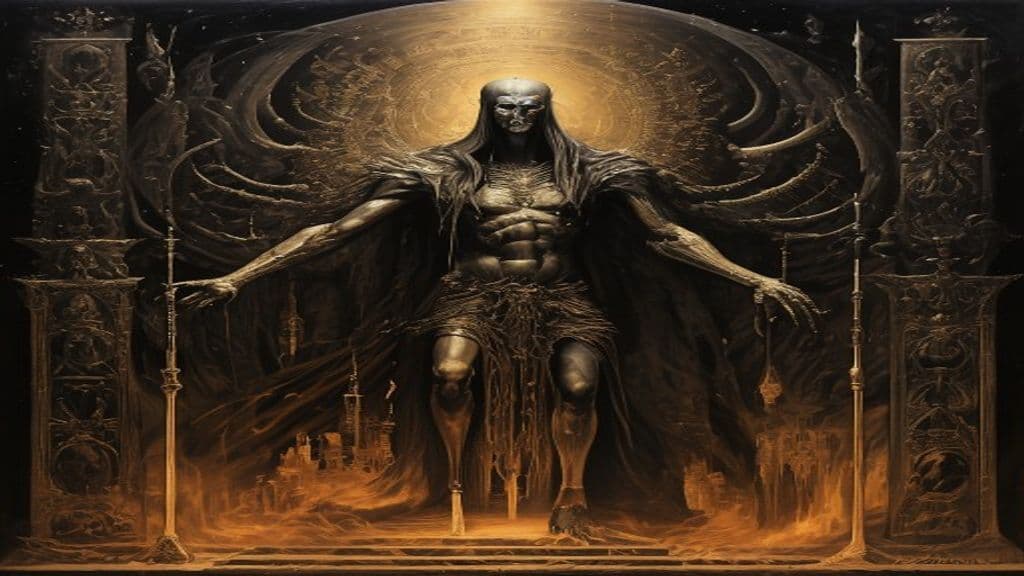
Nergal
Nergal is a major Mesopotamian deity associated with war, disease, inflicted death, and rulership of the underworld. Principal cult center at Kutha (temple E‑Meslam), he appears in hymns and myths (e.g., the Epic of Erra, "Nergal and Ereshkigal") and is sometimes equated with or called Erra or Meslamtaea.

Shamash (Utu)
Shamash (Akkadian šamaš; Sumerian Utu) is the ancient Mesopotamian sun god, a principal deity responsible for the visible sun and for juridical, protective, and divinatory functions. He is venerated especially at Sippar and Larsa, appears in major myths as an ally of heroes, and is regarded as the divine witness whose sight underwrites justice and truth.
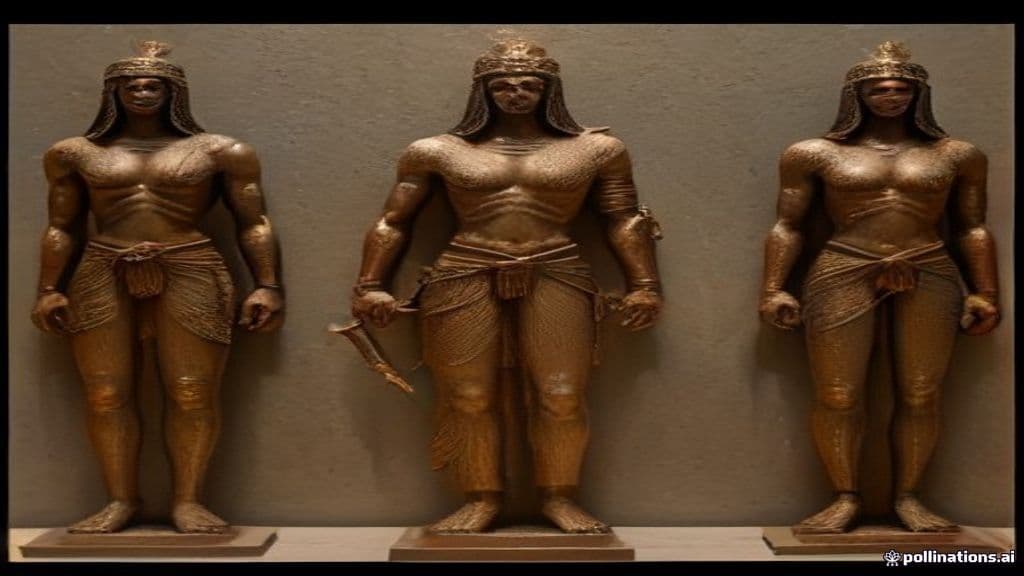
Sebitti
A Mesopotamian heptad of seven masculine warrior figures variably treated as minor war-gods, attendants or weapons of greater deities, astral beings (Pleiades), and as apotropaic household guardians in Neo-Assyrian ritual practice.
'Ain Samiya Goblet
Silver cup from the Middle Bronze Age I, discovered in a tomb at Ain Samiya. (Note: 1. Power tier should be "None", but add a note explaining that historical artifacts don't fit into the typical power tier classification. 2. Add a description of its appearance based on it being a sil)
A Man Was Going Down the Road
Georgian tradition, possibly a reference to a novel title by Otar Chiladze (1973), lacking clear information on its supernatural nature or abilities. (Note: * Power tier should be set to Primordial, as there's no information on its supernatural nature or abilities; it simply appears to be a novel title without further context. * Summary: The summary is ac)
Abu
Abu is a poorly understood Mesopotamian god attested in modern reference summaries. Secondary literature tentatively links him with vegetation and snakes and records that he was often paired with a deity written gu2-la2, but primary details about his cult, iconography, and myths are lacking in the cited sources.
Abzû
Abzû (Sumerian abzû; Akkadian Apsû) is the primordial freshwater abyss in Sumerian–Akkadian cosmology: the deep fresh waters that underlie and surround the earth, source of springs, rivers and ritual holy waters, and a creative principle whose mingling with the salt sea (Tiamat) figures in Mesopotamian cosmogony.
Abī-simtī
Abī-simtī (also rendered Abi-simti, Abisimti) is a named woman attested in third-millennium BCE Mesopotamian documentary and literary texts. She appears in administrative account records as a provider of animals and donor to temple cults and in Sumerian love-song literature as the named beloved/consort addressed by a royal speaker.
Adad
Adad (also Hadad, Haddad; Sumerian Iškur) is the storm- and rain-deity attested in ancient Mesopotamian and Canaanite religious contexts. Sources identify him as a principal weather god whose domain is storms and rainfall and whose name appears across multiple Near Eastern languages and sites, including Ebla (as Hadda, c. 2500 BCE).
Adapa
Adapa is a mythic figure from ancient Mesopotamian (Sumerian and Akkadian) literature: a mortal fisherman and temple sage of Ea at Eridu endowed with exceptional wisdom. He appears in a fragmentary tale in which he breaks the wings of the south wind and is summoned to the divine court; his name was later invoked in exorcistic and ritual contexts as an authoritative identity.
Adgilis Deda
Protective spirit and deity of fertility in pre-Christian Georgian pantheon, revered by mountaineers of northeast Georgia. (Note: 1. Power tier should be Ancient (deity-level) instead of Primordial. 2. Add sensory_cues that reflect Adgilis Deda's association with fertility, such as blooming flowers or lush vegetation. 3. List Wa)
Adonis
Adonis is a mythic mortal youth in ancient Greek tradition, beloved by goddesses (notably Aphrodite and Persephone) whose death and seasonal return are the focus of the women’s midsummer festival Adonia. The cultic practices—planting short-lived 'gardens of Adonis' on rooftops, ritual lamentation, and casting an effigy and withered plants into the sea—symbolically link him to vegetation cycles and Near Eastern dying-and-regenerating god traditions.
Adrammelech
Adrammelech is attested in ancient Semitic textual tradition as a local god of 'Sepharvaim.' The name is commonly glossed as "Magnificent king." In modern times the name has been reused in diverse fictional, musical, and online contexts, but those are creative reworkings rather than continuations of the brief ancient attestation.
Aga of Kish
Aga of Kish (Aga, Agga, Akka) is an Early Dynastic Mesopotamian king recorded in the Sumerian King List, the Tummal Inscription, epigraphic objects, and the Sumerian poem "Gilgamesh and Aga." He functions in texts as a historical/legendary political actor who attempted hegemonic demands on Uruk and was ultimately captured and released by Gilgamesh.
Agasaya
Agasaya is presented in modern secondary sources as a little-attested Semitic war goddess who, according to some summaries, was later absorbed as the warrior aspect of the major Mesopotamian goddess Ishtar. The attestation in available materials is sparse and much inferences about her name, attributes, and later influence are explicitly marked speculative in those sources.
Community Record
- [1]Narundi — Wikipedia. Wikipedia contributors, 'Narundi', Wikipedia, The Free Encyclopedia.wiki
- [2]Narundi — Wikidata. Wikidata entry Q1965445, 'Narundi'.other