
Accounts attached to Bharadvaja vary across genres. Vedic tradition presents him as an authoritative rishi and the eponymous head of a gotra, credited with hymns in Ṛgveda Mandala 6 and as a traditional seer of king Marutta's poets. Purāṇic and epic narratives expand his genealogical and biographical portrait: some later traditions make him son of Atri (variant genealogies), and various Purāṇic accounts relate unusual birth-stories in his family—most notably variant stories about the origin of the warrior-teacher Drona (accounts range from miraculous conception via an apsarā to preservations of semen leading to Drona's birth). Medical and technical traditions recount divine transmission of knowledge to him (e.g., Charaka Saṃhitā and later summaries state that Indra taught Bharadvaja certain medical lore). Buddhist texts and commentarial usage treat Bharadvaja as a clan-name or honorific; persons called Bhāradvāja (e.g., Bhāradvāja Thera, Piṇḍola Bhāradvāja) appear as historical or exemplary figures in Pali sources. A few secondary summaries note traditions that attribute exceptional longevity (e.g., a fragmentary reference to living through three lives in a Taittirīya Brāhmaṇa summary), but such specific claims are fragmentary and vary between sources.
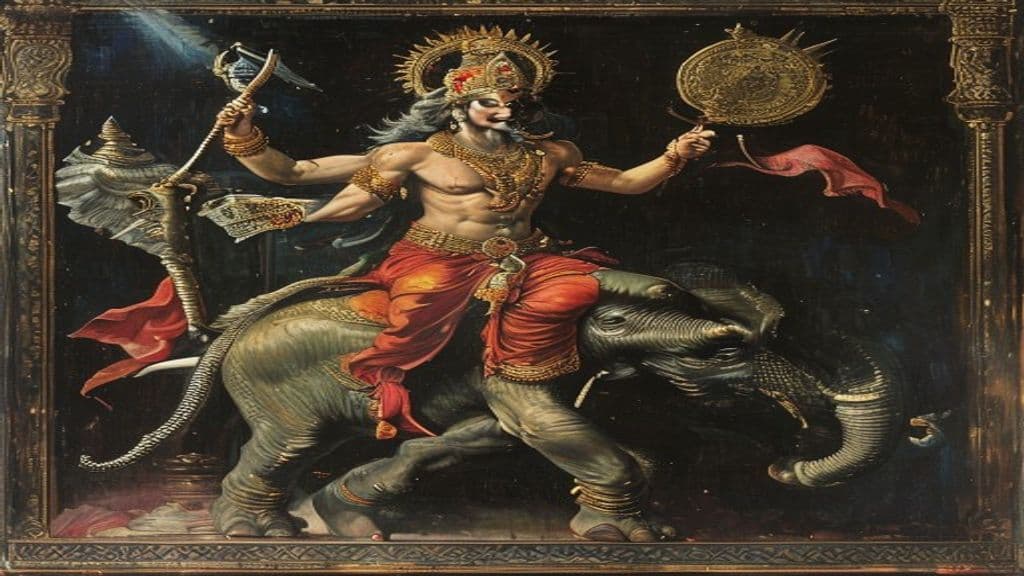
Textual depictions present Bharadvaja primarily as a venerable hermit and teacher rather than a narrowly iconographic supernatural: he is located in an āśrama in epic narratives (for example, Rama, Sītā, and Lakṣmaṇa meet him at his hermitage in the Rāmāyaṇa), appears as an interlocutor or witness in Purāṇic and epic dialogues, and functions as a lineage-head in ritual manuals. The supplied sources do not provide a standardized physical or iconographic description (clothing, marks, or fixed supernatural attributes); instead, portrayals emphasize his role as an aged, learned seer encountered in a hermitage or as the named authority behind ritual and technical texts.
Bharadvaja's attributed capacities are literary, ritual, and pedagogical rather than explicitly 'magical' in the supplied material. Traditions ascribe to him (and his school) portions of the Ṛgveda (notably Mandala 6), ritual corpora (Bharadvaja srauta-sūtra and gṛhya-sūtra), technical works (Dhanur-veda attributed in Mahābhārata 12.203), phonetic and educational texts (Bharadvaja-śikṣā), and medical associations (Charaka Saṃhitā reports Indra teaching Bharadvaja medical knowledge). He is depicted as teacher and progenitor—father or instructor of important figures such as Drona (with variant origin accounts), teacher of disciples connected to martial and ritual traditions, and as a recipient of divine instruction (notably Indra). In Buddhist literature, the name identifies individuals of Brahmin lineage or eminent practitioners (e.g., Piṇḍola Bhāradvāja, Bhāradvāja Thera). These attributes indicate high sacerdotal, scholarly, and pedagogical authority across genres; claims of extraordinary longevity appear in fragmentary secondary notes but are not uniformly documented in the supplied sources.
Hiraṇyagarbha
Hiraṇyagarbha (Sanskrit: हिरण्यगर्भ, 'golden womb') is a Vedic and later Hindu cosmological concept: a primordial golden seed or 'cosmic egg/womb' from which the manifested universe is said to originate. It is presented variously as an impersonal formative principle, the 'Soul of the Universe' in Upanishadic language, and in Purāṇic and exegetical contexts as the first-born or creator (identified with Prajāpati or Brahmā).
Parīkṣit
Parīkṣit is a legendary-historical Kuru king of classical north Indian tradition attested in Vedic, epic and Purāṇic materials. He is portrayed as a sacrificial sponsor and righteous ruler whose life intersects with sages, Nāgas, and divine protection; his death by the Nāga Takṣaka and the subsequent snake-sacrifice of his son Janamejaya form central narrative episodes.
Rudras
A plural class of Vedic divine beings regarded as manifestations or attendants of the god Rudra (later identified with Śiva). They function as atmospheric/wind deities, vital forces within the human body, and ritually important gods occupying an intermediate place among the Vedic divinities.
Svāhā
Svāhā is both the Vedic oblation-formula uttered when offering into the sacred fire and a personified goddess associated with sacrificial power (śakti) and the fire-god Agni. As formula she functions as the consummatory invocation in yajña and as a mantric ending in Mahāyāna Buddhist dhāraṇīs; as goddess she is described in Upanishadic and Purāṇic materials as the power that makes oblation effective and as a divine consort and mother in various narratives.
Vāmadeva
Vāmadeva is a Vedic rṣi (seer) attested as the author of Mandala 4 of the Rigveda and later as a teacher, priest, and moral-ritual authority in Upanishadic, epic, and Purāṇic narratives. Texts record him composing hymns, advising kings, issuing curses and boons, and acting within hermitage and court settings.
Bhairavi
Bhairavi (Sanskrit: भैरवी) is a Mahāvidya — a fierce form of the Great Mother in Hindu tantric and Puranic traditions. She appears both as a deity, consort of Bhairava, and as a title or attainment for a female tantric adept (a realized yogini). Iconography and texts portray her as awe-inspiring and ambivalently maternal: protective to devotees and terrible to the wicked.
Bhaisajyaguru
Bhaisajyaguru (Bhaiṣajya‑guru; Medicine Buddha) is a Mahāyāna buddha associated with healing, medicine, and a pure land called Vaiḍūryanirbhāsa (Pure Lapis Lazuli). He functions as a therapeutic savior whose remedies operate through the "medicine of his teachings," vows, devotional practice, and radiance associated with lapis‑lazuli light.
Bhaiṣajyarāja (Medicine King Bodhisattva)
Bhaiṣajyarāja (Sanskrit: Bhaiṣajyarāja; Chinese: 藥王 Yào Wáng) is a Mahāyāna bodhisattva associated with healing, medicine, and supreme self‑offering. He appears in the Lotus Sūtra and in visualization/contemplation sutras and is often connected ritually and iconographically with the Medicine Buddha (Bhaiṣajyaguru) and with the paired bodhisattva Bhaiṣajyasamudgata.
Bhaiṣajyasamudgata
A Mahāyāna bodhisattva associated with the therapeutic activity of the Buddha and invoked in visualization (Guan) sūtras. He is named alongside the Medicine King (Bhaiṣajyarāja) and is the co-subject of a dedicated contemplation sūtra used in meditative-healing practice.
Bharata (Mahābhārata)
Bharata (Sanskrit: भरत) is a legendary human emperor and ancestral king in the Indic epic tradition. Portrayed as a cakravartin‑type sovereign and progenitor, his deeds, rituals, and lineage provide an eponymous foundation for the name Bhārata and for later dynastic identity.
Bharata (Ramayana)
Bharata is the younger half-brother of Rāma in the Hindu epic Rāmāyaṇa, who refuses the throne after Rāma's exile and serves as regent of Ayodhyā from Nandigrāma, ruling in Rāma's name while living an ascetic life. In devotional and pilgrimage traditions he is also assimilated into divine schema—described in some sources as an incarnation of Viṣṇu's Panchajanya and presented among the quadruple expansion of Rāmācandra.
Bhargava (Hindu tradition)
A Brahmin race or dynasty founded by the legendary sage Bhrigu in Hindu mythology. (Note: - Power tier should be Ancient (deity-level), not Primordial, as there's no indication of cosmic powers. - Abilities section needs clarification that the source doesn't provide specific information on)
Community Record
- [1]Bharadvaja (Wikipedia). Wikipedia article 'Bharadvaja' (accessed source in research notes)wiki
- [2]Bharadvaja Sutta: About Bharadvaja (Saṃyutta Nikāya). Saṃyutta Nikāya reference to Bharadvaja in Buddhist suttas (provided in research notes)literary
- [3]Pindola Bharadvaja (Wikipedia). Wikipedia entry on Piṇḍola Bhāradvāja, cited in research notes to show Buddhist reuse of the namewiki
- [4]The Bharadvajas in Ancient India (Archive). Digitized monograph listed in research notes discussing Bharadvaja traditionsother
- [5]Charaka Saṃhitā (as cited in secondary summaries). Secondary note in research materials: Charaka Saṃhitā tradition records Indra teaching medicine to Bharadvaja (summary in research notes)literary
- [6]Myth and Folklore Encyclopedia: Bharadvaja (summary). Online encyclopedia summary cited in the supplied research notesfolk
- [7]Bharadvaja entries and manuscript listings (archive links in research notes). Archive listings of manuscript material and related textual resources referenced in the research notesother