
The only primary attestation of the Portunes is Gervase of Tilbury's Otia Imperialia (medieval Latin), which records creatures called Portunes in England and Neptunes in France. Gervase lists them among other uncanny beings, explicitly placing them in a catalogue of 'demons' but adding that they 'might instead be a mysterious ghost' of unknown origin. The names in his text are Latinized forms; vernacular forms are not preserved. Later commentators have debated the names' derivation—Francis Young links Neptunes to netun ('marine monster') and to the Roman Neptune and considers a possible Portunus association for the English form, while Felix Liebrecht argues from the names that they may be water-associated spirits. These etymological proposals are interpretive layers atop Gervase's single surviving medieval report rather than independent folk origin narratives.
According to Gervase's description in the Otia Imperialia, Portunes have 'an aged appearance and wrinkled face' yet are 'very small in stature, measuring less than half a thumb.' Later scholars debate this size phrase—C. C. Oman and Thomas Keightley have suggested possible textual corruption or emendation, while S. E. Banks and J. W. Binns note manuscript agreement and accept the very-small reading—so the primary-text appearance is of an extremely diminutive, wrinkled, aged-looking domestic creature.
Gervase records that Portunes assist peasants by performing heavy domestic work quickly, indicating a service-oriented capacity in the household sphere. He also depicts hearth-centered, nocturnal habits: they 'enter peasant houses at night, warm themselves by the fire, and roast small frogs which they carry in their pockets.' Additionally, Gervase recounts mischievous behavior—a prank in which Portunes take the reins of a solitary English rider at night and lead the horse into mud, then depart 'roaring with laughter.' The combined testimony portrays them as morally ambivalent domestic spirits: helpful in performing labor but also given to practical jokes and harassment of travellers.
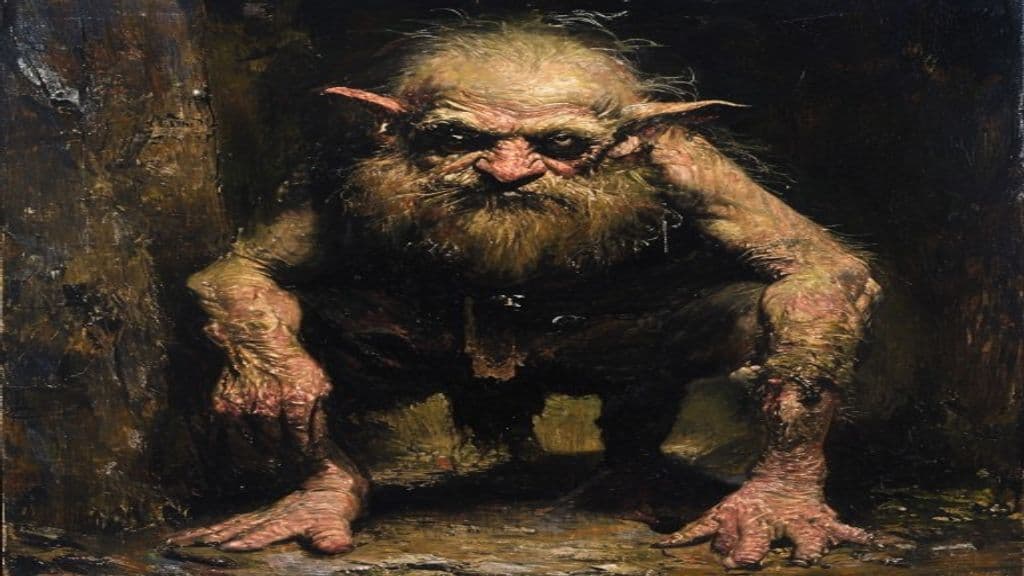
Goblin
A class of small, often grotesque humanoid beings in European folk belief that range from household helpers to tricksters and violent figures. Goblins occupy liminal spaces—hearths, cellars, ruins and wild places—and their behavior toward humans depends on region, story, and reciprocal treatment.
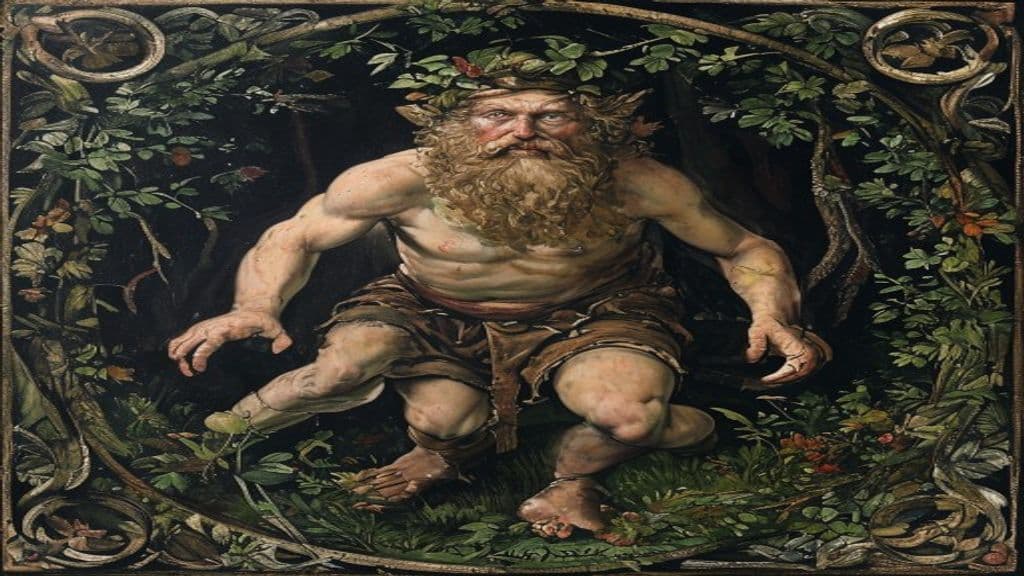
Puck
Puck is a northwest European liminal spirit occupying a space between household sprite and wild fairy trickster. Portrayed as a domestic helper who expects food offerings and as a nocturnal jester of the fairy court, Puck performs both useful chores and mischievous pranks in folklore and literature.
Pontus
Pontus is attested in the supplied sources primarily as a Greek theonym meaning "sea" (Πόντος, Póntos) and as a geographic/ethnic designation for the region on the southern coast of the Black Sea. The corpus does not provide evidence of Pontus functioning as a discrete, living folkloric spirit with attendant rituals or abilities.
Ponyo
Ponyo is a fictional goldfish-like child with a human face from the Studio Ghibli film Ponyo on the Cliff by the Sea. Born as Brunhilde to the underwater wizard Fujimoto and the powerful maternal figure Gran Mamare, she escapes to the human shore, bonds with a boy named Sōsuke, and uses potent magic whose release threatens the balance between sea and land.
Pop (ghost)
Pop (Thai: ปอบ, Pop or Pob) is a Thai folkloric spirit believed to inhabit or possess a living person (commonly a sorceress) and to leave the host at night to feed on human viscera, especially intestines. Village traditions describe types, hereditary or transmissible lines, face-switching deception, and a hierarchical superior spirit (Ha Gom) that commands lesser Pops.
Popobawa
Popobawa is a recent folkloric shetani (malicious spirit) from Zanzibar and coastal Tanzania, blamed for nocturnal assaults, poltergeist-like disturbances and episodes of community panic. Reports describe it as a shapeshifting, night-attacking spirit whose sightings have episodically risen since the mid-20th century and that is met locally with charms, exorcisms and communal vigilance.
Poroniec
A hostile supernatural being in Slavic folklore believed to arise from stillborn fetuses or improperly buried infant remains; considered especially dangerous because of the unrealized potential of the life lost and connected to taboos and household burial practices.
Porphyrion
Porphyrion (Ancient Greek: Πορφυρίων) is a Giant (one of the Gigantes) in ancient Greek myth who is repeatedly marked as one of the greatest of his kind and a principal combatant against the Olympian gods in the Gigantomachy. Ancient authors variously describe him as attacking gods (notably Hera and Heracles) and as being slain by divine force or a hero.
Poseidon
Poseidon is a principal deity of the ancient Greek pantheon, counted among the Twelve Olympians; he presides over the sea, storms, earthquakes and horses and functions as protector of seafarers and guardian of cities and colonies.
Pothi Amma (unattested in supplied sources)
The supplied source set does not contain a folkloric, ethnographic, or lexical attestation of a supernatural figure named 'Pothi Amma' or 'Poṟi Amman'. The available excerpts only record occurrences of the lexical element 'pothi' in Tamil song texts and commentary on rural musical repertoire; no information about a spirit or goddess by this name is present.
Poutini
Poutini is a taniwha (water spirit) in Ngāi Tahu oral tradition associated with the West Coast (Te Tai o Poutini) of New Zealand's South Island. In the cited sources Poutini is described primarily as a guardian or kaitiaki of the people and of valued resources such as pounamu (greenstone).
Povitrulya
Povitrulya (Ukrainian: Повітруля) is a female wind-associated figure from Ukrainian lower mythology, described as an airy, winged maiden from the Carpathians who aids lovers and appears in folk tale motifs where her wings can be taken or burned to bind her to the human world.
Power animal
A contemporary New Age / Neoshamanic category for animal-form spirit-allies adopted in modern Western shamanic-style practices and also a phrase circulating in popular culture; not a single traditional indigenous entity and lacking a unified cosmology in the provided sources.
Prahasta
Prahasta (Sanskrit: प्रहस्त, IAST: prahasta, lit. "he who has extended hands") is a powerful rakshasa warrior in the Ramayana tradition, presented there as Ravana's chief commander who leads Lanka's armies in campaigns against gods, asuras, and the invading forces of Rama. Variants across traditions differ on his precise kinship to Ravana and on ethical portrayal, with some later retellings depicting him as a virtuous figure who counsels restraint.
Community Record
- [1]Portunes — Wikipedia summary of Otia Imperialia and commentary. Wikipedia: Portunes (summary of Gervase of Tilbury's Otia Imperialia and later commentary)wiki
- [2]Wikidata: Portunes. Wikidata entry for Portunesother
- [3]Shaun Duke — Bestiary: the Portunes (blog summary/commentary). Shaun Duke, 'Bestiary–the Portunes' (blog), summarizing Portunes as faery-like rural spiritsfolk
- [4]Commentary notes cited in the Wikipedia article (Oman, Keightley, Banks & Binns, Young, Liebrecht). Summarised scholarly positions on naming and size emendation (C. C. Oman; Thomas Keightley; S. E. Banks & J. W. Binns; Francis Young; Felix Liebrecht) as presented in the Wikipedia articlewiki
- [5]Archive: assorted modern cultural uses and references. Collection of modern cultural uses of the name 'Portunes' (not additional medieval folklore evidence)other