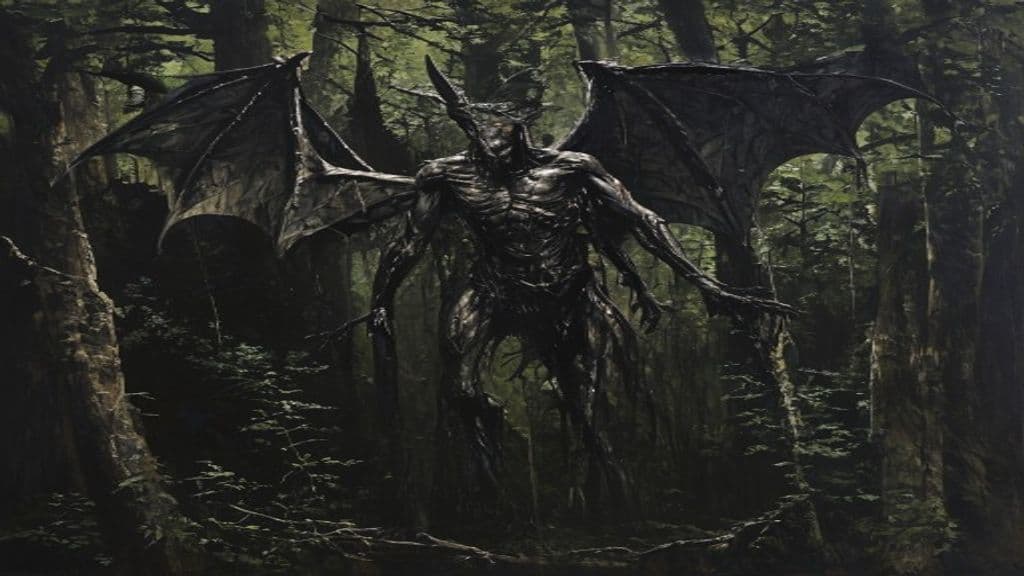
The Sasabonsam enforces rules of renewal in the forests, maintaining natural balance and harmony between humans and nature. Its role is rooted in the Akan people's spiritual connection with their environment.
The Sasabonsam has humanoid features with bat-like characteristics, including wings that can stretch over 20 feet wide and iron teeth. It lives in trees, indicating an arboreal habitat.
As a guardian of natural balance, the Sasabonsam feeds on people who wander into its territory, enforcing rules of renewal and maintaining harmony between humans and nature.
Sarpa Kavu
Sacred site or grove in Hindu tradition, inhabited by nagas and other snakes. (Note: - Power tier: Primordial (Sarpa Kavu is a sacred site with deep cultural significance, not just a regional power) - Sensory cues: Provide specific details on how one might sense the presence or energy)
Sarpanit
Sarpanit (also Zarpanitu, Ṣarpānītu) is a Mesopotamian goddess, the principal consort of the Babylonian chief god Marduk. Originating in the village of Zarpan and later worshiped in Babylon and the temple Esagil, she is associated in late sources with queenship among the gods, motherhood, pregnancy, and intercession on behalf of petitioners.
Sarpedon
Sarpedon is a name applied to several figures in Greek myth; the best-known bearer is a son of Zeus who fought for Troy in the Trojan War. Other traditions make him a Cretan royal son of Zeus and Europa, and a separate Thracian Sarpedon is a son of Poseidon and eponym of a cape. The name later appears in non-mythic contexts (ship name, insect genus).
Sarugami
A name that appears in a comparative survey of monkey-related figures under the Japan heading; the provided sources give no independent traditional accounts, descriptions, or rituals for Sarugami itself.
Saruman
Saruman is a fictional Istari (wizard) in J. R. R. Tolkien's legendarium: originally 'Saruman the White', leader of the Istari and head of the White Council, he becomes a traitor who seeks power through knowledge, industry, persuasion and the creation of armies, and is ultimately defeated, stripped of office, and reduced before his final fall.
Sarvanīvaraṇaviṣkambhin
A Mahāyāna bodhisattva named for his function of removing or blocking 'all hindrances' (sarva-nivāraṇa). He appears in Mahāyāna sutras and tantric texts and is invoked in mantra and dhāraṇī practice to purify obstacles to meditation and spiritual attainment.
Satan
A central oppositional figure in Abrahamic traditions who functions variously as an accuser, tempter, tester, and rebel. In earliest Hebrew Bible contexts the term functions as a role within the divine council; in later Jewish, Christian, and Islamic developments the figure becomes a more fully personified adversary who incites humans to sin and leads hostile spirits.
Satanachia
A named infernal commander attested in grimoire compendia and modern occult compilations, described as a Great General or commander‑in‑chief who commands dozens of legions and several named subordinate spirits; attributed with a disturbing power over women in some Grand Grimoire summaries.
Sati
Sati (Sanskrit: सती) is a Hindu goddess traditionally identified as the daughter of Daksha and the first wife of Śiva. In the sources provided she functions as a divine exemplar of marital felicity, chastity, and longevity; her self‑immolation at Daksha's sacrifice is a pivotal Puranic episode that shapes later narratives in which she is identified with Dakshayani and with the goddess who later appears as Parvati.
Saturn
Saturn appears in the supplied sources in two registers: as the sixth planet of the Solar System described by modern astronomy, and as a named god in ancient Roman religion. The astronomical account provides detailed physical and orbital properties; the mythological account in the provided material is limited to the single-line classification of Saturn as a god in ancient Roman mythology and the note that the planet is named after that figure.
Satyabhāmā
Satyabhāmā is a goddess in the Krishna-centered Vaishnava tradition, presented as one of Krishna's chief/third consorts and as an incarnation of Bhūmi (the Earth) and an aspect of Lakshmi; she appears in scriptural episodes (notably the pārijāta episode in Śrīmad-Bhāgavatam) and in living devotional and performative contexts (temples, classical dance).
Satyr
In ancient Greek tradition a satyr (σάτυρος, sátyros) is a male nature spirit of woodlands, mountains, and pastures who accompanies Dionysus (and is later identified with Pan/fauns). Satyrs embody ribaldry, music, dance, and unrestrained sexuality and appear collectively (as a chorus) in the satyr play as well as individually in mythic episodes (e.g., Marsyas, Silenus).
Community Record
- [1]