
Satanachia appears in the corpus of named infernal beings preserved in Grimoires and later occult compendia. He is attested primarily in summaries and catalogs of the Grand Grimoire tradition and appears alongside other grimoire nobles in later listings and blogs. Different sources place him under higher infernal principals such as Lucifer, Mammon, or Lucifuge, and the Grimoirium Verum-style schemata pair him with entities like Agaliarept as part of a hierarchical infernal command structure. The sources do not provide a mythic birth or cosmogonic origin beyond his functional role inside those grimoire hierarchies.
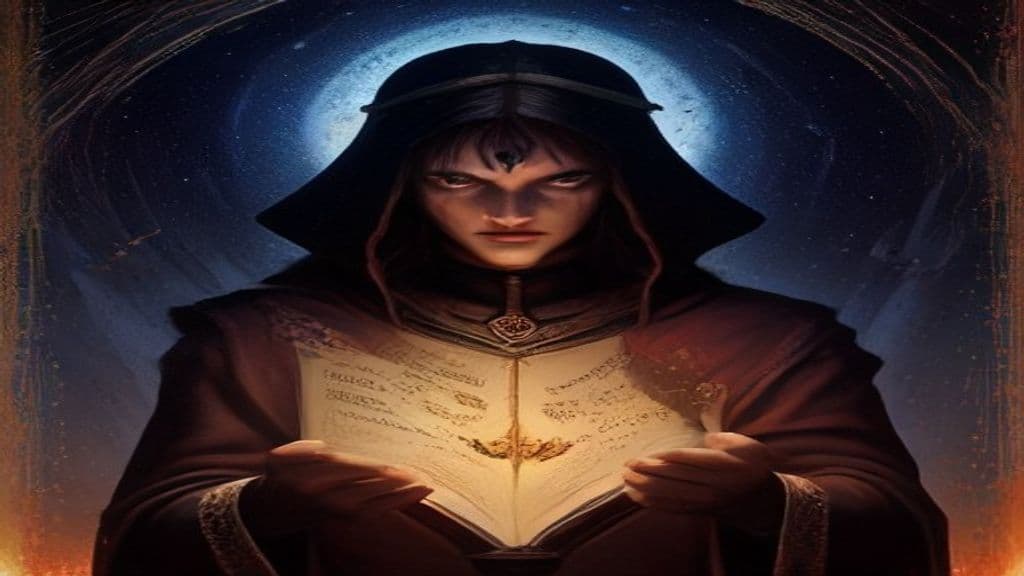
The supplied sources do not give a consistent textual physical description. Modern derivative material and an occult blog reproduce a graphic 'Sigil of Satanachia,' suggesting a sigilic representation in contemporary occult practice, but no primary grimoire text among the provided materials supplies a detailed corporeal portrayal.
Grimoire‑style summaries describe Satanachia as a high military officer who 'controls either forty‑five or fifty‑four legions of demons' (sources differ on the exact number) and who holds named subordinate spirits such as Pruflas/Pruslas, Aamon/Amon, and Barbatos; Astaroth is also listed under him in at least one summary. The Grand Grimoire is cited in modern summaries ascribing to him the power to 'subjugate all women and girls, and to do with them whatever he wishes.' Secondary and derivative sources (e.g., a game wiki) add attributes such as 'profound knowledge of all the planets,' but those specific claims are not attested in the primary grimoire excerpts cited and should be regarded as later elaborations.

Barbatos
Barbatos is a named spirit in European grimoire tradition, listed among the Seventy-Two spirits of The Lesser Key of Solomon and also appearing in the Grand Grimoire. He is given a ducal rank, commands legions of spirits, and is invoked in ceremonial contexts for knowledge, revelation of hidden things, and reconciliation.
Astaroth
Astaroth is a named adversarial spirit in Christian demonological literature, commonly catalogued as a high-ranking infernal officer (described in sources as a 'Great Duke' or 'Grand Duke' of Hell). The figure represents the Christian polemical reception of ancient Near Eastern goddess-names (Astarte/Ashtoreth) recast within narratives and demonological lists and appears in medieval legendary episodes as well as later occult imagery and modern popular culture.

Lucifer
A multilayered figure whose core identity in the cited sources is the planet Venus as the brilliant morning star (Latin lucifer, 'light-bringer' / Hebrew hêlêl, 'shining one'). In later Jewish and especially Christian exegesis the Isaiah image Helel ben Shachar is reinterpreted as a mythic fall motif and becomes associated with a rebellious heavenly being identified with the adversary; this development overlays the earlier astronomical and poetic personification.

Agaliarept
A named high-ranking spirit from post-medieval grimoire tradition, presented in the Grimoirium Verum and the Grand Grimoire as a commanding officer in a hierarchical host of spirits; credited with revealing secrets and commanding a legion, and cited in later printed occult imprints and modern fiction.
Sarpedon
Sarpedon is a name applied to several figures in Greek myth; the best-known bearer is a son of Zeus who fought for Troy in the Trojan War. Other traditions make him a Cretan royal son of Zeus and Europa, and a separate Thracian Sarpedon is a son of Poseidon and eponym of a cape. The name later appears in non-mythic contexts (ship name, insect genus).
Sarugami
A name that appears in a comparative survey of monkey-related figures under the Japan heading; the provided sources give no independent traditional accounts, descriptions, or rituals for Sarugami itself.
Saruman
Saruman is a fictional Istari (wizard) in J. R. R. Tolkien's legendarium: originally 'Saruman the White', leader of the Istari and head of the White Council, he becomes a traitor who seeks power through knowledge, industry, persuasion and the creation of armies, and is ultimately defeated, stripped of office, and reduced before his final fall.
Sarvanīvaraṇaviṣkambhin
A Mahāyāna bodhisattva named for his function of removing or blocking 'all hindrances' (sarva-nivāraṇa). He appears in Mahāyāna sutras and tantric texts and is invoked in mantra and dhāraṇī practice to purify obstacles to meditation and spiritual attainment.
Sasabonsam
A vampiric entity in West African folklore, enforcing rules of renewal in the forests. (Note: 1. Power tier: Lesser (not Ancient) - The Sasabonsam's abilities are more consistent with a regional spirit rather than a deity-level entity. 2. Abilities: remove "enforcing rules of renewal" - The so)
Satan
A central oppositional figure in Abrahamic traditions who functions variously as an accuser, tempter, tester, and rebel. In earliest Hebrew Bible contexts the term functions as a role within the divine council; in later Jewish, Christian, and Islamic developments the figure becomes a more fully personified adversary who incites humans to sin and leads hostile spirits.
Sati
Sati (Sanskrit: सती) is a Hindu goddess traditionally identified as the daughter of Daksha and the first wife of Śiva. In the sources provided she functions as a divine exemplar of marital felicity, chastity, and longevity; her self‑immolation at Daksha's sacrifice is a pivotal Puranic episode that shapes later narratives in which she is identified with Dakshayani and with the goddess who later appears as Parvati.
Saturn
Saturn appears in the supplied sources in two registers: as the sixth planet of the Solar System described by modern astronomy, and as a named god in ancient Roman religion. The astronomical account provides detailed physical and orbital properties; the mythological account in the provided material is limited to the single-line classification of Saturn as a god in ancient Roman mythology and the note that the planet is named after that figure.
Satyabhāmā
Satyabhāmā is a goddess in the Krishna-centered Vaishnava tradition, presented as one of Krishna's chief/third consorts and as an incarnation of Bhūmi (the Earth) and an aspect of Lakshmi; she appears in scriptural episodes (notably the pārijāta episode in Śrīmad-Bhāgavatam) and in living devotional and performative contexts (temples, classical dance).
Satyr
In ancient Greek tradition a satyr (σάτυρος, sátyros) is a male nature spirit of woodlands, mountains, and pastures who accompanies Dionysus (and is later identified with Pan/fauns). Satyrs embody ribaldry, music, dance, and unrestrained sexuality and appear collectively (as a chorus) in the satyr play as well as individually in mythic episodes (e.g., Marsyas, Silenus).
Satyrion
Satyrion (Ancient Greek: Σατύριον / Satyria) is attested in classical and later sources as a local nymph and place-name associated with the region of Taras/Tarentum (Taranto) and, secondarily, as a botanical name (certain orchids) and an aphrodisiac materia medica product named 'satyrion.' The figure functions mainly as an eponymous ancestress (mother of Taras by Poseidon) and the toponym anchors springs and local cultic/occupational memory; later herbalists and early modern medical writers use the name for orchids and sexual remedies.
Saulė
Saulė is the personified Sun in Baltic (Lithuanian and Latvian) traditional cosmology, treated as a living solar goddess who rises, travels, and rests and who is central to seasonal festivals and life-giving imagery.
Community Record
- [1]Satanachia — Wikipedia. Wikipedia, 'Satanachia' article — summary of Grand Grimoire attributions and legion counts.wiki
- [2]Satanachia | Megami Tensei Wiki. Megami Tensei Wiki entry — derivative summary attributing 54 legions and planetary knowledge in later media context.wiki
- [3]Satanachia – V.K. Jehannum (Blog). V.K. Jehannum blog post reproducing a sigil image and listing variant names, subordinates, and superiors.other
- [4]Book of Ceremonial Magic: Chapter III. Internet Sacred Text Archive, 'Book of Ceremonial Magic' — representative grimoire material and related demonological schemata referenced in secondary discussions.literary
- [5]Dukes of Hell: Naming Lusties | Book of the Neglected (blog). Modern occult compilation discussing ranks and attributions in grimoire lists; used as a contextual secondary source for variations.other