In Chinese mythic accounts recorded and summarized in classical and popular sources, a group of ten sun-crows (sanzuwu, popularly Jinwu or Yangwu) perched on the Fusang mulberry in the East; each day one was rostered to traverse the sky in a sun-carriage driven by the suns' mother Xihe. In a famous legendary episode (placed in some chronologies around 2170 BC) all ten emerged at once and scorched the world, after which the archer Hou Yi shot down nine, leaving a single sun-crow. Variants and attendant motifs appear in Han-period iconography (e.g., Mawangdui silk painting) and earlier archaeological bird-sun imagery. In Japan the bird known as Yatagarasu appears in Shinto narratives as a heavenly messenger and guide (notably guiding the legendary Emperor Jimmu); scholarship notes that the explicit three-legged description appears in later interpretations and that the Kojiki account does not itself state three legs, suggesting a subsequent conflation with continental sun-crow motifs.
Characteristically depicted with three legs (tripedal). In Chinese iconography the sun-crow is often shown as a bird set within a sun-disc and is frequently rendered in red or golden hues (Jinwu, 'golden crow') rather than the black of ordinary corvids; archaeological attestations include Yangshao and Longshan pottery motifs and Han-period (Mawangdui) paintings and imperial ornamentation. In Japanese tradition Yatagarasu is represented as a large raven or crow; many modern and later-period depictions show three legs, but primary Kojiki narration lacks explicit tripedal anatomy, and the three-legged image may be a later interpretive layer.
Functions vary by cultural context. In Chinese myth the sanzuwu is a solar agent: a rostered sun-bird that traverses the heavens, associated with Xihe, and involved in cosmological narratives (ten suns, the Hou Yi episode). Some textual traditions link the sun-crows with mythic plants (the two grasses Diri and Chunsheng) in Shanhaijing-derived material and portray them as capable of producing world-scale heat when multiple suns appear. The bird also appears as a divine attendant or messenger in certain accounts (e.g., serving Xi Wangmu). In Japanese Shinto the Yatagarasu acts as a heavenly guide and signifier of divine will, sent to guide or endorse human leaders' journeys (for example, guiding Emperor Jimmu).
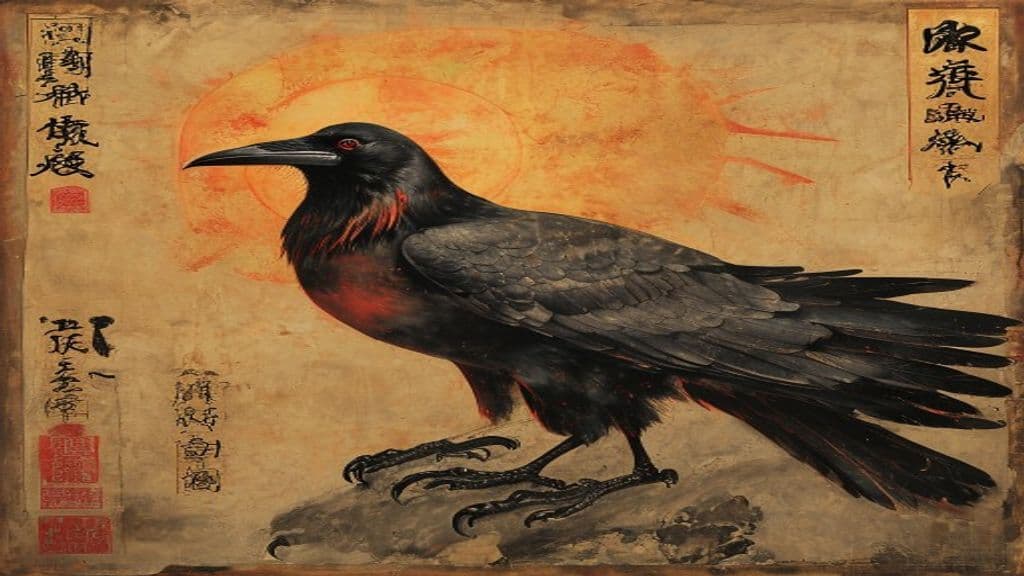
Three-legged crow
A recurrent East Asian mythic bird motif: in Chinese sources a tripedal sun-bird (sanzuwu / Jinwu / Yangwu) embedded in cosmology and imperial symbolism; in Japanese Shinto the Yatagarasu functions as a divine guiding crow. The motif appears across archaeological and literary contexts and carries solar and guiding associations rather than being consistently hostile.
Three-legged crow
A recurrent East Asian mythic bird motif: in Chinese sources a tripedal sun-bird (sanzuwu / Jinwu / Yangwu) embedded in cosmology and imperial symbolism; in Japanese Shinto the Yatagarasu functions as a divine guiding crow. The motif appears across archaeological and literary contexts and carries solar and guiding associations rather than being consistently hostile.
Three-legged crow
A recurrent East Asian mythic bird motif: in Chinese sources a tripedal sun-bird (sanzuwu / Jinwu / Yangwu) embedded in cosmology and imperial symbolism; in Japanese Shinto the Yatagarasu functions as a divine guiding crow. The motif appears across archaeological and literary contexts and carries solar and guiding associations rather than being consistently hostile.
Three-legged crow
A recurrent East Asian mythic bird motif: in Chinese sources a tripedal sun-bird (sanzuwu / Jinwu / Yangwu) embedded in cosmology and imperial symbolism; in Japanese Shinto the Yatagarasu functions as a divine guiding crow. The motif appears across archaeological and literary contexts and carries solar and guiding associations rather than being consistently hostile.
Three-legged crow
A recurrent East Asian mythic bird motif: in Chinese sources a tripedal sun-bird (sanzuwu / Jinwu / Yangwu) embedded in cosmology and imperial symbolism; in Japanese Shinto the Yatagarasu functions as a divine guiding crow. The motif appears across archaeological and literary contexts and carries solar and guiding associations rather than being consistently hostile.
Three-legged crow
A recurrent East Asian mythic bird motif: in Chinese sources a tripedal sun-bird (sanzuwu / Jinwu / Yangwu) embedded in cosmology and imperial symbolism; in Japanese Shinto the Yatagarasu functions as a divine guiding crow. The motif appears across archaeological and literary contexts and carries solar and guiding associations rather than being consistently hostile.
Three-legged crow
A recurrent East Asian mythic bird motif: in Chinese sources a tripedal sun-bird (sanzuwu / Jinwu / Yangwu) embedded in cosmology and imperial symbolism; in Japanese Shinto the Yatagarasu functions as a divine guiding crow. The motif appears across archaeological and literary contexts and carries solar and guiding associations rather than being consistently hostile.
Three-legged crow
A recurrent East Asian mythic bird motif: in Chinese sources a tripedal sun-bird (sanzuwu / Jinwu / Yangwu) embedded in cosmology and imperial symbolism; in Japanese Shinto the Yatagarasu functions as a divine guiding crow. The motif appears across archaeological and literary contexts and carries solar and guiding associations rather than being consistently hostile.
Thomas le Mousquetaire
The available sources do not attest Thomas le Mousquetaire as a folkloric or supernatural being. The term mousquetaire (musketeer) is documented as a literary/military archetype in Alexandre Dumas's The Three Musketeers and as an adapted helper/props-provider labelled "le Mousquetaire" in French-language episodes of La Maison de Mickey; no source supplied identifies a distinct supernatural entity named Thomas.
Thor (Þórr)
Thor (Old Norse Þórr) is a central god in the pre-Christian Germanic/Norse religious framework, primarily associated with thunder, storms, strength, protection, fertility, and the welfare of farmers. He is a hammer-wielding warrior who fights monstrous enemies (notably Jörmungandr) and is widely attested from Roman-era Germania through the Viking Age, with ongoing cultural presence in personal and place-names and weekday nomenclature (Thursday).
Thoth
Thoth is an ancient Egyptian deity of the Moon, wisdom, writing, measurement, and magic, functioning as divine scribe, counsellor, and maintainer of Ma'at; he appears in myth as inventor/author of knowledge and as a recorder in funerary judgment and cosmic calculation.
Thracians
The Thracians were an Indo‑European–speaking collection of tribes and tribal groupings inhabiting large parts of Southeast Europe in antiquity, known from Greek and Roman accounts for their martial reputation, rich musical and poetic traditions, and local religious cults including oracular sanctuaries.
Thranduil
Thranduil is a fictional Elven king in J. R. R. Tolkien's Middle-earth legendarium. A Sindarin Elf who rules the Woodland Realm (Greenwood the Great / Mirkwood), he is depicted in the sources as a hereditary monarch, military leader, and guardian of his people across the Second and Third Ages.
Three Great Onryō of Japan (Nihon San Dai Onryō)
A commonly cited grouping of three historically prominent vengeful spirits (onryō) in Japanese tradition—Sugawara no Michizane, Taira no Masakado, and Emperor Sutoku—whose deaths and subsequent misfortunes were historically narrated as causing calamities and requiring cultic responses to placate them.
Threefold Death
A cosmological concept in Celtic mythology, affecting grand figures such as kings and gods. (Note: 1. Power tier: Downgrade to Ancient (deity-level), as the threefold death affects grand figures like kings and gods but doesn't imply cosmic influence. 2. Abilities: Rewrite to clarify that it's not a)
Thunder Butte
A large, isolated hill with cultural significance in Lakota tradition. (Note: 1. Power tier is likely Greater (powerful regional) rather than Primordial (cosmic), as it has cultural significance but doesn't appear to possess supernatural abilities. 2. Abilities should be explic)
Thunderbird
Thunderbird is a legendary supernatural creature named in the histories and cultures of certain North American Indigenous peoples. The supplied sources identify Thunderbird by the English name and situate it broadly within North American Indigenous cultural histories but do not provide detailed ethnographic or linguistic information.
Thuận Thiên (sword)
Mythological sword imbued with magical power associated with Emperor Lê Lợi's liberation of Vietnam from Ming occupation. (Note: 1. Power tier: Reduce to Greater (powerful regional) as Thuận Thiên's abilities are tied to a specific ruler and region, rather than being on a deity-level. 2. Origin story: Clarify that Lê Lợi procla)
Thyestes
Thyestes is a mythic human king of the Pelopid/Atreid cycle in ancient Greek and Roman tradition, central to a notorious family curse and a sequence of intra-familial crimes (adultery, fratricide, incest, and a cannibalistic banquet). His story is recounted in classical summaries and dramatized in Roman tragedy (notably Seneca) and later adaptations, and functions as a paradigmatic tale of inherited pollution and revenge.
Thyia
Thyia (Ancient Greek Θυία) is attested in Greek mythic-cultic tradition as a naiad — a freshwater nymph of a spring on Mount Parnassos in Phokis — and as a local female figure connected with cult activity. Her name is derived from the verb θύω ('to sacrifice'), and some sources connect the name-form with Thyiad/’Bacchic’ terminology, suggesting a possible link to cultic or ecstatic contexts.
Community Record
- [1]Three-legged crow. Wikipedia, 'Three-legged crow' (summary of East Asian motifs and sun-crow traditions)wiki
- [2]Yatagarasu. Wikipedia, 'Yatagarasu' (Shinto guiding crow; notes on Kojiki and later three-leg interpretation)wiki
- [3]Yatagarasu: The Three-legged Crow That Guided Emperor Jimmu on his Journey. Kokugakuin University article on Yatagarasu (guiding role in Emperor Jimmu narrative; shrine associations)other
- [4]Yatagarasu (the three-legged crow) - Green Shinto. Green Shinto summary of Yatagarasu as divine guide and modern emblematic usefolk
- [5]Commentary: Something to Crow About: Why Is the Japanese Football Team Logo a Three-Legged Crow?. Critical Asian Studies commentary (discussion of Yatagarasu imagery and interpretive history, noting possible later conflation with Chinese Yangwu)other