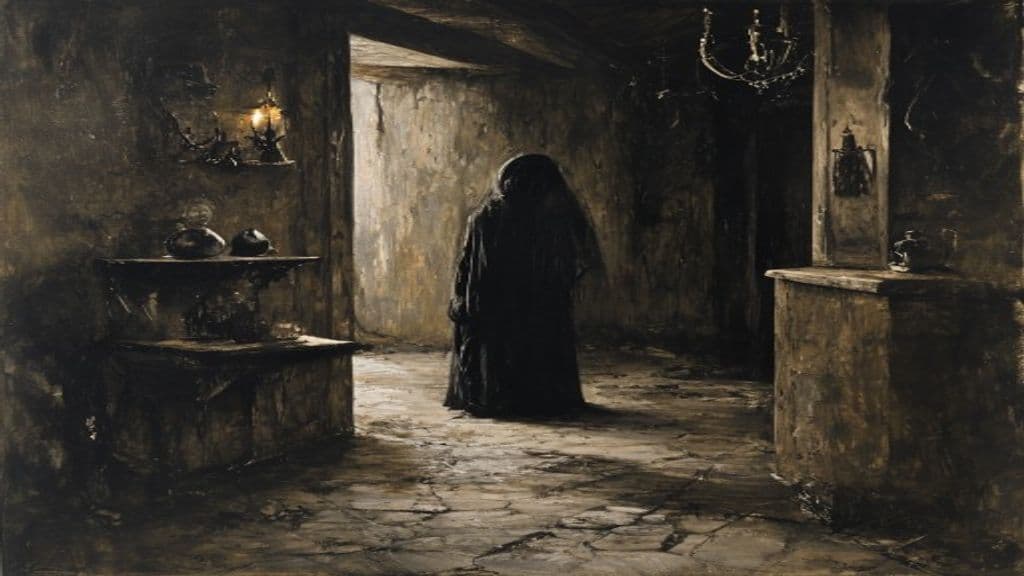
There is no single canonical origin tale in the provided sources. Etymologically the term comes from Old Norse varðhygi (vǫrð 'ward/guardian' + hugr 'mind, spirit'), placing the concept within Norse attendant-spirit taxonomy. Secondary sources identify vardøger as originally considered a fylgja and/or vǫrð (guardian or attendant spirit). The phenomenon also has an analogue in Finnish folklore known as etiäinen.
Vardøger is primarily reported through sensory traces rather than a single fixed visual form: footsteps, voice, scent, and an overall likeness or demeanor that faithfully reproduce the person. Some accounts (via etymological and comparative notes) describe an older conceptual strand that represents a human's inner essence manifesting as an animal resembling the person's character, reflecting its link to fylgja/vǫrð traditions.
The vardøger precedes its associated person, producing convincing sensory evidence (sound, scent, voice, visible likeness) that the person is already present. This can create a reverse-déjà-vu effect where witnesses believe they have already seen or heard the person. It has been likened to a phantom double or a form of bilocation. Sources portray it with a less sinister connotation than a doppelgänger and associate it with guardian/attendant spirit roles rather than malicious agency.

Bäckahäst
A Scandinavian water-horse figure: a horse-shaped water spirit associated with streams, rivers, lochs and other watery edges. Presented in comparative folklore as a member of the wider water-spirit or ‘water-horse’ family that functions as a cautionary figure about the hazards of water and unknown horses at the water’s edge.
Deildegast
A Norwegian folkloric ghost bound to boundary stones as postmortem punishment for those who moved or tampered with property markers; compelled to attempt to restore displaced stones but never succeeding, it serves as a social deterrent against moving borders.
Einherjar
Warriors who died in battle and were brought to Valhalla by valkyries, playing a crucial role in the events leading up to Ragnarök. (Note: - Power tier should be Primordial since they are associated with a cosmic event (Ragnarök) and are not described as deities or regional powers. - Abilities: The einherjar don't actually engage in dail)
Flogdrake
A Scandinavian firedrake or "fly‑dragon" associated with evening streaks of light in the sky and with tunnelling mountain lairs that hide ore and treasure. Primarily attested in Swedish folklore, it participates in a pan‑European motif of fiery serpents and is sometimes linked with household or earth spirits in nearby traditions.
Freyja
Freyja is a major Vanir goddess in Norse mythology associated with love, beauty, fertility, gold, war, and the seiðr form of magic. She rules the field Fólkvangr and the hall Sessrúmnir, where she receives half of those slain in battle, and is attested across the Poetic Edda, the Prose Edda, skaldic poetry, and later Scandinavian folklore.
Mare (folklore)
A nocturnal malicious spirit from Germanic and neighboring Slavic popular belief that afflicts sleepers and animals by 'riding' or pressing on chests, producing nightmares, sleep‑suffocation, night‑sweats, and exhausted animals. The mare overlaps with related Germanic night‑beings (alp, Mahr, Trute/Drude) and appears in varied regional tale forms and household practices.
Nixie
A category of water spirit from Germanic and neighbouring European folklore associated with lakes, streams, ponds and waterfalls. Commonly described as shapeshifting and linked to enchanted music, nixies may be helpful or dangerous to humans depending on local tales.
Revenant
A revenant is a deceased human (corporeal corpse or spirit) that returns from death to appear among or assault the living. The category spans multiple cultures and historical periods and includes walking corpses, barrow-dwellers, and other postmortem returns addressed by communal funerary and ritual responses.
Troll cat
A witch-created familiar in Scandinavian folklore that steals milk and cream for its mistress. It appears in two main forms—ball-shaped yarn-like constructs (Norwegian trollnøste/trollnøa) and ordinary-looking cats—and is closely linked to accusations of witchcraft and rural dairy loss.
Vittra
A type of wight (supernatural spirit) from northern Swedish folk belief associated with herding and the rural environment. Vittror were believed to live among humans and only revealed a supernatural nature if their livestock were mistreated; they are also linked in sources to motifs of longing and seduction.
Varda / Elbereth
Varda, often called Elbereth in secondary references, is identified in the provided sources as one of the Valar — the mightiest Ainur who chose to enter the created world (Arda) in J. R. R. Tolkien’s legendarium. The Valar are described in the sources as the 'Powers of the World' who shape and govern Arda after its form is determined by the Music of the Ainur.
Varima-te-takere
Varima-te-takere is the primordial mother-figure of southern Cook Islands cosmology (Mangaia/Rarotonga). She is the originating substrate or womb in the lowest depth of Avaiki from which the principal gods and, by extension, humankind are formed.
Community Record
- [1]Vardøger (Wikipedia). Wikipedia contributors, 'Vardøger,' Wikipedia, The Free Encyclopedia.wiki
- [2]Vardøger (Wikidata). Wikidata summary for Vardøger.wiki
- [3]Vardøger — Stephen Volk (novella reference). Author page noting modern literary use of the term 'Vardøger.'other