
The bäckahäst is presented in the sources as the Scandinavian/local instantiation of a cross-cultural ‘water-horse’ motif rather than a single, unified origin tale. Etymologically the Swedish name combines bäck (stream/brook) and häst (horse), locating the creature at streams and brooks. In comparative overviews it is listed alongside other water-horse types (for example the Scottish kelpie and various nixie/neck/nykur traditions); the surviving material frames the bäckahäst primarily as a folkloric explanation and warning about the dangers at watery margins rather than offering a single founding myth or chronicleable origin event in the supplied sources.
Sources describe the bäckahäst in general terms as a horse-like water-being — a ‘water horse’ associated with rivers, lochs and seas. The provided material does not give a consistent set of distinctive visual details (coloration, size, wet or otherworldly sheen) for a specifically Swedish, localized description; instead the motif in comparative accounts typically emphasizes a seemingly ordinary horse found at the water’s edge that is in fact a supernatural water spirit.
Comparative sources place the bäckahäst within the broader family of water-spirits (nixie/nykur/neck) commonly attributed with shapeshifting and deceptive behavior in Germanic folklore; water-horse traditions are also described in summary sources as predatory toward humans (drowning or eating people) and as mechanisms for warning against danger at waterways. The supplied notes emphasize that much of the explicit predatory description comes from generalized 'water-horse' accounts rather than a uniquely documented Swedish ritual corpus for bäckahäst, so predatory and shapeshifting traits are presented as part of the comparative water-spirit complex in the available material.
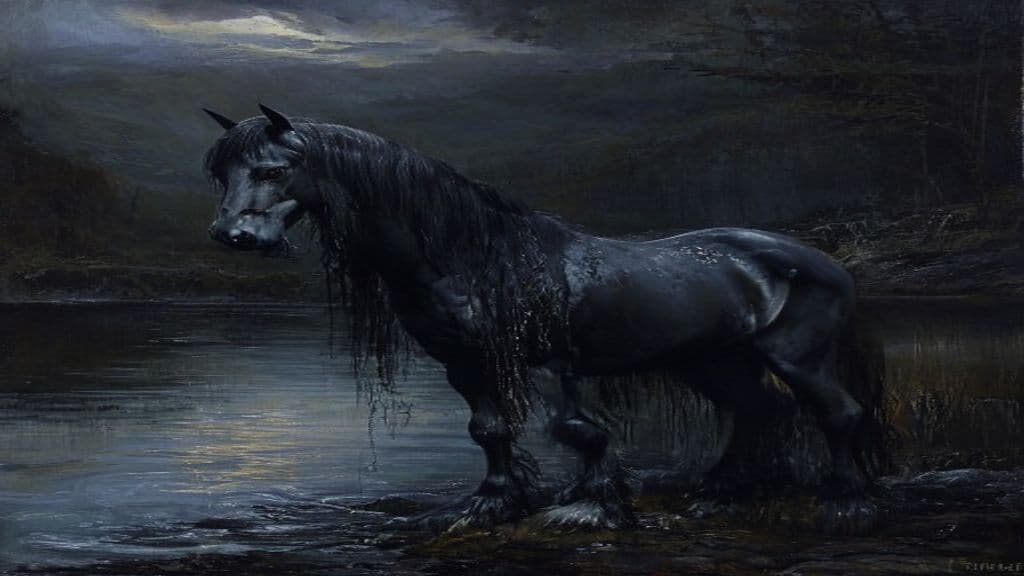
Kelpie
A Scottish shape-shifting water horse that appears as a beautiful tame horse near lochs and rivers, then drowns and devours any rider foolish enough to mount it.
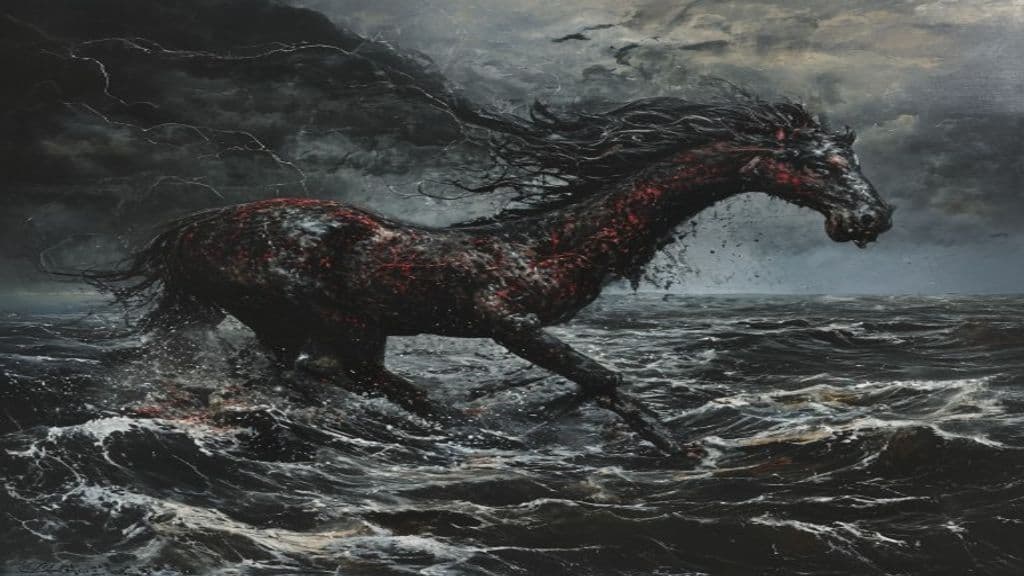
Nuckelavee
The most terrifying creature of Orcadian folklore — a skinless, horse-headed demon of the sea whose breath spreads plague and whose presence causes crops to wither. It cannot cross fresh water.
Deildegast
A Norwegian folkloric ghost bound to boundary stones as postmortem punishment for those who moved or tampered with property markers; compelled to attempt to restore displaced stones but never succeeding, it serves as a social deterrent against moving borders.
Einherjar
Warriors who died in battle and were brought to Valhalla by valkyries, playing a crucial role in the events leading up to Ragnarök. (Note: - Power tier should be Primordial since they are associated with a cosmic event (Ragnarök) and are not described as deities or regional powers. - Abilities: The einherjar don't actually engage in dail)
Flogdrake
A Scandinavian firedrake or "fly‑dragon" associated with evening streaks of light in the sky and with tunnelling mountain lairs that hide ore and treasure. Primarily attested in Swedish folklore, it participates in a pan‑European motif of fiery serpents and is sometimes linked with household or earth spirits in nearby traditions.
Freyja
Freyja is a major Vanir goddess in Norse mythology associated with love, beauty, fertility, gold, war, and the seiðr form of magic. She rules the field Fólkvangr and the hall Sessrúmnir, where she receives half of those slain in battle, and is attested across the Poetic Edda, the Prose Edda, skaldic poetry, and later Scandinavian folklore.
Mare (folklore)
A nocturnal malicious spirit from Germanic and neighboring Slavic popular belief that afflicts sleepers and animals by 'riding' or pressing on chests, producing nightmares, sleep‑suffocation, night‑sweats, and exhausted animals. The mare overlaps with related Germanic night‑beings (alp, Mahr, Trute/Drude) and appears in varied regional tale forms and household practices.
Nixie
A category of water spirit from Germanic and neighbouring European folklore associated with lakes, streams, ponds and waterfalls. Commonly described as shapeshifting and linked to enchanted music, nixies may be helpful or dangerous to humans depending on local tales.
Revenant
A revenant is a deceased human (corporeal corpse or spirit) that returns from death to appear among or assault the living. The category spans multiple cultures and historical periods and includes walking corpses, barrow-dwellers, and other postmortem returns addressed by communal funerary and ritual responses.
Troll cat
A witch-created familiar in Scandinavian folklore that steals milk and cream for its mistress. It appears in two main forms—ball-shaped yarn-like constructs (Norwegian trollnøste/trollnøa) and ordinary-looking cats—and is closely linked to accusations of witchcraft and rural dairy loss.
Vardøger
A spirit-predecessor in Scandinavian folklore whose sensory manifestations (footsteps, voice, scent, appearance) precede a living person, producing the impression that the person was present before arrival. Traditionally associated with attendant/guardian spirit concepts such as fylgja and vǫrð.
Vittra
A type of wight (supernatural spirit) from northern Swedish folk belief associated with herding and the rural environment. Vittror were believed to live among humans and only revealed a supernatural nature if their livestock were mistreated; they are also linked in sources to motifs of longing and seduction.
Bârmân (بارمان)
Bârmân is a Turanian hero and commander in Ferdowsi’s Shahnameh who fights in the Great War of Iran and Turan during the reign of Nowzar. In the epic he kills the Iranian Qobád and is later slain by the Iranian warrior Qaran; he is represented in Safavid illustrated Shahnameh folios as a recognizable martial figure.
Bêlit
Bêlit is a fictional Shemite pirate-queen from Robert E. Howard's Hyborian Age, captain of the ship Tigress and romantic partner of Conan in the short story "Queen of the Black Coast" (1934). Presented as a mortal warrior-leader whose life and death intersect with supernatural elements in the tale, she is remembered as an avaricious and charismatic sea-queen in later adaptations and comics.
Community Record
- [1]Nixie (folklore) — Wikipedia. Wikipedia, 'Nixie (folklore)'wiki
- [2]Wihwin — Wikipedia. Wikipedia, 'Wihwin'wiki
- [3]Water Horses | Villains Wiki. Villains Wiki, 'Water Horses'other
- [4]Swedish Folklore: Myths, Creatures, and Key Tales Guide - Making Art Fun. Making Art Fun, 'Swedish Folklore: Myths, Creatures, and Key Tales Guide'other
- [5]Nuckelavee (blog/summary). Paul J. Holden, 'Nuckelvee' (summary/retelling)other
- [6]Writers.SE: Naming non-English folklore creatures (discussion). Writers StackExchange discussion, 'Naming non-English folklore creatures'other
- [7]Wikidata: Bäckahästen. Wikidata entry for 'Bäckahästen'other