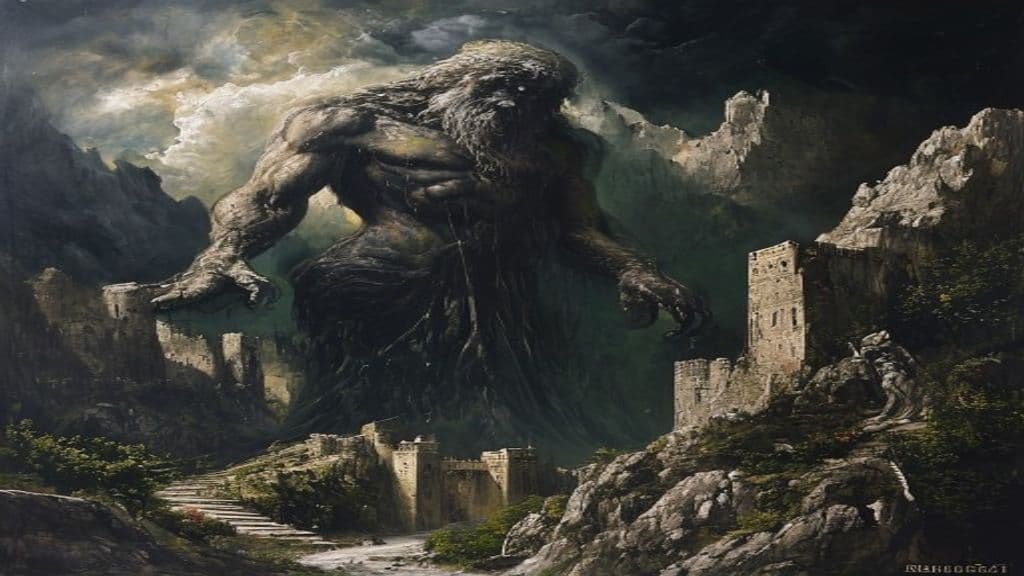
Zaden was worshipped in Kartli, specifically at Mount Zedazeni, which was built as a fortress by King Parnajom of Iberia.
No physical description is provided in the source material. However, it mentions that a colossus of Zadeni was built at Mount Zedazeni.
As a god of fruitfulness, Zaden's primary role appears to be associated with fertility and prosperity.

Yuxa
Yuxa is a Turkic legendary serpent‑being: an aged snake that transforms into a sentient, shape‑changing creature which may appear as a reptilian dragonlike form or as beautiful human men and women, interacting socially and sexually with people.
Yōkai
Yōkai (妖怪) are a broad class of supernatural beings and spirits in Japanese folklore that encompass shapeshifters, tricksters, animal-spirits, possessed objects, humanoid apparitions, and formless uncanny phenomena. Rooted in Shinto and older animistic notions, the category functions as an umbrella term for many locally named entities and has been shaped by historical, artistic, and academic processes.
Yūrei
Yūrei (幽霊) are spirits of the dead in Japanese folklore who remain bound to the world of the living rather than having completed transition to an afterlife. They are a culturally specific category of ghost/spirits, often discussed alongside related terms such as bōrei and shiryō and appearing widely in literary, visual, and local legend contexts.
Zaarin / Zaar (reported string)
The supplied sources do not contain ethnographic information about a Mongolian possessing spirit called Zaarin or Zaar. The string "Zaarin" appears in the provided materials as a toponym in a technical CIA list and as a personal name in a Sindh Historical Society table of contents; no folkloric description, origin, appearance, abilities, or rituals for a spirit are present in the supplied documents.
Zababa
Zababa is a Mesopotamian war god and the tutelary deity of the city of Kish, invoked in contexts of warfare, royal legitimation, and civic protection. From the Early Dynastic period through the first millennium BCE he appears in god lists, royal inscriptions, kudurru (boundary stone) formulas, and astronomical texts; from the Old Babylonian/Middle Babylonian period onward he is commonly paired with the goddess Bau as his consort.
Zabulistan
A historical region in southern Afghanistan and southeastern Iran, with no known supernatural entity associated with it. (Note: 1. Power tier should be Ancient (deity-level) instead of Primordial (cosmic), since there's no indication of supernatural or deity-level associations with Zabulistan. 2. Remove "Supernatural entity as)
Zadkiel
Zadkiel (Hebrew: צִדְקִיאֵל, Ṣīḏqīʾēl, 'God is my Righteousness'), also called Hasdiel in some sources, is an archangel in Jewish and Christian angelology associated primarily with kindness, benevolence, mercy, and forgiveness. In mystical systems Zadkiel is linked to the sephirah Chesed (the fourth sephirah) and the planet Jupiter; some texts identify him with the unnamed 'Angel of the Lord' who restrains Abraham in the Binding of Isaac, though this identification is disputed.
Zaebos
Zaebos is a named infernal spirit recorded in European demonological catalogues (notably the Dictionnaire Infernal). He is presented as a high-ranking infernal noble — described as a 'Grand Count' or duke — and is traditionally said to appear as a handsome soldier mounted on a crocodile. Modern adaptations sometimes expand or reassign additional functions to the figure.
Zafar Jinni
An unattested or fragmentary name appearing in the supplied source excerpts; no traditional entity explicitly called "Zafar Jinni" is documented in the provided materials. The excerpts contain isolated occurrences of the word "jinni" and the lexical item "Zafar" (glossed in one footnote as "victory"), but do not combine them into a coherent folkloric being.
Zafarnamah (Mustawfi)
Persian epic poem written by Hamdallah Mustawfi, exploring Iranian history and culture. (Note: 1. Power tier should be Ancient (deity-level) does not fit; Primordial is typically reserved for entities related to the creation of the world or fundamental forces. 2. Appearance section is missing 3)
Zagovory
Magical entities invoked through incantations in Eastern Slavic folklore, capable of controlling reality with the power of words. (Note: - Summary: Add that they are not directly "invoked" through incantations, but rather the power of words is leveraged for magical effects. - Power tier: Based on source material, it seems more accurate)
Zagzagel
Zagzagel is an attested proper name appearing once in the supplied materials as an item in a syncretic, list-like litany. The sources supply no descriptive, ritual, linguistic, or functional information about the name; it is recorded only as a lexical item within a parade of names and terms.
Community Record
- [1]Wikipedia: Zadenwiki