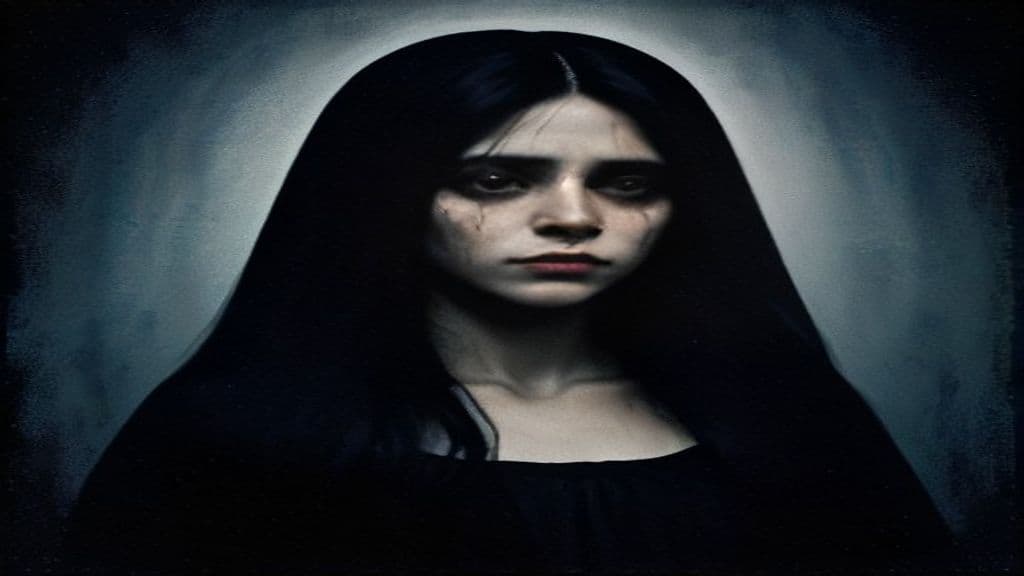
In the provided summary, La Llorona's central origin motif is maternal filicide: she is described as a woman who drowned her children in a river and now roams bodies of water mourning them. The supplied excerpt frames this act and her ongoing mourning as the source of her vengeful ghost-status. The source does not supply variant origin narratives, historical development, or deeper cultural context beyond identifying her as a mourning woman tied to a river.
The supplied material identifies the figure simply as a woman who cries; no further physical description (clothing, age, distinguishing marks) is given in the provided excerpt.
According to the source excerpt, La Llorona is vengeful and is said to roam near bodies of water mourning the children she drowned. Folklore as cited attributes to her crying the consequence that whoever hears it will suffer misfortune, death, or become extremely unsuccessful in life. The source does not describe other supernatural abilities (for example, shape‑changing, possession, or speech beyond crying) or detail mechanisms by which her cries bring harm.
LGBTQ Themes in Hindu Mythology
Hindu mythology represents a diverse range of entities and themes that challenge traditional binary notions of sex and gender, reflecting the tradition's emphasis on diversity, inclusivity, and acceptance. (Note: - Power tier: Primordial is likely an overestimation; given that the sources describe LGBTQ themes as "not a distinct category" but rather a spectrum within Hindu mythology, it's unclear if these enti)
La Cegua
La Cegua is a Central American folkloric shapeshifting female apparition, commonly told in Nicaraguan and wider Mesoamerican oral traditions. She appears as an attractive woman from behind to lure certain men (notably drunk men and womanizers) along lonely roads at night, then reveals a horrifying true face—often described as a horse head or a skull—preceding harm or dire consequences. The figure functions primarily as a moral cautionary tale enforcing social norms around intoxication and sexual conduct.
La Chasse-galerie (The Flying Canoe)
A French-Canadian folktale about a bewitched or enchanted bark canoe that flies through the night after men make a pact with a malign supernatural agent (often identified as the Devil). The story functions as a Wild Hunt–type narrative fused with Indigenous legends of a flying canoe and serves as a moral test about taboos, sobriety, and bargaining with otherworldly powers.
La Condená
A sparsely documented feminine-named restless spirit attested in a small set of tertiary sources. The only clear descriptive line in the supplied corpus calls her a "ghost doomed to walk the earth in penance for carnal sins." Other claims about regional rooting or attributes come from a single unverified fandom entry and are not corroborated in the provided materials.
La Galigo
Supernatural being central to the Bugis creation myth, holding significant importance in their cosmology. (Note: - Summary is vague; more specific information about La Galigo's role in the creation myth would improve accuracy. - Power tier: Since there is no mention of "Primordial" abilities, it's unclear what t)
La Guita Xica
La Guita Xica is a Catalan mule–dragon figure tied to the Patum de Berga Corpus Christi festivities. Historically described as threatening or demonic, twentieth-century traditions reframe it as a protective festival spirit embodied by large effigies that parade and theatrically spit fireworks.
La Patasola
La Patasola is a legendary one-legged female monstrous figure from Colombian and northern South American folk narrative who inhabits virgin forests and mountains. She appears as a beautiful woman to lure men, then reveals a single leg with a cleaved hoof and a bestial face, and is portrayed as punitive toward men who transgress social or ecological norms.
La Sayona
La Sayona is a Venezuelan popular-legend vengeful female spirit who, according to tradition, appears to men who commit infidelity. Originating in an origin-tale about a woman named Casilda, the figure functions as an avenger of wronged women and is associated with a long white underdress (the 'sayona').
La Sirène
La Sirène is a mermaid-like water spirit (lwa) within Haitian Vodou, represented in ritual art and drapo (Vodou flags) and situated in Vodou pantheon lists alongside other named lwa. She is associated with marine imagery and participates in the visual and religious culture of Haitian Vodou rather than appearing only as a folkloric sea creature.
La Vaca
La Vaca is not attested in the supplied sources as a supernatural being. In the provided materials the term appears as a Spanish toponym and lexical item: notably a small wetland in Bogotá (Humedal La Vaca / Techovita), an islet on Lake Nicaragua (Isla La Vaca), and as lexical occurrences in media or personal names. No folkloric, mythological, or supernatural attributes are documented in the sources provided.
Labasu
Labasu is a Mesopotamian malignant spirit or demon of disease attested in Sumerian–Akkadian textual tradition. It appears in medical, astrological and anti-witchcraft corpora as a named etiological agent for fever and related illnesses and commonly occurs alongside Lamashtu and Ahhazu in ritual lists and expulsions.
Labdacus
Labdacus (Ancient Greek: Λάβδακος, Lábdakos) is a legendary/mythic king of Thebes in Greek tradition. He is chiefly significant as a dynastic ancestor — grandson of Cadmus, son of Polydorus, and father of Laius — and appears in variant accounts that place his brief rule and early death within the genealogical history that leads to Oedipus.
Community Record
- [1]La Llorona. Wikipedia, entry 'La Llorona'wiki