
Multiple folkloric variants account for La Patasola's origins rather than a single canonical source: some tellings cast her as a woman transformed for cruelty, infidelity or neglect (including versions of a scorned or wicked woman), others as a mother who killed or abandoned a child; narratives vary and the legend circulates in oral, archival and popular forms. Sources treat these origin types as competing local variants rather than a single mythic biography.
Commonly she first appears as a beautiful, seductive woman—often taking the likeness of a beloved person—to lure men into the woods. Her revealed or true form is described as hideous: a single leg terminating in a cleaved bovine-like hoof, frequently one breast, bulging eyes, a hooked nose, large lips and often catlike/feline fangs. She is also reported in some versions to assume animal guises (large black dog or cow) or otherwise shapeshift.
La Patasola lures men—hunters, loggers, miners, millers and herders—by appearing as a woman or known beloved and sometimes by singing; versions report she either devours flesh or sucks blood using feline-like fangs. She is portrayed as territorial and protective of the forest and its animals: interfering with human activities (disorienting people, blocking paths, disrupting hunting) and punishing men who exploit or harm the wild or who pursue sexual impropriety. The creature is a shapeshifter in many accounts and may sing when pleased (a short poetic song is attributed in some literary citations).
Weaknesses
- conditionavoidance and company (cultural precaution)
- otherrecognition of physical defect (e.g., one leg/other identifying flaws in related traditions)
Wards
- conditiondo not go alone into virgin forest; travel with companions
- conditiondo not follow an unknown or lone beautiful woman into the woods
- conditionavoid speaking or fantasizing about women while working alone in the forest (behavioral precaution)
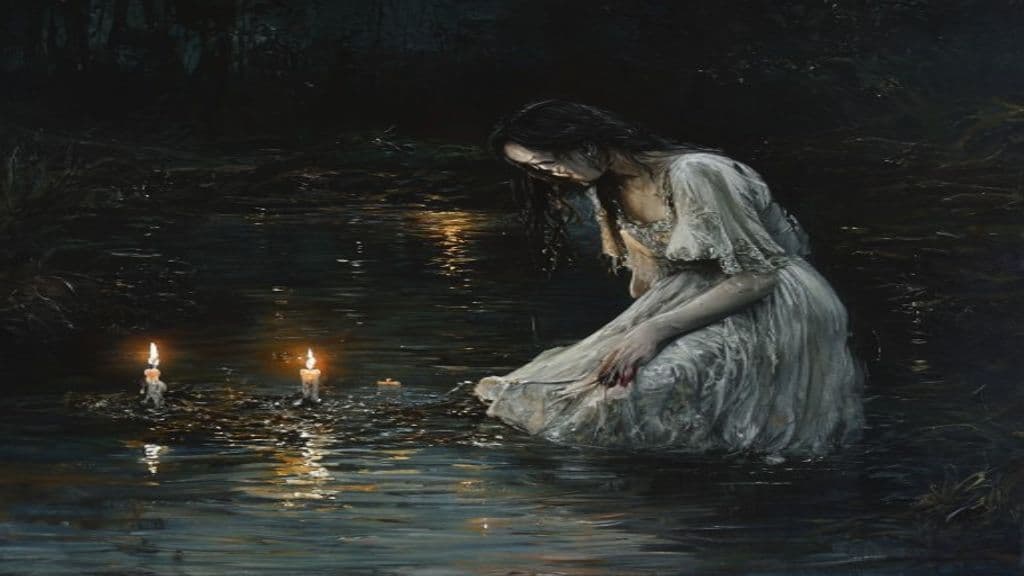
La Llorona
The Weeping Woman of Mexican folklore — the ghost of a mother who drowned her children and now wanders rivers and lakes, weeping for them and taking other children she finds at night.

La Sayona
La Sayona is a Venezuelan popular-legend vengeful female spirit who, according to tradition, appears to men who commit infidelity. Originating in an origin-tale about a woman named Casilda, the figure functions as an avenger of wronged women and is associated with a long white underdress (the 'sayona').
La Chasse-galerie (The Flying Canoe)
A French-Canadian folktale about a bewitched or enchanted bark canoe that flies through the night after men make a pact with a malign supernatural agent (often identified as the Devil). The story functions as a Wild Hunt–type narrative fused with Indigenous legends of a flying canoe and serves as a moral test about taboos, sobriety, and bargaining with otherworldly powers.
La Condená
A sparsely documented feminine-named restless spirit attested in a small set of tertiary sources. The only clear descriptive line in the supplied corpus calls her a "ghost doomed to walk the earth in penance for carnal sins." Other claims about regional rooting or attributes come from a single unverified fandom entry and are not corroborated in the provided materials.
La Galigo
Supernatural being central to the Bugis creation myth, holding significant importance in their cosmology. (Note: - Summary is vague; more specific information about La Galigo's role in the creation myth would improve accuracy. - Power tier: Since there is no mention of "Primordial" abilities, it's unclear what t)
La Guita Xica
La Guita Xica is a Catalan mule–dragon figure tied to the Patum de Berga Corpus Christi festivities. Historically described as threatening or demonic, twentieth-century traditions reframe it as a protective festival spirit embodied by large effigies that parade and theatrically spit fireworks.
La Llorona
La Llorona is presented in the supplied source as a vengeful female ghost in Hispanic American folklore who roams near bodies of water mourning children she drowned; hearing her crying is said to bring misfortune, death, or ruin to listeners.
La Llorona
The Weeping Woman of Mexican folklore — the ghost of a mother who drowned her children and now wanders rivers and lakes, weeping for them and taking other children she finds at night.
La Sayona
La Sayona is a Venezuelan popular-legend vengeful female spirit who, according to tradition, appears to men who commit infidelity. Originating in an origin-tale about a woman named Casilda, the figure functions as an avenger of wronged women and is associated with a long white underdress (the 'sayona').
La Sirène
La Sirène is a mermaid-like water spirit (lwa) within Haitian Vodou, represented in ritual art and drapo (Vodou flags) and situated in Vodou pantheon lists alongside other named lwa. She is associated with marine imagery and participates in the visual and religious culture of Haitian Vodou rather than appearing only as a folkloric sea creature.
La Vaca
La Vaca is not attested in the supplied sources as a supernatural being. In the provided materials the term appears as a Spanish toponym and lexical item: notably a small wetland in Bogotá (Humedal La Vaca / Techovita), an islet on Lake Nicaragua (Isla La Vaca), and as lexical occurrences in media or personal names. No folkloric, mythological, or supernatural attributes are documented in the sources provided.
Labasu
Labasu is a Mesopotamian malignant spirit or demon of disease attested in Sumerian–Akkadian textual tradition. It appears in medical, astrological and anti-witchcraft corpora as a named etiological agent for fever and related illnesses and commonly occurs alongside Lamashtu and Ahhazu in ritual lists and expulsions.
Labdacus
Labdacus (Ancient Greek: Λάβδακος, Lábdakos) is a legendary/mythic king of Thebes in Greek tradition. He is chiefly significant as a dynastic ancestor — grandson of Cadmus, son of Polydorus, and father of Laius — and appears in variant accounts that place his brief rule and early death within the genealogical history that leads to Oedipus.
Lacedaemon
Lacedaemon (Lakedaimon, Lacaedemon) is a mythic eponymous king in classical Greek tradition: the legendary founder whose name is given to the region and polis of Lacedaemon/Sparta. He is presented genealogically as a son of Zeus and the Pleiad Taygete and as husband of Sparta, serving an etiological function linking the city to divine ancestry.
Community Record
- [1]Patasola - Wikipedia. Wikipedia entry 'Patasola' (article summarizing Colombian folklore figure)wiki
- [2]La Patasola | USC Digital Folklore Archives. USC Digital Folklore Archives entry 'La Patasola' (archival performance and commentary)folk
- [3]ANALISIS DEL PATRIMONIO CULTURAL DE LA LEYENDA DE LA PATASOLA. Archive.org: 'Analisis del patrimonio cultural de la leyenda de la Patasola' (academic/archival analysis framing the legend as a living cultural artifact)academic
- [4]La Patasola: A Terrifying Legend - Alternative Belief News. Alternative Belief News article 'La Patasola: A Terrifying Legend' (popular retelling and summary)other
- [5]La Patasola of South American Folklore | Into Horror History. Into Horror History blog post 'La Patasola of South American Folklore' (popular account and synthesis)other
- [6]Patasola (Wikidata). Wikidata entry for Patasola (cataloging the folkloric entity)wiki
- [7]Patasola magdalenae - Wikipedia (taxonomic name unrelated to legend). Wikipedia entry for Patasola magdalenae (extinct primate genus; taxonomic use of the name noted as distinct from the folkloric figure)wiki
- [8]The Curse of La Patasola - Apple TV listing. Apple TV listing for film 'The Curse of La Patasola' (popular media representation)other
- [9]Archive audio: Gillie Jones is our Special Guest - Audio Only. Archive.org audio item including folkloric discussion (media/archival material)folk