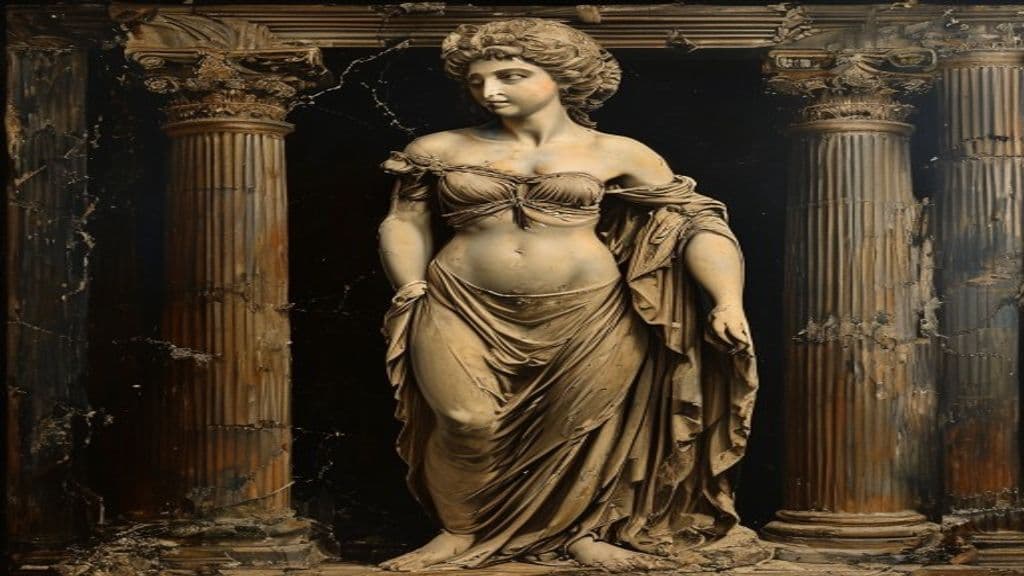
In the account transmitted from Antoninus Liberalis and summarized in modern references, Aspalis, daughter of Argaeus of Melite, was seized upon by a local tyrant. To avoid being taken as his concubine she hanged herself. When the community came to bury her, her body was reported missing and, in its place, a wooden statue of Artemis was found; the tradition states that Artemis, out of pity, turned Aspalis' body into the cult statue. The narrative further records that Aspalis' brother Astygites avenged her by killing the tyrant, and the city thereafter instituted an annual rite tied to the wooden image and Aspalis' memory.
Ancient sources describe Aspalis as a young and beautiful maiden (the account notes she was among the 'most beautiful girls' targeted by the tyrant) and identify her filial relation (daughter of Argaeus). After her death the most salient visual element in the tradition is the wooden statue of Artemis discovered where her body had been; no further iconographic details of the statue or of Aspalis' personal appearance are preserved in the cited summaries.
The sources do not ascribe supernatural powers to Aspalis herself; her principal agency in the tradition is moral and exemplary—she chose suicide to preserve honor. Posthumously she functions as the human origin for a cult image: the tradition reports that Artemis transformed or replaced her corpse with a wooden statue, so Aspalis' role is etiological (providing sacred legitimacy for a local form/epithet of Artemis) rather than describing independent magical abilities.

Aslan
Aslan is the singular, talking lion figure at the center of C. S. Lewis's The Chronicles of Narnia, functioning as creator, king, judge, savior, and moral authority within that fictional cosmology. The name also appears in unrelated contexts (personal names, a lion-like alien in Traveller RPG) but those are distinct referents.
Aslaug
Aslaug (Old Norse: Áslaug), also called Aslög or by the byname Kráka ("Crow"), is a legendary woman of Old Norse saga tradition, presented in medieval narratives (notably the Tale/Saga of Ragnar Lodbrok and the Völsunga material) as a noble-born figure raised in concealment and later married to the hero Ragnar Lodbrok.
Asmodai
Asmodai (variants: Asmodeus, Asmodaeus, Ashmedai) is a named, kingly malign spirit attested in late-antique and medieval Judaeo-Christian narrative traditions — most prominently the deuterocanonical Book of Tobit and legends about Solomon — where he functions as a leading hostile spirit who troubles humans.
Asmodeus
Asmodeus (Heb. Ashmedai/Ashmeday; Gr. Asmodaios; Arabic Sakhr in some accounts) is a named malignant spirit appearing in Near Eastern Jewish, Christian deuterocanonical, and later Islamic storytelling. Traditions portray him as a princely or kingly figure among malevolent spirits who intervenes in human affairs—notably hostile to marriages and in contest with King Solomon—and who can be driven off or bound by ritual fumigation and angelic agency.
Asopis
Asopis is the name borne by two distinct women in ancient Greek genealogical traditions: (1) a naiad listed among the daughters of the river-god Asopus and Metope, and (2) a Thespian princess, one of the fifty daughters of King Thespius, who bore Heracles a son named Mentor. The name is explicitly glossed as 'daughter of Asopus' in the cited sources, marking it primarily as a patronymic/eponymic identifier within Greek mythic genealogies.
Asopus
Asopus is a Greek river-eponym: both the name of several rivers and of mythic personages identified with those rivers. Traditions alternately present Asopus as a divine river-god (often as a child of Oceanus and Tethys, or in variant genealogies a son of Poseidon or Zeus), and as a local founding king; he functions as progenitor of many eponymous daughters and as an agent in myths explaining springs, city origins, and river characteristics.
Aspidochelone
A massive sea creature in Arabian tradition that lures sailors to their deaths with its 'island' appearance, emitting a sweet smell to attract fish. (Note: 1. Power tier should be Primordial (as it's described as a "giant sea monster" and its appearance is often mistaken for an island). 2. No source material mentions any connection to the symbolism of Sa)
Asrai
A female aquatic fairy or water-spirit figure appearing in English-language literature and later folkloric-style retellings; associated with lakes and deep water and variably described as timid, long-lived, and vulnerable to light. Its provenance is disputed between 19th‑century literary origins and later folkloric claims.
Assaracus
Assaracus is a mytho-historical king of Dardania in ancient Greek genealogical tradition, presented as a mortal ancestor within the royal house that connects to the foundation and lineage of Troy (Ilium). He is primarily attested as a dynastic progenitor—son of Tros, brother of Ilus, and father of Capys—and is not described in the supplied sources as a supernatural being.
Assessors of Maat
A collective of forty-two minor divine figures in ancient Egyptian funerary religion who act as judicial assessors in the post-mortem tribunal of Osiris. They are each associated with one of the 'Negative Confessions' in Chapter 125 of the Book of the Dead and serve to determine the deceased's conformity to Maat (truth, justice, and cosmic order).
Astacia
Astacia is attested in a brief encyclopedic note as a nymph in Greek mythology after whom, according to that note and a referenced Pauly‑Wissowa entry, Dionysus named a city. Attestation in the supplied materials is extremely limited: a one-line Wikipedia entry and a bibliographic pointer to Paulys Realencyclopädie der classischen Altertumswissenschaft (RE).
Astarion Ancunín
Astarion Ancunín is a fictional player-controllable character from Larian Studios' Baldur's Gate 3 (2023). Presented as a High Elf rogue who was infected by an Illithid tadpole and revealed to be a vampire spawn, he functions in-game as a companion/protagonist with a personal quest concerning his former master, Cazador Szarr.
Community Record
- [1]Aspalis. Wikipedia: 'Aspalis' article (summary of Antoninus Liberalis and other references).wiki
- [2]Melitaea (Thessaly). Wikipedia: Melitaea (Thessaly) entry (geographic and civic context).wiki
- [3]Aspalis entry — ToposText / classical sources index. ToposText index entry for Aspalis (compilation of classical attestations).other
- [4]Aspalis | Facts, Information, and Mythology. Pantheon.org summary of the Aspalis tradition (modern retelling referencing classical sources).other