
The name Astyoche appears across Greek myth as multiple distinct women rather than a single continuous entity. One principal attestation makes Astyoche a naiad associated with a fresh-water spring or fountain of the town of Troy, daughter of the river-god Simoeis; in this role she is placed in the network of river-gods and naiads that articulate local sacred geography and sometimes mother founding figures (theoi.net). Separately, several mortal princesses named Astyoche occur in epic and genealogical traditions: for example, an Astyoche identified as mother of Tros by Erichthonius anchors a dynastic line connected to Troy (as enumerated in classical genealogical summaries and modern compendia). Another important mortal attestation depicts a Trojan princess of Laomedon's house named Astyoche who, in some accounts, is bribed (with a golden vine according to tradition-preserving summaries) to persuade her son Eurypylus to join the Trojan War—an episode that parallels the motif of Eriphyle and is preserved in the collected traditions summarized in modern references. Likewise, variant post-war narratives record an Astyoche taken captive after Troy's fall who—alongside named captive women—sets fire to Greek ships on the Italian coast in some tellings. These origin strands show the name's dual function: a local sacred nymph tied to place and a mortal matron whose actions and offspring connect to heroic lines.
Primary sources and the provided summaries do not record a consistent physical description for Astyoche beyond her categorical identifications. Where she functions as a naiad the literature (as summarized in theoi.net) places her among freshwater nymphs attached to springs and fountains—classically visualized in Greek art and literature as youthful female figures associated with water, but no direct, specific iconographic description of Astyoche herself survives in the cited materials. In her mortal iterations Astyoche appears as a princess or noblewoman within epic/genealogical narratives; these accounts typically do not supply physical detail, portraying her instead through relational roles (wife, mother, captive, persuader). Therefore, extant sources describe role and affiliation rather than bodily appearance.
The sources provide no evidence of distinctive supernatural powers possessed uniquely by Astyoche beyond those implied by her class or narrative function. As a naiad she is identified with a spring of Troy (theoi.net), which places her among the class of local water-nymphs that embody and sacralize natural sites and may function as progenitors in genealogical traditions (e.g., mother of Tros in some accounts). In mortal narratives Astyoche's notable actions are social and causative: she is named mother of important figures (Tros; in other traditions mothers of warriors or princes) and is recorded in some accounts as persuading or being bribed to induce a warrior (Eurypylus) to join the Trojan War—an act compared explicitly to the Eriphyle motif in the summaries provided—and in a variant tale as a captive who sets Greek ships ablaze during the post-war wanderings. The sources do not attribute explicit magical abilities, possession, or cosmically altering feats to Astyoche; her influence is narrative, genealogical, and situational according to the citations available.
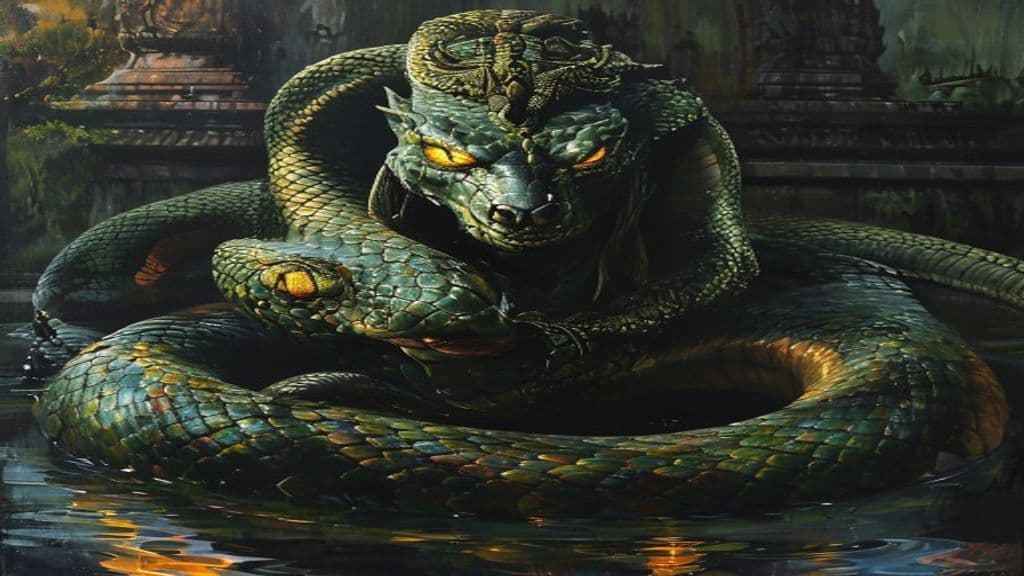
Naga
Divine serpent beings of Hindu, Buddhist, and Jain cosmology — powerful guardians of water, earth, and underground treasures. Revered as deities in South and Southeast Asia.

Naiad
A class of female nature-spirits in ancient Greek religion whose being is bound to particular bodies of fresh water (springs, wells, fountains, streams). Naiads are local, embodied presences venerated in community cults and invoked in rituals of purification, healing, and life-cycle events, yet they may also act harmfully toward humans.
Astris
Astris is a minor figure in Greek literary tradition, named among the Heliades in Nonnus's Dionysiaca; she is presented as a daughter of Helios who marries the river-god Hydaspes and becomes mother of the Indian king Deriades. Her attestation in the supplied material is primarily genealogical rather than cultic or narrative.
Astyanax
In classical Greek and Roman literature Astyanax is the infant son of Hector and Andromache whose survival or death symbolizes the potential continuity of Troy's royal house. He is depicted as a mortal child whose fate is contested in the immediate aftermath of the sack of Troy; later medieval and Renaissance traditions sometimes recast him as a legendary founder-figure who survives.
Astydameia
Astydameia (Ancient Greek Ἀστυδάμεια) is not a single supernatural being but an ancient Greek personal name borne by several mortal women in mythic tradition — queens, wives, and mothers who appear as genealogical and narrative nodes in the heroic age (figures associated with Peleus, Heracles, Acastus, Pelops, etc.). The name literally evokes civic rulership, and the bearers act within social and political roles rather than as spirits or deities.
Astydamia
Astydamia is a mortal woman attested in classical Greek genealogical myth. In the primary mythographic excerpt provided she is named as a daughter of Pelops and as wife of Alcaeus (mother of Amphitryon and Anaxo in that account); a modern botanical note alternatively identifies an Astydamia as wife of Acastus, son of Pelias, a conflicting attribution in the sources given.
Astylus
Astylus is a taxonomic genus of beetles in the family Melyridae (more than 110 described species), and the name also appears in the archaeological record as the appellation of a caupona (inn/shop) excavated at Pompeii. Sources treat Astylus as entomological and archaeological, with no attested folkloric or supernatural identity.
Astynome
Astynome (Ancient Greek: Ἀστυνόμη) is not a single supernatural being but a personal name attested for several different mortal women in Greek mythic and genealogical traditions — for example, a Niobid, a daughter of Talaus and mother of Capaneus, a captive woman identified with Chryseis in Trojan War material, and a woman transformed into a rock after seeing Artemis naked.
Astłik
Astłik (Astghik) is an ancient Armenian goddess associated with beauty, love, fertility, and water; in some earlier attestations she is also reported as a creator figure. Her cult is tied to local temples and seasonal ritual life, notably the Vardavar water‑drenching festival, and later identifications connect her with the planet Venus and Greco-Roman love‑goddess types.
Asura
Asura (Sanskrit: असुर) are a class of supernatural beings in Indian religious traditions. In Hinduism they are described as power-seeking beings related to, and often oppositional toward, the Deva; in Buddhist cosmology they form a demigod/titan class characterized by passions such as wrath and envy. Individual asura figures (notably the asura Svarbhānu) appear in myths that produce the eclipse-entities Rahu and Ketu.
Asuras
In Vedic mythology, the Asuras are a group of beings described as the 'enemies' or 'opponents' of the Devas (gods), often associated with chaos and disorder. (Note: 1. Power tier should be Ancient (or Deity-level), as they are described as eternal enemies of the gods. 2. Sensory cues and wards/weaknesses sections should be filled in, as there's no information to )
Aswang
The most feared supernatural being in Philippine folklore — a shape-shifting monster that appears human by day but transforms at night to prey on pregnant women and children.
Atabey
Atabey is a principal Taíno ancestral mother-spirit (a zemi) associated with fresh water, fertility, and prime matter; she appears in early ethnohistorical transmissions with multiple names and manifestations ranging from nurturing mother to violent storm-mother.
Atago Gongen
Atago Gongen (愛宕権現) is a syncretic mountain guardian venerated around Mount Atago as a local gongen (manifestation) of the bodhisattva Jizō and as a protective kami. Traditionally worshipped by Shugendō practitioners, townspeople, and samurai, the cult emphasizes protection from fire, theft, and disaster and developed through honji-suijaku fusion of Buddhist and Shinto ideas.
Community Record
- [1]Astyoche (Wikipedia). Wikipedia, 'Astyoche' entry (compilation of classical attestations and variants)wiki
- [2]ASTYOKHE, Astyoche (Theoi Classical Texts Library). Theoi.net summary: 'ASTYOKHE, Astyoche, was the Naiad-nymph of a fresh-water spring or fountain of the town of Troy... PARENTS. SIMOEIS.'literary
- [3]Family tree / genealogical summaries (online compilation). Online genealogical compilation citing classical lineages relating river-gods, naiads, and Trojan dynasty connectionsother