The name Chaitra (Sanskrit: चैत्र, Caitra) is etymologically linked to the Moon's proximity to the Chitra nakshatra on the full-moon day; the month is therefore named for an astronomical/astrological relation to that lunar station. In traditional Hindu luni-solar reckoning Chaitra functions as the first month in many lunar-year systems and is organized into the bright (Shukla) and dark (Krishna) fortnights, with months of 29–30 days that track the Moon's cycle. Its calendrical placement and ritual salience arise from this astronomical rooting (nakshatra alignment) and its position at the spring threshold in seasonal schemes.
As a calendrical period Chaitra has no physical form; it is instantiated temporally. In luni-solar reckoning and in the Indian national calendar it maps roughly to March–April (Gregorian). In regional solar and vernacular calendars it corresponds to different months: it aligns with Choitro (the last month) in the Bengali calendar; with Chait in the Nepali (Vikram Samvat) calendar as the last month; and with Chittirai in the Tamil calendar, which falls in April–May. In solar-calendar terms it corresponds to the Sun's entry into Pisces (Mina) in certain systems. Its 'appearance' is thus temporal and regional rather than corporeal.
Chaitra's operative role is calendrical and ritual: it marks spring (Vasanta), occasions multiple new-year and seasonal festivals, and indexes specific religious commemorations. Documented functions include marking the lunar new year beginning (Chaitra Navaratri beginning on Chaitra Shukla Pratipada), structuring regional new-year observances (Gudi Padwa, Puthandu, Vishu, Ugadi), and hosting specific festival dates such as Ram Navami (Chaitra Shukla Navami), Hanuman Jayanti (observed on the month's Purnima in sources), and Chitra Pournami (full-moon observance with bathing and puja in Tamil contexts). In Jain tradition the month contains Mahavira's birth (Mahavir Janma Kalyanak on Chaitra Sud 13). Its "actions" are scheduling and occasioning rituals (purificatory bathing, puja, offerings) rather than animate agency.
Weaknesses
- othernot applicable
Wards
- othernot applicable
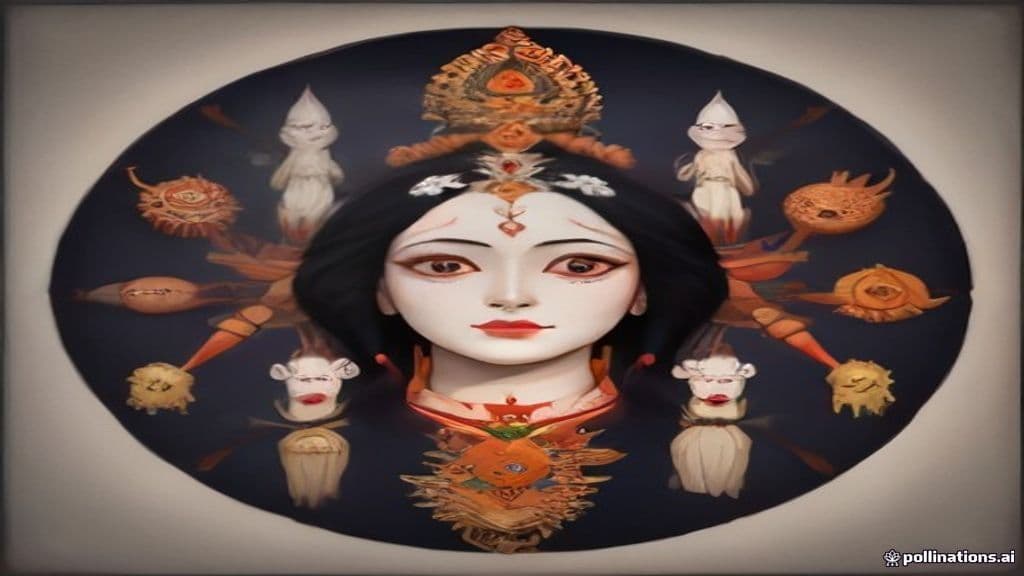
Navadurga
Navadurga (Sanskrit: नवदुर्गा, Navadurgā) denotes nine interrelated manifestations or stages of the goddess Durga worshipped together during Navaratri, Durga Puja, and in regional jatras and masked-dance traditions (notably in Nepal). They function as collective aspects of a single divine being tied to the nine-day contest with the demon-king Mahishasura and to communal rites of protection, victory, and renewal.
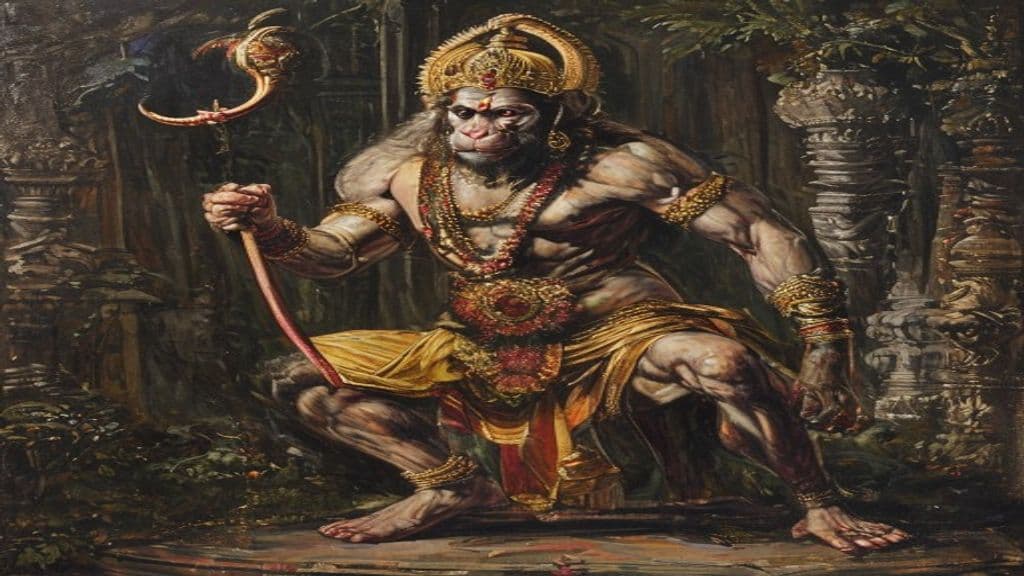
Hanuman
Hanuman is a divine vanara (monkey‑like being) in Hindu literature, foremost companion and devoted servant (Rama-dūta) of Lord Rama in the Ramayana. Revered in later Bhakti traditions, he is worshipped as a protector and exemplar of devotion, strength, and service.
*Péh₂usōn (reconstructed)
Péh₂usōn is a hypothetical Proto‑Indo‑European pastoral guardian reconstructed by comparative scholars from parallels in Greek and Vedic traditions. Proposed as a Graeco‑Aryan ancestor‑figure, the reconstruction describes a protector of flocks, roads, and travellers rather than an attested historical cultic personality.
Abhimanyu
Abhimanyu is a youthful Kuru/Pandava warrior-hero in the Sanskrit epic Mahābhārata. Son of Arjuna and Subhadra, he is famed for entering the Chakravyuha battle formation on the thirteenth day of the Kurukshetra War and dying at age sixteen; his posthumous son Parikshit continues the Kuru line.
Abhinandananātha
Abhinandananātha is the fourth Tīrthaṅkara (ford-maker) of the current Jain cosmic age (avasarpini). Traditional accounts place his birth in Ayodhyā to the Ikshvāku (Solar) dynasty, describe his renunciation and attainment of omniscience beneath a priyangu tree, and record his liberation on Mount Śikharjī.
Achyuta
Achyuta (Sanskrit: अच्युत, acyuta) is primarily an epithet/theonym in Vaishnava Hindu tradition applied to Vishnu and Krishna, signifying the divine quality of being 'not fallen' — immutable, infallible, and imperishable. It functions as a devotional name in scripture, liturgy, and Pancharatra lists of divine emanations rather than as an autonomous folkloric spirit.
Acintya
Acintya is an Indonesian Hindu theological-symbolic representation of the ineffable supreme divine principle. In Balinese and Javanese practice it functions as a way to make ultimate reality present in ritual and art—often aniconically as an empty throne (padmasana) or anthropomorphically as a naked, flame-surrounded figure—rather than as a narrative, intervening deity.
Adi (asura)
Adi is attested in modern reference works as the name of an Asura who 'appears in the Matsya Purāṇa.' Beyond this single-line citation in secondary sources, no descriptive material about the figure is provided in the supplied research notes.
Adi Shakti
Adi Shakti (also Adi Parashakti, Mahadevi, Adya Shakti) is the primordial feminine power in Hindu/Shakta theology, regarded as the ultimate reality (Para Brahman) and the source from which all goddesses and gods manifest. She is both an impersonal cosmic principle (Mulaprakriti) and a focus of devotional invocation in temples, mantras, and pilgrimage sites such as Shakti Peethas.
Adi Vinayaka
Adi Vinayaka (Ādi Vināyaka; also called Nara Mukha Vinayaka) is a named iconographic and devotional form of the Hindu god Ganesha portraying the deity with a human head, described in sources as the form before the episode of decapitation by Shiva. It is rarely worshipped and appears in a small number of South Indian shrines and in devotional/musical repertoires.
Aditi
Aditi is a major Vedic goddess in Hindu tradition who personifies the boundless, infinite cosmic principle and functions as the maternal matrix from which many celestial deities (the Ādityas and other groups) are born. In the Vedic hymns she is invoked as a protective liberator who guards petitioners, provides wealth and safety, and frees devotees from hindrances such as sin and sickness.
Agastya
Agastya (also Agathiyar/Agasti) is a revered Vedic and later-period Indian rishi (sage) figure credited in textual traditions as an inspired seer, ascetic, teacher, culture-founder, and attributed author of Vedic, Puranic and Tamil works; in South Indian tradition he is associated with origins of Tamil grammar and Siddha medicine and is identified astronomically with the star Canopus.
Aghasura
Aghasura is an asura from the Vaishnava/Hindu narrative tradition (notably the Srimad‑Bhāgavatam) who, at the command of Kamsa, assumed the form of a vast serpent to ambush Kṛṣṇa and the cowherd boys in Vṛndāvana. The episode demonstrates Kṛṣṇa’s protective, divine power as he enters and destroys the demon from within.
Agiya Baital
The fire-form of the Vetala — a cremation ground spirit of UP and Bihar that manifests as a wandering flame rather than a corpse-inhabitor, leading night travellers off roads and into marshland or flames with a dancing fire that seems always just ahead.
Community Record
- [1]Chaitra — Wikipedia. Wikipedia, 'Chaitra' article (accessed as provided in research notes).wiki
- [2]Chaitra — Wikidata. Wikidata item Q2365308 for Chaitra (metadata referenced in research notes).wiki
- [3]చైత్రమాసమాహాత్మ్యము (Chaitra Masamāhātmya) — Archive entry. Digital Library of India metadata entry for a Telugu work titled 'Chaitra Masamāhātmya' (not quoted in full in provided notes).other
- [4]Archive — Chaitra Reddy576 Favorites (metadata). Archive.org entry listed in research notes (contextual/archive material).other