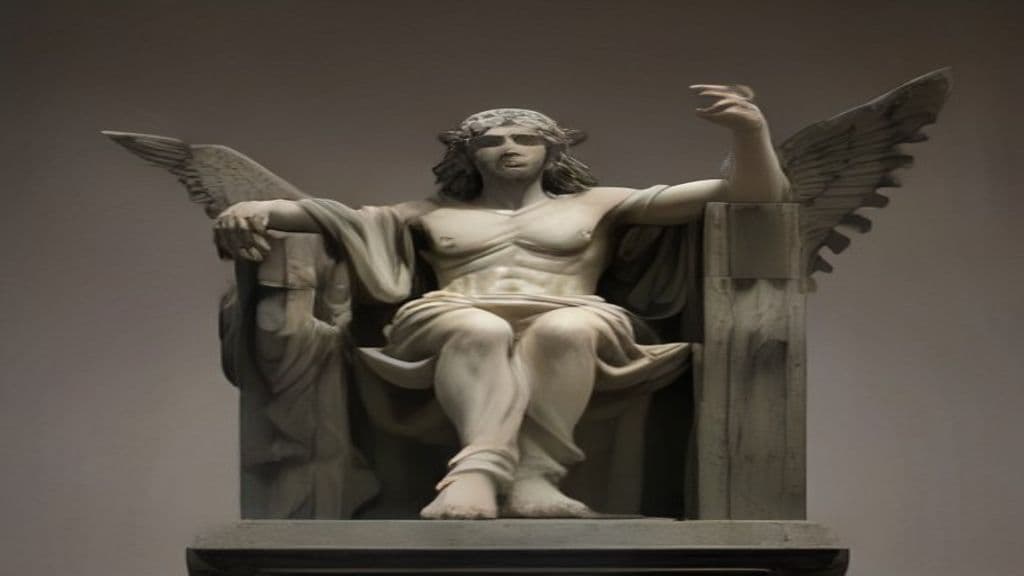
The term daimon/daemon in classical sources names a class of intermediary beings present in Greek religious and ethical thought rather than a single origin myth. Sources and discussions of the term treat daemons as part of the unseen population of agents—alongside local chthonic powers and household spirits—who affect human life, fate, and cult practice. The Socratic tradition specifically records an inner daemonic sign (the daimonion) that guided Socrates' moral deliberation, illustrating the role of daemons as personal attendants; separate references to Roman practices (Compitalia/crossroads festival) show comparable local spirits being integrated into communal cult life (sources: TheCollector; forum excerpts referencing Morford & Lenardon; Wikipedia disambiguation and related pages).
Classical sources and the provided excerpts offer no consistent physical description for daemons as a class. Rather than a standard corporeal form, daemons are attested as non-corporeal signs or attendant presences (e.g., Socrates' 'daemonic sign'). Named mythic monsters (such as Python at Delphi) are discussed in the same cultural space but are distinct individual figures and should not be conflated with the generic daimon class in the available material (sources: TheCollector; Python article; forum excerpts).
From the sampled material daemons are credited chiefly with advisory and sign-bearing functions: Socrates' daemon acts as a guiding inner voice or daemonic sign, providing warnings or prohibitions rather than commanding actions. The term in classical literature is also used for nature-spirits and local attendant beings connected to places, households, and festivals, implying roles in omens, fate-related influence, and cultic interaction. Classical usage allows for benevolent or ambivalent behavior—daemons could be helpful or harmful depending on context—rather than being uniformly malevolent (sources: TheCollector; forum excerpts; references to Compitalia and Roman/Greek religious contexts; Wikipedia disambiguation).
Agraeus
Agraeus (Greek: Ἀγραῖος) is primarily an epithet in ancient Greek religion meaning "the hunter," applied to deities (notably Apollo and in feminine form to Artemis) to mark their hunting aspect. The name also appears as a personal name in mythic genealogies and is secondarily attested in a Phoenician context in a late summary source.
Aidos
Aidos (Ancient Greek: Αἰδώς) is the personification of shame, modesty, and reverent restraint in classical Greek thought. Treated variously as an ethical feeling, a moral force, and occasionally as a goddess with local cults, Aidos embodies the inner reverence that restrains wrongdoing and governs social propriety.
Alastor
Alastor (Ancient Greek: Ἀλάστωρ) is a concept-personification in Greek tradition denoting an avenging spirit or personified curse that punishes certain moral offences—especially familial bloodshed—and operates alongside chthonic avengers such as the Erinyes. Over time the term broadened to a secular insult and was reinterpreted in later Christian demonology as a type of possessing evil spirit.
Bacchus
Bacchus is the Roman identification of the Greek god Dionysus, a deity associated with wine, vegetation and fertility, ritual ecstasy and theatrical performance. In Roman religion he is conflated with the Italic Liber and known for rites that induce possession, frenzy (baccheia), and group revelry.
Eosphoros
Eosphoros is the classical Greek personification of the planet Venus in its morning‑star appearance, literally the 'dawn‑bringer'. Portrayed as a luminous, winged youthful figure who precedes the chariots of dawn (Eos) and the sun (Helios), the figure was later rendered in Latin as Lucifer/Luciferus and reinterpreted in post‑classical theological and literary traditions.
Dactyls
Dactyls (Ancient Greek Daktuloi, literally "fingers") are archaic mythical figures in Greek tradition associated with Mount Ida; some traditions credit an Idaean Dactyl named Herakles with originating the Olympic Games. The term also appears in later cultural registers (poetic meter, modern astronomical naming).
Daedalion
Daedalion (Ancient Greek: Δαιδαλίων) is a figure from Greek myth: a son of Hesperos/Phosphorus, father of Chione, and brother of Ceyx who, grieving his daughter's death, attempts suicide and is transformed by Apollo into a hawk. The metamorphosis is presented etiologically to explain hawk strength and predatory habits as continuations of his character and grief.
Daedalus
Daedalus (Greek Δαίδαλος) is a legendary master craftsman, architect, and inventor of Greek mythic tradition credited with complex constructions (the Labyrinth), ingenious devices (a wooden cow), and mechanical inventions (wings for flight). He functions as an archetypal artisan whose skill alters human affairs and whose pride produces moral and social consequences.
Daeira
Daeira is an Oceanid-nymph closely associated with the Eleusinian Mysteries and the town of Eleusis in Attica. Her name means "the knowing one," and ancient sources present her variously as a local progenitor, a bearer of esoteric initiation knowledge, and in multiple traditions equated or contrasted with major goddesses such as Persephone, Demeter, Aphrodite, Hera, and Hekate.
Daemones Ceramici
A class of hostile craft‑bound spirits in Greek tradition associated with pottery and kilns; they are named in later summaries as agents that plague potters by causing breakage, scorching, and kiln failure. The motif survives primarily in a short hexameter poem ('Kiln' / 'Potters') that frames potters' success as dependent on Athena while attributing craft disasters to malign daimones.
Daeva
In Zoroastrian and Iranian tradition, a daeva (Avestan daēuua) is a class of supernatural being that the Zoroastrian revelation repudiates; in the oldest texts they are 'gods that are (to be) rejected' and in later tradition they come to be depicted as divinities promoting chaos and, ultimately, as personifications of evil.
Dag the Wise
Dag the Wise (Old Norse Dagr spaki) is a legendary Swedish king in the Yngling dynasty attested in skaldic and saga sources. He is noted for understanding the speech of birds and for keeping a sparrow that gathered news; the bird's death prompted a vengeful expedition to Reidgotaland in which Dag was ambushed and killed.
Community Record
- [1]What Was Socrates’s Daemon? The Truth Behind the Voice Guiding the Philosopher. TheCollector, 'What Was Socrates’s Daemon? The Truth Behind the Voice Guiding the Philosopher'other
- [2]Demon (disambiguation). Wikipedia, 'Demon (disambiguation)'wiki
- [3]Python (mythology). Wikipedia, 'Python (mythology)'wiki
- [4]Orcus. Wikipedia, 'Orcus'wiki
- [5]Forum discussion citing Morford & Lenardon and classical contexts. EarlyWritings forum thread referencing scholarship (Morford & Lenardon) and discussions of daimones and related cult practiceother
- [6]Wikidata: Daemon. Wikidata entry for 'Daemon'other