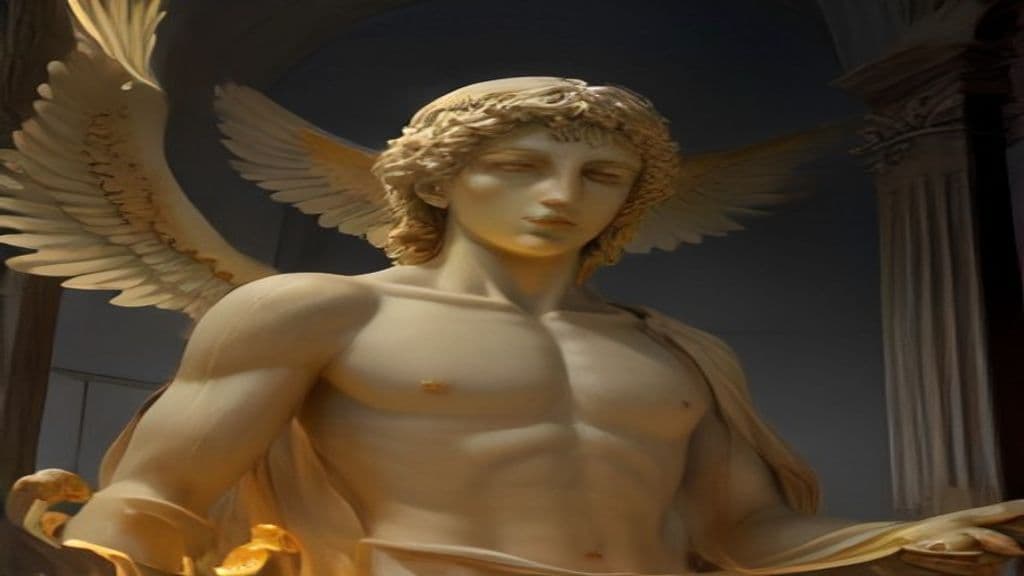
Eosphoros originates as the personification of the morning appearance of the planet Venus in classical Greek mythic astronomy. The name Eosphoros (Εωσφόρος / Eôsphoros) means 'dawn‑bringer' (Eos = Dawn; -phoros = bearer), with Phosphorus (Φωσφόρος) used as a variant/epithet meaning 'light‑bringing'. In Roman usage the same astronomical personification is rendered as Lucifer/Luciferus. Classical sources treat Eosphoros as the luminous herald of dawn rather than as a moralized rebel; the later association of the Latin name Lucifer with fallen‑angel motifs is a post‑classical theological reception of the morning‑star vocabulary.
Classical iconography and literary summaries depict Eosphoros as a handsome, youthful, often winged figure with a shining aureole about his head and sometimes torch‑bearing attributes, representing the bright point of light that precedes sunrise (iconographic note; Theoi; Wikipedia). As an astronomical object Eosphoros is experienced visually as the bright morning star (Venus) rising in the eastern twilight.
In the classical corpus Eosphoros's functional 'power' is heraldic and astronomical: his rising signals dawn, he leads or precedes the chariots of Eos (Dawn) and Helios (Sun), and his appearances mark seasonal shifts toward longer days. The adjective/phosphorus sense ('light‑bringing' or 'torch‑bearing') is also used as an epithet for other deities (e.g., Hecate, Artemis, Hephaestus), indicating a shared luminous attribute. Later literary and theological receptions (Latin Lucifer usages) recast the name within motifs of pride and fall, but those behaviors are receptional and not described in the classical Greek sources cited.
Agraeus
Agraeus (Greek: Ἀγραῖος) is primarily an epithet in ancient Greek religion meaning "the hunter," applied to deities (notably Apollo and in feminine form to Artemis) to mark their hunting aspect. The name also appears as a personal name in mythic genealogies and is secondarily attested in a Phoenician context in a late summary source.
Aidos
Aidos (Ancient Greek: Αἰδώς) is the personification of shame, modesty, and reverent restraint in classical Greek thought. Treated variously as an ethical feeling, a moral force, and occasionally as a goddess with local cults, Aidos embodies the inner reverence that restrains wrongdoing and governs social propriety.
Alastor
Alastor (Ancient Greek: Ἀλάστωρ) is a concept-personification in Greek tradition denoting an avenging spirit or personified curse that punishes certain moral offences—especially familial bloodshed—and operates alongside chthonic avengers such as the Erinyes. Over time the term broadened to a secular insult and was reinterpreted in later Christian demonology as a type of possessing evil spirit.
Bacchus
Bacchus is the Roman identification of the Greek god Dionysus, a deity associated with wine, vegetation and fertility, ritual ecstasy and theatrical performance. In Roman religion he is conflated with the Italic Liber and known for rites that induce possession, frenzy (baccheia), and group revelry.
Daemon (classical)
In classical Greek and Roman contexts a daemon (daimon) denotes an intermediary spirit or nature-being that can be benevolent, ambivalent, or morally mixed. Daemons occupy an ontological position between gods and humans and appear as personal guiding signs, place-linked spirits, or participants in local cultic life rather than as categorically evil entities.
Ent
An Ent is a fictional, tree-like, sentient humanoid from J. R. R. Tolkien's Middle-earth who serve as ancient 'Shepherds of the Trees', guarding forests and vegetation and reacting when those they tend are harmed.
Entellus
Entellus is a mortal heroic boxer featured in Virgil's Aeneid (Book V), celebrated for defeating the younger Dares during funeral games in Sicily and for an ensuing demonstration of strength that ties him etiologically to the Sicilian town Entella.
Eochaid mac Eirc
Legendary High King of Ireland from the Fir Bolg in the medieval Irish invasions cycle; credited in tradition with establishing a system of justice, founding a capital at Tailtiu (Teltown) and holding an annual August festival, and slain after the Fir Bolg's defeat by the Tuatha Dé Danann at the first Battle of Magh Tuiredh.
Eos
Eos is the ancient Greek goddess and personification of the dawn who rises each morning from the edge of Oceanus to bring light, open the gates of heaven for her brother Helios, and usher in the day; she is a daughter of the Titans Hyperion and Theia, sister to Helios and Selene, and mother of several winds and astral figures.
Eoten (ēoten)
Eoten (Old English ēoten) is the Old English term glossed as 'giant' and cognate with Old Norse jötunn. In Anglo‑Saxon and Norse literary traditions the word is used within a wider family of large non‑human beings (jötnar, þurs, risi, troll) that often occupy liminal or primeval roles in myth and saga.
Eotenas
Eotenas (Old English eotenas) are a race-class of other-than-human beings attested in Anglo-Saxon poetic contexts, notably Beowulf, where they appear among a catalogue of hostile or monstrous stocks. Philological traditions link the term to Old Norse jötnar/ettins (often rendered "giants" in modern summaries), but primary Old English lines give little concrete physical description.
Epaphus
Epaphus (Ancient Greek Ἔπαφος) is a mythic human figure in Greek tradition, presented as a son of Zeus and Io who becomes king of Egypt and an eponymous ancestor in genealogical myths. He functions as a legendary founder-king linking Olympian divinity to foreign lands (notably Egypt and Libya) and as a progenitor in lineages that lead to figures such as Belus, Agenor, Cadmus, and Europa in some traditions.
Community Record
- [1]Phosphorus (morning star) - Wikipedia. Wikipedia: 'Phosphorus is the god of the planet Venus in its appearance as the Morning Star. Another Greek name for the Morning Star is Eosphorus, which means "dawn‑bringer"... As an adjective, the word "phosphorus" is applied in the sense of "light‑bringing" and "torch‑bearing" as an epithet of several gods and goddesses...'wiki
- [2]EOSPHORUS & HESPERUS (Eosphoros & Hesperos) - Greek Gods of the Morning & Evening Stars - Theoi. Theoi: summary and iconographic references for Eosphoros as the Greek god/personification of the Morning Star and pairing with Hesperus.academic
- [3]Eos – The Light of All‑Seeing Dawn – Supersededotcom (iconographic note). Supersededotcom: 'Eosphoros, god of the morning star, Venus, leads the procession of the day: the chariots of Eos, the dawn, and Helios the sun. Eosphoros is depicted as a handsome young winged god with a shining aureole upon his head.'other
- [4]Wikidata: Lucifer (morning star / Latin usage). Wikidata: notes the Latin name Lucifer/Luciferus as a name for the Morning Star and its later use as a name for the devil/Satan in post‑classical contexts.wiki
- [5]Question: Linking Lucifer to Diana (Jesterbear FAQ excerpt). Jesterbear FAQ: contains receptional phrasing reusing 'How you have fallen from heaven, Eosphoros...' illustrating later theological/literary appropriation of the morning‑star vocabulary.folk
- [6]ASCENSION LYRICS - 'Consolamentum' (lyric reference). Darklyrics: modern musical use of the name in 'King divine Eosphoros. Lightbearer Eosphoros...'.literary
- [7]Archive: Lucifer, le porteur de lumière - Cycle de la Gnose (video description). Archive video description: example of later theological/gnostic receptional material treating Lucifer as 'light‑bearer' within post‑classical interpretive frames.other
- [8]Mythology Stackexchange: Is it Lucifer or Venus?. Community discussion addressing distinctions and conflations between the astronomical morning star (Venus/Eosphoros) and the later Lucifer traditions.other