
Alastor is not presented in classical sources as a single biographical being with a life-story but as a functional personification and epithet. In archaic and classical Greek usage the term denotes an avenging force or personified curse; it is used as an epithet of Zeus (e.g., Zeus Alastor) who avenges evil deeds—particularly familial bloodshed—and is described as allied with the Erinyes. Tragic writers used the name generically to designate any deity or daemon who avenges wrongs committed by men (illustrated in literary contexts such as Euripides' Electra). By the 4th century BC the word alastor had also degraded in ordinary speech to a pejorative meaning roughly 'scoundrel.' In later Christian demonological reception the figure/label was recast as a kind of possessing entity and likened to Nemesis, and the name was used more broadly for harmful spirits.
Classical sources do not supply a consistent, stable embodied form for Alastor; ancient attestations emphasize function and epithet rather than standardized iconography. The term appears variably as an epithet of a god (Zeus Alastor), as a personified curse or daemon allied to the Erinyes, and is applied by writers to different agents who enact vengeance. Consequently no single classical visual description is preserved in the provided material. Separately, modern fictional traditions (not ancient) have depicted an entity named Alastor with a vivid corporeal appearance (for example, a Greyhawk source describing a ghostly farm lad), but that portrayal belongs to a distinct fictional tradition and is not part of the classical attestations.
In classical material Alastor's operative 'abilities' are moral-retributive rather than technical powers: as an avenging spirit or personification of a curse it relentlessly pursues the guilty and enacts vengeance—specifically noted as punishing children for the sins of their fathers—and functions in the chthonic system of punishment alongside the Erinyes. As an epithet of Zeus the avenging aspect enforces retribution for evil deeds, especially familial bloodshed. Later Christian demonological readings attribute to Alastor characteristics of a possessing spirit and equate or liken it to Nemesis, using the name as a general label for a class of harmful spirits; these are interpretive receptions rather than uniform classical attributes.
Weaknesses
- otherNo specific vulnerabilities attested in provided classical sources; cultic propitiation implied
Wards
- ritualCultic propitiation at an altar (Zeus Alastor at Thasos)
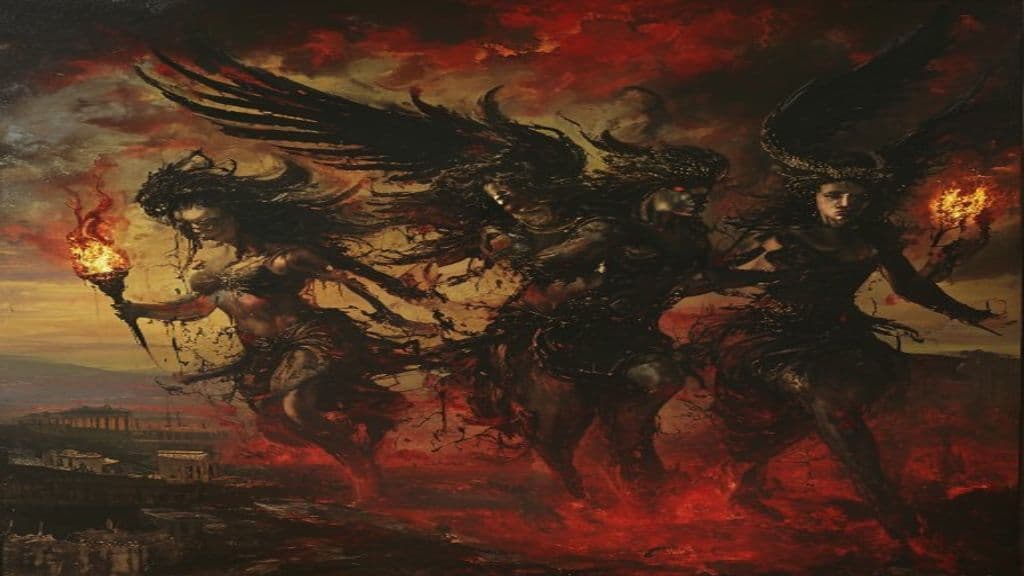
Erinyes
The three avenging Furies of Greek myth — Alecto, Megaera, and Tisiphone — who pursued and tormented those guilty of crimes against blood kin, especially murder of family members.
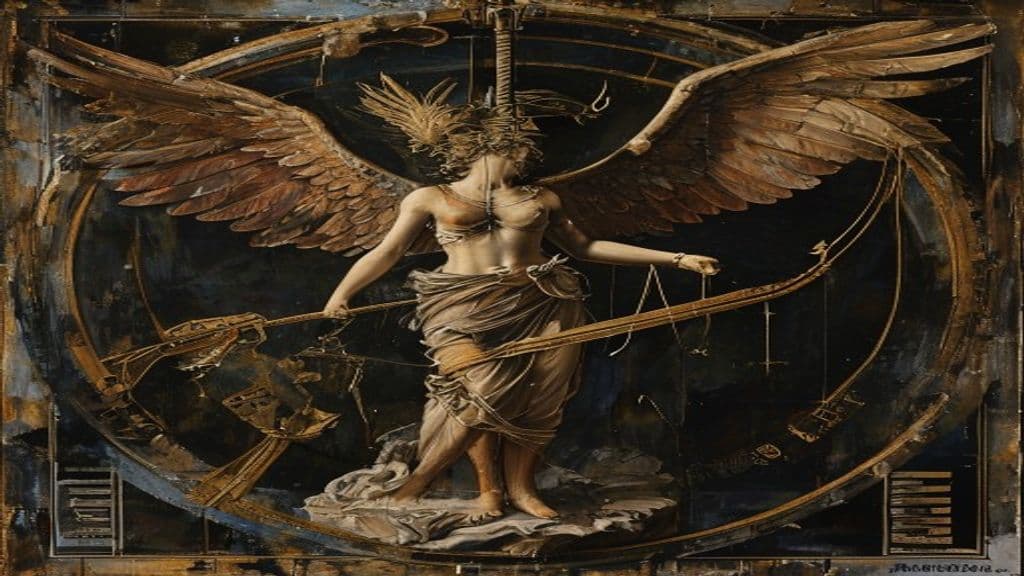
Nemesis
Nemesis (Greek: Νέμεσις), also called Rhamnousía in her local cult, is the personified goddess of distributive justice and retributive balance in ancient Greek religion and myth. She functions to restore due measure—rewarding or withholding according to desert—and punishes hubris and excessive fortune.
Agraeus
Agraeus (Greek: Ἀγραῖος) is primarily an epithet in ancient Greek religion meaning "the hunter," applied to deities (notably Apollo and in feminine form to Artemis) to mark their hunting aspect. The name also appears as a personal name in mythic genealogies and is secondarily attested in a Phoenician context in a late summary source.
Aidos
Aidos (Ancient Greek: Αἰδώς) is the personification of shame, modesty, and reverent restraint in classical Greek thought. Treated variously as an ethical feeling, a moral force, and occasionally as a goddess with local cults, Aidos embodies the inner reverence that restrains wrongdoing and governs social propriety.
Bacchus
Bacchus is the Roman identification of the Greek god Dionysus, a deity associated with wine, vegetation and fertility, ritual ecstasy and theatrical performance. In Roman religion he is conflated with the Italic Liber and known for rites that induce possession, frenzy (baccheia), and group revelry.
Daemon (classical)
In classical Greek and Roman contexts a daemon (daimon) denotes an intermediary spirit or nature-being that can be benevolent, ambivalent, or morally mixed. Daemons occupy an ontological position between gods and humans and appear as personal guiding signs, place-linked spirits, or participants in local cultic life rather than as categorically evil entities.
Eosphoros
Eosphoros is the classical Greek personification of the planet Venus in its morning‑star appearance, literally the 'dawn‑bringer'. Portrayed as a luminous, winged youthful figure who precedes the chariots of dawn (Eos) and the sun (Helios), the figure was later rendered in Latin as Lucifer/Luciferus and reinterpreted in post‑classical theological and literary traditions.
Alammuš
Alammuš is a Mesopotamian deity who functioned as the sukkal (attendant or court-official deity) of the moon god Nanna (Akkadian Sin). He is attested in offering lists, god-lists, oath formulas, legal and seal texts, and in Mesopotamian astronomical lists where he is paired with Ningublaga as the 'Little Twins.'
Alan
A class of non‑human spirit-beings in Tinguian (Philipine) folklore associated with reproductive wastes and springs; said to transform discarded menstrual blood, afterbirth, or miscarried tissue into human children whom they rear, and to dwell in fine houses near springs. Key described features include wings and backward-pointing fingers and toes.
Alan Scott
Alan Scott is a fictional American comic-book superhero, the original bearer of the Green Lantern name, created by Martin Nodell and Bill Finger and debuting in All-American Comics #16 (July 10, 1940). He is a Golden Age costumed crimefighter who uses a mystical ring recharged from a green lantern and served as a founding member and early leader of the Justice Society of America.
Alan Wake
Alan Wake is a fictional human protagonist created by Remedy Entertainment: a bestselling crime‑thriller novelist who experiences metafictional supernatural events when manuscript pages of a book he does not remember writing come to life in the town of Bright Falls. The character appears across video games and related media (Alan Wake, DLC episodes, American Nightmare, Alan Wake 2) in stories that frame the threat as a pervasive 'darkness' opposed by light.
Alatreus
Alatreus is a youthful mythic warrior named in Roman-era treatments of Greek myth (notably Statius's Thebaid). He is identified as the son of Lapithaon and the nymph Dercetis and appears as a tender-aged but effective combatant in battlefield episodes.
Alatyr
A sacred world-stone in East Slavic and wider Slavic folklore, described as the "father to all stones" and the "navel of the earth." Located at the world's center (often on Buyan island), it is associated with a miraculous spring, sacred letters, healing properties, and liminality between the human world and other realms.
Alaunus / Alauna
Alaunus (masculine) and Alauna (feminine) are Gaulish theonyms attested in Roman‑period inscriptions and preserved in river- and place‑names across western and central Europe. The surviving evidence is epigraphic and toponymic; modern scholars often interpret the deity as associated with healing and prophecy and note at least one dedication equating him with Mercurius (Mercurius Alaunus).
Community Record
- [1]Alastor - Wikipedia. Wikipedia: Alastorwiki
- [2]Wikidata: Alastor. Wikidata entry for Alastorother
- [3]Greyhawk: Alastor Land (fictional depiction). Greyhawk Online — Alastor Land (modern fictional portrayal cited in notes)other
- [4]Alastor (poem) — Percy Bysshe Shelley. Shelley's poem 'Alastor' (modern literary work referencing the name)literary
- [5]Archive: Alastor Bozzelli Favorites. Archive entry referencing the name Alastorother