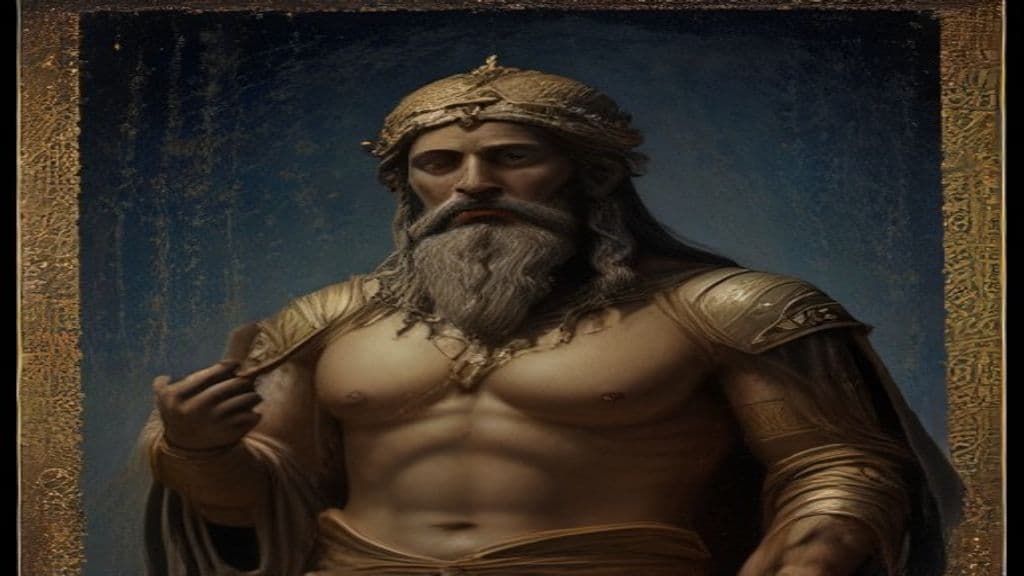
Epaphus is described in Greek sources as born of Zeus and Io; his name (Ancient Greek Ἔπαφος) is glossed as 'Touch' and invokes his conception by the touch of Zeus. Traditions vary: some place his birth in Euboea (the cave Boösaule, per Strabo as preserved in summaries) while others place his birth in Egypt on the Nile after Io's wanderings. Accounts further relate that he was concealed (in some versions by the Curetes at Hera's request) and that Io later found him in Syria and he was nursed by the wife of the king of Byblos. He rises to be king of Memphis (Egypt) and is reported as the father of Libya, through whom descend Belus and Agenor; Agenor in turn is an ancestor in traditions of Cadmus and Europa.
No consistent physical or iconographic description of Epaphus survives in the provided sources; he is represented as a human king and ancestor rather than as a supernatural form. Some traditions equate or associate him with Egyptian royal foundation (king of Memphis) but the sources offered here do not preserve specific bodily or costume details.
Sources do not attribute overt magical powers or supernatural faculties to Epaphus. His notability lies in his divine conception (son of Zeus), his royal role as founder/king of Memphis, and his place in genealogical narratives that explain the origins of peoples (e.g., Libya) and later lineages (Belus, Agenor, Cadmus, Europa in some accounts). Mythic incidents include being concealed at birth (Curetes/Hera motif), a social rivalry with Phaethon (a mocking exchange recorded in summaries), and a tradition in which Hera's jealousy is implicated in his being killed while hunting. Abilities are thus social and narrative (genealogical legitimacy, kingship) rather than supernatural in the extant material.
Weaknesses
- othernone attested in sources
Wards
- othernone attested in sources

Äio
No folkloric or mythological entity named "Äio" is attested in the provided source set. The available materials contain unrelated uses of similar letter sequences (e.g., the plant genus Aiouea, the astronomical body Io, software terms "io"), but none describe a being, tradition, or rituals called Äio.

Zeus
Zeus (Ancient Greek: Ζεύς) is the supreme deity of the classical Greek pantheon, a sky-and-thunder god who rules as king of the gods on Mount Olympus and functions as a sky‑father who assigns roles among the immortals.

Cadmus
Cadmus is a legendary Phoenician prince and culture-hero in Greek myth, credited with founding Thebes, slaying a local dragon/guardian, marrying Harmonia, and—by some ancient sources—bringing a Phoenician script to Greece.
Hera
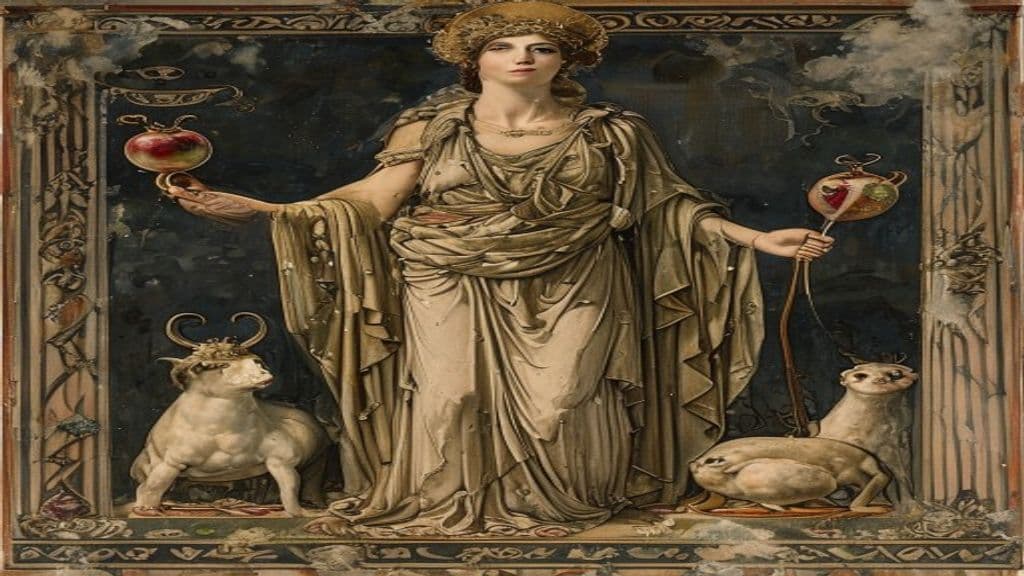
Hera is an ancient Greek goddess, queen of the Olympian gods, and a principal tutelary deity of marriage, women, and family. She functions in myth and cult as protector of lawful marriage and women in childbirth, a civic tutelary figure (notably of Argos), and a sometimes-jealous consort of Zeus with archaic fertility associations in certain local rites.
Entellus
Entellus is a mortal heroic boxer featured in Virgil's Aeneid (Book V), celebrated for defeating the younger Dares during funeral games in Sicily and for an ensuing demonstration of strength that ties him etiologically to the Sicilian town Entella.
Eochaid mac Eirc
Legendary High King of Ireland from the Fir Bolg in the medieval Irish invasions cycle; credited in tradition with establishing a system of justice, founding a capital at Tailtiu (Teltown) and holding an annual August festival, and slain after the Fir Bolg's defeat by the Tuatha Dé Danann at the first Battle of Magh Tuiredh.
Eos
Eos is the ancient Greek goddess and personification of the dawn who rises each morning from the edge of Oceanus to bring light, open the gates of heaven for her brother Helios, and usher in the day; she is a daughter of the Titans Hyperion and Theia, sister to Helios and Selene, and mother of several winds and astral figures.
Eosphoros
Eosphoros is the classical Greek personification of the planet Venus in its morning‑star appearance, literally the 'dawn‑bringer'. Portrayed as a luminous, winged youthful figure who precedes the chariots of dawn (Eos) and the sun (Helios), the figure was later rendered in Latin as Lucifer/Luciferus and reinterpreted in post‑classical theological and literary traditions.
Eoten (ēoten)
Eoten (Old English ēoten) is the Old English term glossed as 'giant' and cognate with Old Norse jötunn. In Anglo‑Saxon and Norse literary traditions the word is used within a wider family of large non‑human beings (jötnar, þurs, risi, troll) that often occupy liminal or primeval roles in myth and saga.
Eotenas
Eotenas (Old English eotenas) are a race-class of other-than-human beings attested in Anglo-Saxon poetic contexts, notably Beowulf, where they appear among a catalogue of hostile or monstrous stocks. Philological traditions link the term to Old Norse jötnar/ettins (often rendered "giants" in modern summaries), but primary Old English lines give little concrete physical description.
Epeius
Epeius (Ancient Greek: Ἐπειός) is a name borne by at least two distinct mortal figures in Greek mythic-historical tradition: an Elean prince/king of the heroic age associated with the succession of Elis and the foundation narratives of Olympia, and an Achaean soldier-engineer celebrated in epic tradition as the builder of the wooden stratagem used at Troy (the Trojan Horse). Both personae appear as human actors within genealogical and epic frameworks rather than as supernatural beings.
Epeius of Elis
Epeius (Ancient Greek: Ἐπειός) is a legendary ancestral king of Elis in Greek tradition, presented as a son of Endymion who won a footrace at Olympia and thereby obtained the kingship. He is an eponymous founder: from his reign the people of Elis were called Epeans; he is treated as a mortal dynastic ancestor rather than a deity.
Epeius of Phocis
Epeius (Ancient Greek: Ἐπειός; Latinized Epeus) is a heroic-age Greek figure from the Trojan War cycle, remembered as a warrior and as the builder of the hollow Wooden Horse. Traditions portray him as a man of exceptional physical strength and technical/architectural skill who dedicated the tools of his craft to Athena and was later associated with settlement traditions in Italy.
Ephraim ben Isaac of Regensburg
A 12th-century Jewish scholar and liturgical poet who contributed to the evolution of halakhic thought, involved in controversy surrounding post-Talmudic authority. (Note: 1. Power tier should be Human, but add that he is also a significant figure in Jewish literature and thought, as per the description of his abilities. 2. Add the name "Ben Yakir" as an alternate title)
Epic-Puranic Royal Genealogies (Hindu tradition)
Historical accounts of ancient Indian dynasties as recorded in the Epic-Puranic narratives. (Note: - Power tier: Should be Primordial=cosmic (given the historical and genealogical significance), not Minor Spirit. - Summary: Should mention that these are considered historical events by Indian tradit)
Epicaste
Epicaste (Ancient Greek Ἐπικάστη, Epikaste) is a personal name attested for multiple mortal women in ancient Greek mythic genealogies and epic references. The name functions as a narrative identifier across several local traditions (Thebes, Calydon, Elis, Argos, Pylos/Ithaca) rather than denoting a single supernatural being or class of spirit.
Community Record
- [1]Epaphus — Wikipedia. Wikipedia contributors, 'Epaphus', Wikipedia, The Free Encyclopediawiki
- [2]Wikidata: Epaphus. Wikidata entry Q675699other
- [3]Odes of Athens (LP0039) — Archive summary of Bacchylides fragment. Archive: LP0039 Odes of Athens (summary referencing Bacchylides fragment)literary
- [4]Hyginus Fabulae — Epaphus (Latin text and summaries). Hyginus, Fabulae (online Latin text and summaries)literary