Attestations of Lagamal begin in the early Mesopotamian literary and administrative record (seal inscription of the Sargonic period; statues and documents in the Ur III period) and the deity is most closely associated with the city of Dilbat, where a temple existed and the god is named as a son of the city's tutelary god Urash and of Ninegal. Lagamal's name is Akkadian and glossed as 'no mercy' (per modern lexical glossing). The deity also appears in Terqa, where a local female form is attested, and was later introduced into the Elamite religious milieu at Susa, where texts pair Lagamal with judicial/underworld deities such as Inshushinak and Ishmekarab. These attestations show regional adaptation (including a female form in Terqa) rather than a single harmonized origin narrative across all locales.
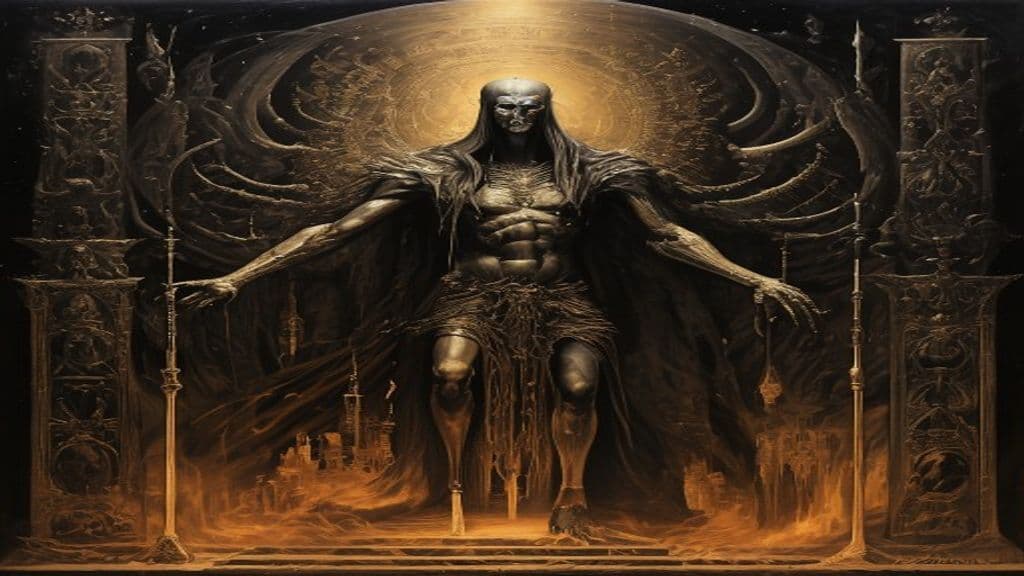
Direct descriptive iconography is not preserved in the summarized sources. Archaeological and textual records attest cult statues of Lagamal (for example in Ur, Ur III period) and discussions in texts about whether statues should have lion heads indicate that images were made and sometimes debated, but no consistent anthropomorphic description or standard iconographic type is recorded in the provided material.
In the surviving textual record Lagamal is associated primarily with the underworld and with roles in judgment or accusatory functions in postmortem reckoning—an interpretation explicitly attested in Susa texts and described by modern scholars as an adversarial or 'accuser' role in afterlife judgment. God lists and lexical texts sometimes equate or align Lagamal with the Mesopotamian death-god Nergal, and in Susa Lagamal appears alongside Inshushinak and Ishmekarab (deities connected with underworld justice), indicating overlapping functional domains with those powers. Mesopotamian local genealogies and ritual documents also place Lagamal in active cultic roles (temples, statue processions, sacrifices) as a city/divisional deity rather than as a purely mythic abstraction.
Nergal
Nergal is a major Mesopotamian deity associated with war, disease, inflicted death, and rulership of the underworld. Principal cult center at Kutha (temple E‑Meslam), he appears in hymns and myths (e.g., the Epic of Erra, "Nergal and Ereshkigal") and is sometimes equated with or called Erra or Meslamtaea.

Inshushinak
Inshushinak is the principal tutelary deity of the city of Susa in Elamite tradition, functioning as the city's lord, protector, royal legitimizer, and divine judge with associations extending into funerary and underworld contexts.

Ishmekarab
Ishmekarab (Išmekarab / Išnikarab) is a Mesopotamian deity associated with justice, oath‑enforcement, and divine judgment. Attested in Assyrian lists of divine judges and in Elamite/Susa contexts, the figure is invoked in legal and curse formulas and appears in scholarship as participating in juridical/afterlife roles in some Susa texts.
'Ain Samiya Goblet
Silver cup from the Middle Bronze Age I, discovered in a tomb at Ain Samiya. (Note: 1. Power tier should be "None", but add a note explaining that historical artifacts don't fit into the typical power tier classification. 2. Add a description of its appearance based on it being a sil)
*Perkʷūnos
*Perkʷūnos is the reconstructed Proto-Indo-European thunder‑god hypothesized by comparative linguistics and mythology. Scholarly reconstructions portray him as a storm or thunder figure associated with fructifying rain and as the combatant who fights a multi‑headed water‑serpent to release life‑giving waters; no direct attestations from the Proto‑Indo‑European period survive and the figure is inferred from later Indo‑European traditions.
*Péh₂usōn (reconstructed)
Péh₂usōn is a hypothetical Proto‑Indo‑European pastoral guardian reconstructed by comparative scholars from parallels in Greek and Vedic traditions. Proposed as a Graeco‑Aryan ancestor‑figure, the reconstruction describes a protector of flocks, roads, and travellers rather than an attested historical cultic personality.
57 Mnemosyne
57 Mnemosyne is a large main-belt asteroid (S-type) discovered in 1859 and named after the Greek Titaness Mnemosyne. It is a non-sentient astronomical body studied for its orbital and rotational properties and has been used in dynamical measurements related to Jupiter.
Abaddon
In Hebrew scripture Abaddon is primarily a noun meaning 'destruction' or a section/condition of the underworld paired with Sheol; in the New Testament Book of Revelation Abaddon is personified as an angelic figure (Greek Apollyon) described as the king of an army of locusts released from the abyss during the apocalypse.
Aban Yasht
The Aban Yasht is a hymn from the Persian tradition that praises Anahita, a goddess associated with water, fertility, and wisdom. It consists of 132 stanzas and is part of the 21 Yashts collection. (Note: - Power tier should be "Primordial" or possibly "Cosmic", given that it's a hymn of great spiritual significance and associated with a goddess. - The article incorrectly states that Anahita is associa)
Abath
No corroborated folkloric entity named "Abath" is documented in the provided sources. The string appears in the supplied material only as a surname/personal name in Aruban/Dutch-Caribbean archival records and as an unrelated taxonomic or encyclopedic hit; no mythic attributes, origin stories, rituals, or apotropaic practices for an entity called Abath are present in the documents reviewed.
Abatur
Abatur is an uthra (celestial emanation) in Mandaeism described as the 'father of the Uthras' and called the Ancient (ʿattīqā). He resides on the boundary between the World of Light and lower regions, functions as a judge who weighs souls (Abatur Muzania), and supplies instructions and materials to the demiurgic uthra Ptahil in accounts from the Diwan (Scroll) of Abatur.
Abatwa (Twa / Batwa)
Abatwa (also recorded as Twa, Batwa, Mutwa; singular forms Barhwa or Murhwa in some transcriptions) are indigenous hunter‑gatherer peoples of the Great Lakes region of Central Africa, historically identified as some of the earliest inhabitants of the area. The available sources treat them as human ethnic groups whose livelihoods, lands, and populations have been severely affected by conservation policies and modern violence.
Abellio
Abellio is a theonym attested in Roman‑period inscriptions from the Comminges area of the Pyrenees and reported as worshipped in the Garonne Valley of ancient Gallia Aquitania. Surviving evidence is limited to a small number of inscriptions; scholars have variously hypothesized solar or arboreal associations and compared the name to forms of Apollo or to Celtic Belenus, but the deity's precise role in local cosmology remains uncertain.
Abraham
Abraham (originally Abram) is the foundational patriarchal ancestor in the Hebrew Bible whose life establishes a covenantal relationship between his family/people and God. He functions as an exemplar of faith, the progenitor of promised descendants, and a narrative anchor for claims of land, blessing, and communal identity in later religious traditions.
Abraun
Abraun is an attested name in German-language plant-legend scholarship (Der abraun, ein beitrag zur pflanzensagenkunde, 1916) and a short database entry (Wikidata) labels it as a spirit from German mythology. Surviving accessible documentation is extremely limited: the principal academic treatment is a 1916 contribution to pflanzensagenkunde (plant-saga studies), but the excerpts available here contain only bibliographic metadata and do not record tales, descriptions, or rituals.
Community Record
- [1]Lagamal — Wikipedia. Wikipedia contributors, 'Lagamal,' Wikipedia, The Free Encyclopedia.wiki
- [2]Lagamal (Wikidata). Wikidata entry Q1957455 for Lagamal.other