In Orphic hymnody Melinoë is described as born of Persephone by the mouth of the Cocytus river. The hymn frames her birth in chthonic terms and presents her as a queen of those below; this Orphic genealogy situates her within underworld cosmology rather than as a civic Olympian. The sources do not preserve a fuller ritualized birth-myth beyond the hymn's brief narrative.
The Orphic hymn describes Melinoë as krokopeplos (saffron-cloaked) and as a protean specter: the hymn calls her a 'two-bodied specter' sprung from Persephone and says she appears in 'weird shapes and strange forms, now plain to the eye, now shadowy, now shining in the darkness.' Inscriptional evidence records her name in a triplicate invocation but does not supply a standardized anthropomorphic portrait.
According to the Orphic hymn Melinoë manifests as an underworld apparition that can drive mortals to madness and produce nocturnal terrors through airy apparitions. Her birth at Cocytus and textual associations with Persephone, Hecate, and chthonic Hermes link her to liminal and psychopompic functions in the soul's passage. In late-antique magical context her name occurs on a bronze tablet among other underworld goddesses in an invocation likely intended for apotropaic or divinatory purposes, indicating that practitioners invoked her name within protective/ritual technology; the sources do not provide evidence of wider routinized commands or serviceable routines she performs beyond these attestations.
Weaknesses
- ritualOrphic hymn petition (recitation)
- conditioninitiatory status (hymn petitions Melinoë to 'show to the initiates a kindly and holy face')
Wards
- ritualOrphic Hymn to Melinoë (petitionary recitation)
- otherinscribed bronze amulet/tablet (triangular bronze plate with voces magicae and triadic invocation)
- ritualtriadic invocation with underworld goddesses (e.g., 'O Persephone, O Melinoë, O Leucophryne')

Persephone
Persephone is an ancient Greek goddess, daughter of Zeus and Demeter, who functions as both queen of the underworld and as the vegetation/spring deity Kore; her abduction by Hades and cyclical return symbolize the seasonal cycle of growth, decline, and renewal of crops and serve as the central narrative of the Eleusinian Mysteries.
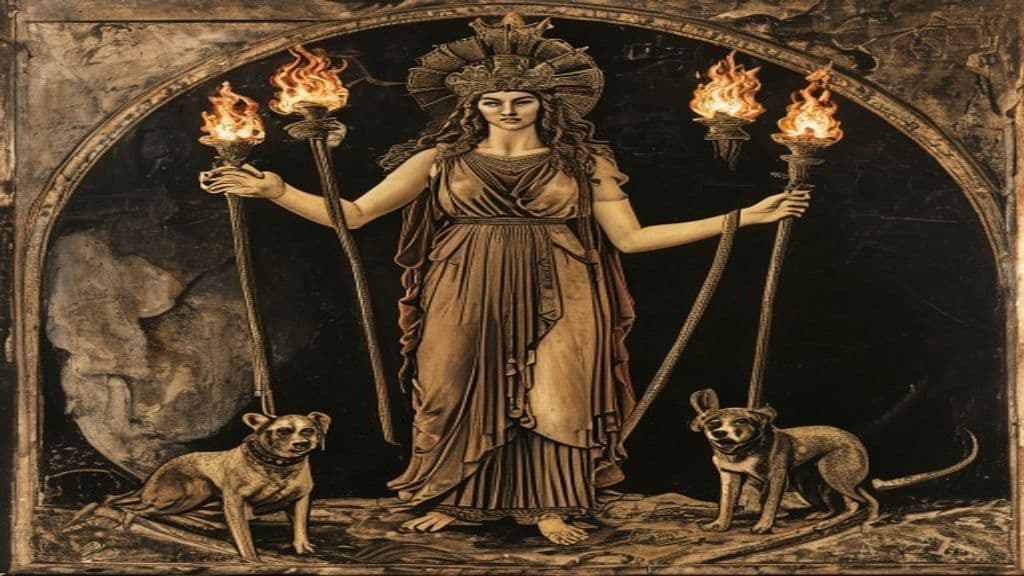
Hecate
Hecate (Ancient Greek: Ἑκάτη) is a liminal goddess in ancient Greek religion associated with crossroads, night, light, magic/witchcraft, the Moon, and household protection. She appears in early Greek poetry (Hesiod) with broad domains and in later traditions (notably the Chaldean Oracles) with expanded cosmological roles; she retained important regional cults, especially in Anatolia (Lagina) and had popular associations with witches in Thessaly.
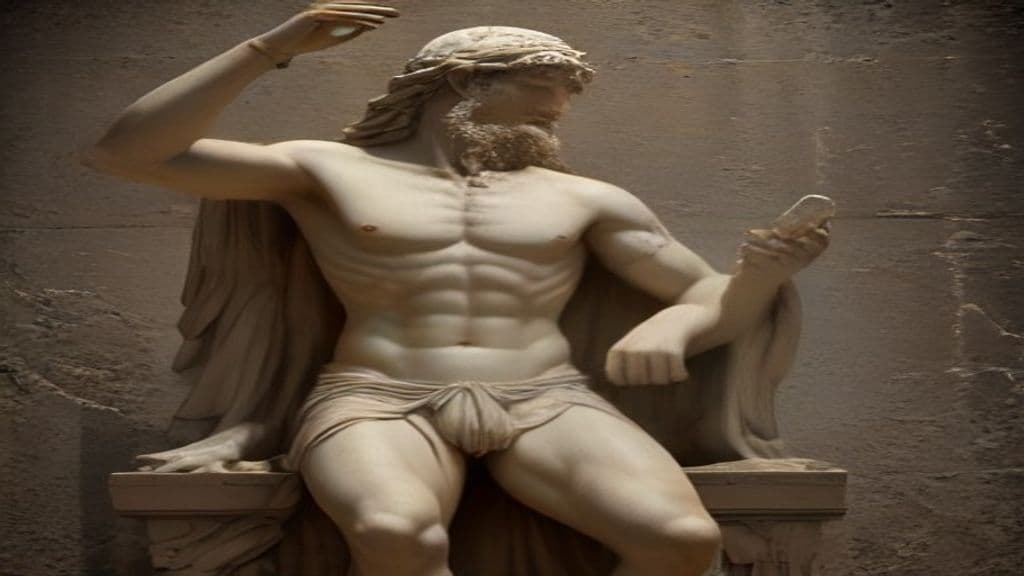
Hermes
Hermes is an Olympian god in ancient Greek religion who functions as the herald of the gods, an intermediary between mortal and divine realms, and a psychopomp guiding souls to the afterlife. He is associated with travel, boundaries, commerce, thieves, oratory, and liminality; in Hellenistic contexts he is syncretized with Egyptian Thoth as Hermes Trismegistus.
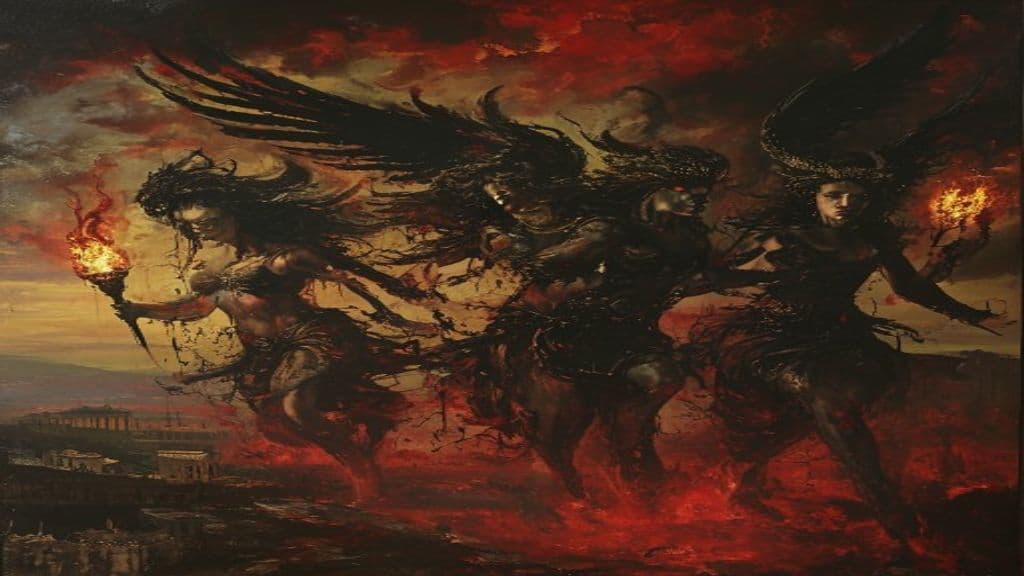
Erinyes
The three avenging Furies of Greek myth — Alecto, Megaera, and Tisiphone — who pursued and tormented those guilty of crimes against blood kin, especially murder of family members.
*Péh₂usōn (reconstructed)
Péh₂usōn is a hypothetical Proto‑Indo‑European pastoral guardian reconstructed by comparative scholars from parallels in Greek and Vedic traditions. Proposed as a Graeco‑Aryan ancestor‑figure, the reconstruction describes a protector of flocks, roads, and travellers rather than an attested historical cultic personality.
3-D Man
3-D Man is a Marvel Comics superhero identity associated with a 1950s-era origin in which the body of Chuck Chandler can materialize in three-dimensional existence when activated by his brother Hal via a pair of glasses. The mantle was later assumed by Delroy Garrett (formerly Triathlon) in modern continuity.
5 Ronin
5 Ronin is a 2011 Marvel Comics five-issue limited series that reimagines five Marvel superhero archetypes as rōnin (masterless samurai) in a fictionalized post‑Sekigahara feudal Japan. The work places Wolverine, Hulk, Punisher, Psylocke, and Deadpool analogues into period roles to explore displacement, revenge, and identity in an era of political upheaval.
57 Mnemosyne
57 Mnemosyne is a large main-belt asteroid (S-type) discovered in 1859 and named after the Greek Titaness Mnemosyne. It is a non-sentient astronomical body studied for its orbital and rotational properties and has been used in dynamical measurements related to Jupiter.
58 Concordia
58 Concordia is a fairly large main-belt asteroid orbiting the Sun, discovered in 1860 and named after the Roman goddess Concordia. Astronomical sources classify it as a C-type (carbonaceous) body with a multi-year orbital period and measurable rotation and pole orientations.
9MOTHER9HORSE9EYES9
An anonymous Reddit screen name and online persona used by the author of the Interface series, a multipart speculative-horror narrative posted in short installments across Reddit in 2016. The name functions as the signature of an authorial identity and as a focal label for a fandom that created archives, a subreddit, and a wiki documenting the story and its fictional phenomena (notably entities called "flesh interfaces").
A.R.G.U.S.
A.R.G.U.S. is a fictional clandestine United States government agency in the DC Comics universe that investigates, contains, and manages superhuman, meta-human, and supernatural incidents and assets. Introduced in The New 52 continuity, it functions as an institutional actor providing intelligence, logistical support, covert task forces (notably Task Force X / the Suicide Squad), and a dedicated magic division across comics and media adaptations.
Aamon
Aamon (also Amon) is a named spirit in early modern Western grimoire tradition (Pseudomonarchia Daemonum; the Ars Goetia / Lesser Key of Solomon). He is presented as a high-ranking infernal officer (Marquis/Prince) who governs forty legions and is credited with knowledge of past and future and with affecting human relationships (reconciling or procuring feuds and favor).
Aba (disambiguation / name-form)
Aba is a polyvalent name-form attested across many unrelated contexts (place names, personal names, animal names, and brief mythological listings). The provided sources do not support a single, coherent supernatural entity called "Aba" and offer no descriptive or ritual material for such a being.
Abarbarea
Abarbarea is a name attested in classical Greek and Roman sources for freshwater nymphs (naiads). The name appears for at least two individual mythic figures — a naiad wife of Bucolion and a naiad counted among ancestors of the Tyrians — and Hesychius records plural forms that may indicate the name was also used as a class-name (Abarbareai / Abarbalaiai).
Abas
Abas (Ancient Greek: Ἄβας, gen.: Ἄβαντος) is not a single mythic being but a recurring personal name borne by multiple mortals and minor mythic figures in Greek epic and genealogical traditions — kings, founders, seers, warriors, attendants, a centaur, and a youth transformed by a goddess. The name is glossed in the sources as 'guileless' or 'good-hearted' and appears across Argive, Theban, Trojan, Euboean, and other local cycles.
Abderus
Abderus (Ancient Greek: Ἄβδηρος, romanized Ábdēros) is a mortal heroic figure in Greek myth closely associated with Heracles, remembered as the youth left in charge of the Mares of Diomedes who was killed by them. He functions as an eponymous local/divine-hero ancestor for the city of Abdera and received funerary commemoration and athletic agones at his tomb.
Community Record
- [1]Melinoë - Wikipedia. Wikipedia entry 'Melinoë' summarizing Orphic hymn, etymology, and inscriptional evidence (Orphic Hymn 71 and Pergamon bronze tablet).wiki
- [2]Wikidata: Melinoessa. Wikidata entry for Melinoë / Melinoessa referenced in source list.other
- [3]Interview / modern cultural references (Hades II art discussion). Archive item listed among sources noting modern reinterpretations; cited only for contemporary cultural references separate from ancient attestations.other
- [4]Archive resource list (modern media references). Archive resource listed in provided notes; included among non-primary modern references.other
- [5]Archive: Hades II mod run (modern cultural reference). Archive video listed in provided notes demonstrating contemporary fictional adaptation; not used for ancient ritual information.other