Son of Iphiclus and grandson of Phylacos, Protesilaus was leader of the Phylaceans and brought forty black ships to Troy. An oracle (the sources name Thetis as involved in the prophetic framework) indicated that the first Greek to land would die; Protesilaus was the first to leap ashore and was immediately slain in the Troad. Variant traditions name different killers (Hector, Aeneas, Euphorbus, Achates, or Cycnus) or even preserve alternative outcomes (Conon's Scione tradition makes him a surviving founder). After his death the hero's tomb became a cult-focus; later literary episodes record his wife Laodamia's extreme grief, a temporary return permitted by the gods in some versions, and her eventual death in mourning.
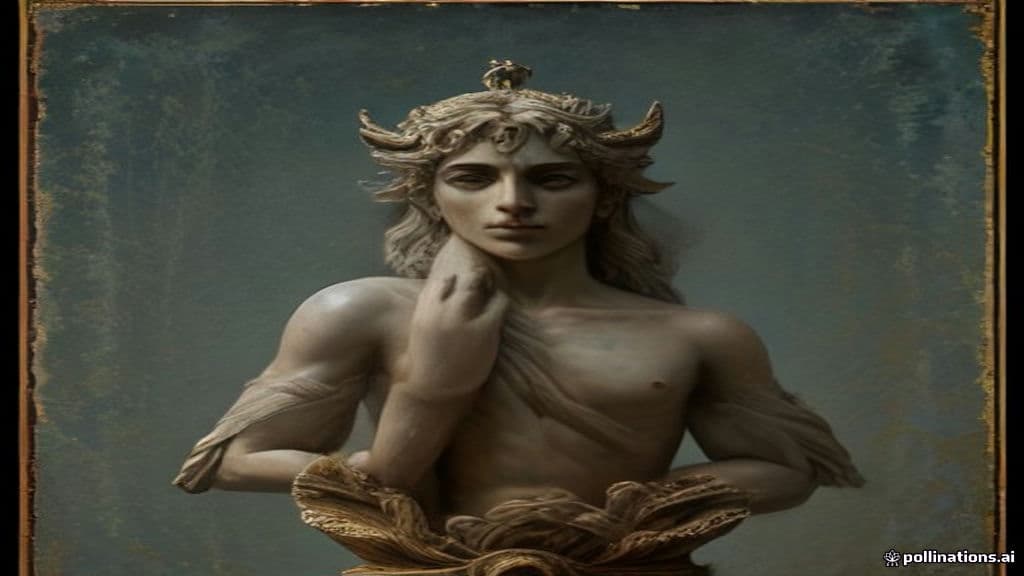
Literary portraits (e.g., Dares as quoted) describe Protesilaus as fair-skinned, dignified, swift, self-confident and even rash. Cult statuary is attested: Philostratus describes a cult statue at Elaeus standing on a base shaped like the prow of a boat; coins of Elaeus (era of Commodus) show him on a ship's prow wearing helmet, cuirass and short chiton, indicating hoplite-like martial dress. Roman copies of an earlier Greek bronze group are said to have depicted his defining moment — the landing — though only fragments survive.
As a mortal hero he functions as a martial leader (bringing forty ships, leading men from Phylace and neighboring districts), a combatant who in one episode disarmed Telephus, and the archetype of the 'first ashore' whose daring caused his death. In literary usage (Philostratus' Heroicus) the dead Protesilaus speaks from beyond the grave to supply an oracular, corrective eyewitness account of events at Troy. His tomb and memory exercise civic and cult power — inspiring votive deposits, sacrifices, athletic games (Pindar records games at Phylace), and acting as an omen or focus for later historical actors (e.g., Alexander's sacrifice at Elaeus).
Telephus
Telephus is a mortal heroic prince and later king of mythic tradition who links Arcadian Greek origins with a Mysian Anatolian kingship; son of Heracles and Auge, he is wounded by Achilles during the Achaean fleet's mistaken landing and later healed, and is father of Eurypylus who fights at Troy.

La Llorona
The Weeping Woman of Mexican folklore — the ghost of a mother who drowned her children and now wanders rivers and lakes, weeping for them and taking other children she finds at night.
*Péh₂usōn (reconstructed)
Péh₂usōn is a hypothetical Proto‑Indo‑European pastoral guardian reconstructed by comparative scholars from parallels in Greek and Vedic traditions. Proposed as a Graeco‑Aryan ancestor‑figure, the reconstruction describes a protector of flocks, roads, and travellers rather than an attested historical cultic personality.
3-D Man
3-D Man is a Marvel Comics superhero identity associated with a 1950s-era origin in which the body of Chuck Chandler can materialize in three-dimensional existence when activated by his brother Hal via a pair of glasses. The mantle was later assumed by Delroy Garrett (formerly Triathlon) in modern continuity.
5 Ronin
5 Ronin is a 2011 Marvel Comics five-issue limited series that reimagines five Marvel superhero archetypes as rōnin (masterless samurai) in a fictionalized post‑Sekigahara feudal Japan. The work places Wolverine, Hulk, Punisher, Psylocke, and Deadpool analogues into period roles to explore displacement, revenge, and identity in an era of political upheaval.
A Elbereth Gilthoniel
An Elvish hymn in Sindarin addressed to Elbereth (Varda) from J. R. R. Tolkien's legendarium. Presented in The Lord of the Rings and later musical and dramatic adaptations, the hymn functions as devotional poetic language that evokes Elvish reverence for the star-kindler rather than an independent supernatural agent.
A.R.G.U.S.
A.R.G.U.S. is a fictional clandestine United States government agency in the DC Comics universe that investigates, contains, and manages superhuman, meta-human, and supernatural incidents and assets. Introduced in The New 52 continuity, it functions as an institutional actor providing intelligence, logistical support, covert task forces (notably Task Force X / the Suicide Squad), and a dedicated magic division across comics and media adaptations.
Aba (disambiguation / name-form)
Aba is a polyvalent name-form attested across many unrelated contexts (place names, personal names, animal names, and brief mythological listings). The provided sources do not support a single, coherent supernatural entity called "Aba" and offer no descriptive or ritual material for such a being.
Abandinus
Abandinus is a locally attested Romano‑Celtic theonym known from a single inscribed bronze feather (votive object) dedicated at Godmanchester (the Roman fort Durovigutum) in Cambridgeshire. Scholars interpret him as a local god or male spirit tied to a specific place and possibly associated with a nearby spring or stream; this association is tentative and based on etymological readings of the name.
Abarbarea
Abarbarea is a name attested in classical Greek and Roman sources for freshwater nymphs (naiads). The name appears for at least two individual mythic figures — a naiad wife of Bucolion and a naiad counted among ancestors of the Tyrians — and Hesychius records plural forms that may indicate the name was also used as a class-name (Abarbareai / Abarbalaiai).
Abas
Abas (Ancient Greek: Ἄβας, gen.: Ἄβαντος) is not a single mythic being but a recurring personal name borne by multiple mortals and minor mythic figures in Greek epic and genealogical traditions — kings, founders, seers, warriors, attendants, a centaur, and a youth transformed by a goddess. The name is glossed in the sources as 'guileless' or 'good-hearted' and appears across Argive, Theban, Trojan, Euboean, and other local cycles.
Abderus
Abderus (Ancient Greek: Ἄβδηρος, romanized Ábdēros) is a mortal heroic figure in Greek myth closely associated with Heracles, remembered as the youth left in charge of the Mares of Diomedes who was killed by them. He functions as an eponymous local/divine-hero ancestor for the city of Abdera and received funerary commemoration and athletic agones at his tomb.
Abellio
Abellio is a theonym attested in Roman‑period inscriptions from the Comminges area of the Pyrenees and reported as worshipped in the Garonne Valley of ancient Gallia Aquitania. Surviving evidence is limited to a small number of inscriptions; scholars have variously hypothesized solar or arboreal associations and compared the name to forms of Apollo or to Celtic Belenus, but the deity's precise role in local cosmology remains uncertain.
Abin Sur
Abin Sur is a fictional extraterrestrial Green Lantern from the planet Ungara in DC Comics. A former history professor turned Green Lantern of Space Sector 2814, he discovered and investigated a prophecy tied to the "Blackest Night," died wounded on Earth and chose Hal Jordan as his ring-successor, and was later reanimated as a Black Lantern in the Blackest Night storyline.
Community Record
- [1]Protesilaus — Wikipedia. Wikipedia: Protesilauswiki
- [2]Wikidata entry for Protesilaus (Q3407973). Wikidata: Protesilausother
- [3]Archive: Riders (1716.) British Merlin (embedded metadata referencing Protesilaus sp.). Archive metadata noting homonymous entomological usage (Protesilaus sp.)other
- [4]Archive: Embedded Video 3 (metadata). Archive embedded video metadata referencing Protesilaus in entomological contextother