
In Vajrayana textual and ritual contexts, vidyārājas arise from the esoteric milieu as personifications of vidyā — a term that in these traditions denotes both 'wisdom' and the efficacious speech-forms of mantras and dharanis. Early textual appearances (for example, Yamāntaka in the Mañjuśrī-mūla-kalpa) portray some vidyārājas as oath-bound attendants of bodhisattvas who perform protective and pedagogical functions; over time, especially as Buddhism moved into Tibet, China, and Japan, certain Wisdom Kings were reinterpreted as the fierce aspects, incarnations, or independent objects of veneration of buddhas and bodhisattvas (a development reflected in Japanese sanrinjin 三輪身 interpretations).
Wisdom Kings are typically depicted with fearsome, wrathful features, though iconography varies by figure and region. Common traits in the sources include dark blue or black skin, multiple heads, arms, and legs, the carrying of various weapons, adornment with skulls, snakes, or animal skins, and a surrounding flaming aura (interpreted as purifying 'fire samādhi'). Individual examples differ: Yamāntaka is often shown with six heads, arms, and legs and associated with a buffalo mount; Hayagrīva in Buddhist art may appear yaksha-like with a small horse head emerging from his hair. Such features are symbolic of their purificatory and subjugating functions rather than literal uniform attributes.
Doctrinally, Wisdom Kings embody the mystic efficacy of mantras and dharanis and are invoked as active agents who gather beings for teaching, subdue unruly or hostile forces, remove obstacles to practice, and convert or vanquish opponents of Buddhism in the textual imagination. They function as guardians of esoteric doctrine, transformers of passions and ignorance into compassion and wisdom, and pedagogues who may employ terrifying forms as skilful means. Their powers are principally described in ritual and scriptural contexts (mantra/dharani embodiment, iconographic role, and protective deployment) rather than as empirical historical acts.
Weaknesses
- otherNo innate vulnerabilities documented in supplied sources; Wisdom Kings are presented as protective/wrathful deities invoked by practitioners rather than hostile beings requiring warding
Wards
- mantraInvocation or recitation of the vidyārāja's associated dharani/mantra (general practice implied in sources)
- ritualIconographic veneration (statues, images, mandalas) and esoteric ritual invocation — used to summon protection or subdue hostile forces
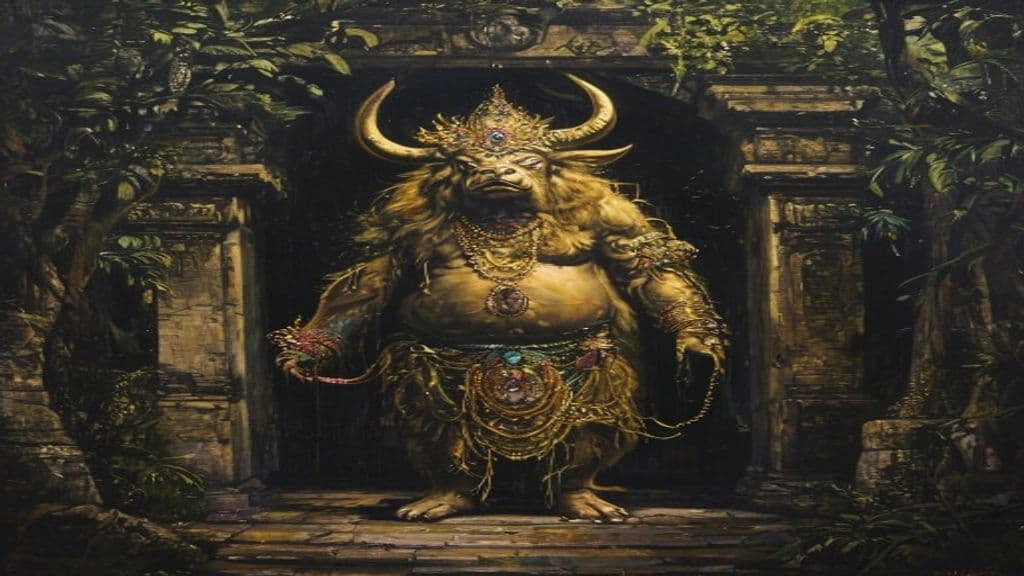
Yaksha
Nature spirits of Hindu, Buddhist, and Jain cosmology — guardians of forests, treasures, and wilderness. Ambivalent beings, capable of great benevolence to the respectful and terrible harm to the greedy.

Hayagrīva
Hayagrīva (Sanskrit: हयग्रीव, IAST hayagrīva, lit. 'horse-necked one') is an avatāra of the Hindu preserver deity Viṣṇu, depicted with a human body and a horse head. In Vaishnava traditions he is chiefly venerated as the divine patron and restorer of sacred knowledge (the Vedas) and as a bestower of learning and intelligence; in some epic passages he also appears in a martial, cosmic form to vanquish demonic forces.
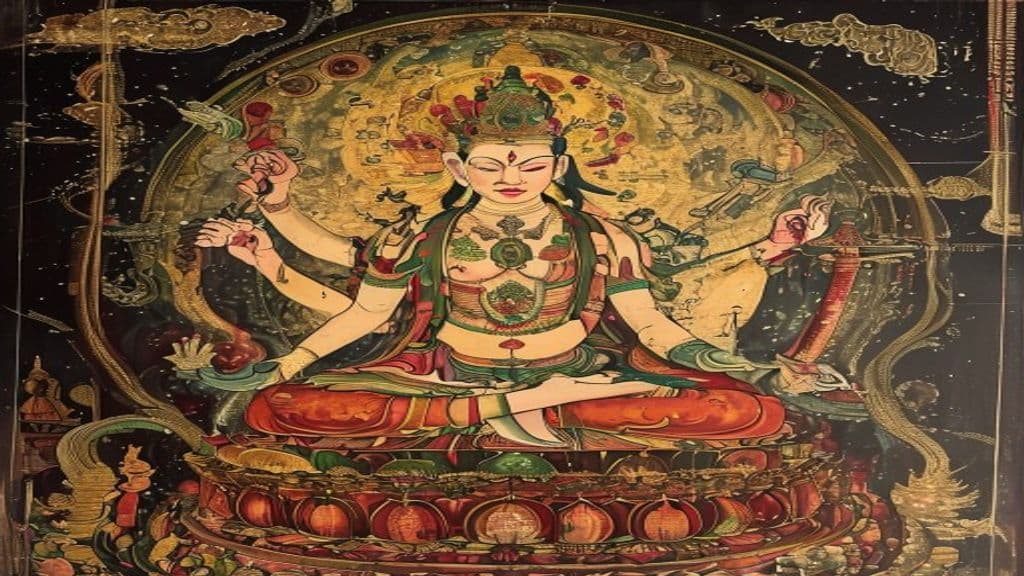
Acala
Acala (Sanskrit: अचल, 'The Immovable') is a wrathful protective deity (dharmapala) in Vajrayāna and East Asian esoteric Buddhism, classed among the Wisdom Kings (Vidyārāja). He functions as a ritual focus for visualization and mantra practice intended to remove obstacles and bind or destroy hostile forces.

Trailokyavijaya
Buddhist wrathful deity and manifestation of the bodhisattva Vajrapāṇi, associated with fierce power and protection. (Note: - Power tier: Trailokyavijaya is not described as Primordial in the source material. Given his association with Vajrapāṇi and being a Wisdom King, it would be more accurate to categorize him as Ancien)
Acalanātha (Acala / Achala)
Acalanātha (also Acala or Achala) is a wrathful deity and dharmapāla — a protector of the Dharma — prominent in Vajrayana and East Asian Mahayana Buddhist contexts. Presented as a fierce, non‑human or semi‑divine protector-figure, Acalanātha functions to defend the teaching and practitioners by removing obstacles and confronting threats to the transmission and practice of Buddhism.
Amoghasiddhi
Amoghasiddhi is one of the Five Tathāgatas (Five Wisdom Buddhas) in Mahayana and Vajrayana/Esoteric Buddhism, representing the Karma family and the quality of "unfailing accomplishment". He functions as an archetypal, protective, and contemplative buddha-body within tantric mandalas, presiding over the northern quarter and invoked in mantras and ritual iconography.
Dakinī
A dakini is a feminine spiritual figure attested in Hindu and Buddhist literature and in Himalayan Vajrayāna cultural contexts; sources in this set characterize the dakini as a type or class of goddess and as a figure embedded in tantric and Himalayan religious landscapes. Specific iconography, powers, and ritual formulas are not documented in the supplied sources.
Goddess
A goddess is a female deity — a sacred female divine figure found across many polytheistic and religious traditions. The term functions as a classificatory label for diverse culturally specific female divinities and metaphysical female principles, ranging from local patronesses to supreme cosmic realities.
Samantabhadri
Samantabhadri is a female Buddha and dakini in the Vajrayana (Tibetan) Buddhist tradition, described as the primordial Mother Buddha and the dharmakaya dakini aspect of the Trikaya. She functions doctrinally as the feminine, non-dual ground of awakening and is identified as the consort and counterpart of Samantabhadra.
Tutelary deity (tradition)
A tutelary is a divine or spirit figure regarded as a guardian, patron, or protector tied to a specific domain (place, household, person, lineage, occupation, or polity). Across cultures the term names a functional role—embodied by gods, spirits, ancestors, or meditational deities—rather than a single ontological type.
Wrathful Deities
In Mahayana and especially Vajrayana Buddhism, wrathful deities are fierce or wrathful forms (Tibetan: trowo; Sanskrit: krodha) of enlightened Buddhas, Bodhisattvas, or Devas. They function as protectors and transformative meditational yidams whose terrifying imagery is a skillful means (upaya) to remove obstacles, protect the Dharma, and transform afflictive emotions into wisdom.
Will-o'-the-Wisp
A wandering light seen over marshy ground at night, leading travellers astray into bogs and fens. Possibly a spirit, possibly the soul of the unbaptised dead, possibly the devil himself.
Will-o'-the-wisp
An atmospheric 'ghost light' — a small, mobile, lamp-like light seen at night over marshes, bogs, wet ground, or graveyards. In many cultures the phenomenon is interpreted as a supernatural being or manifestation (wandering nature-spirit, soul of the dead, transformed witch, or treasure-indicator); modern science offers chemiluminescent explanations for some occurrences.
Wind Horse
In Mongolian shamanistic tradition, the Wind Horse is a symbolic representation of the human soul associated with flight and liberation. (Note: 1. Power tier should be Greater (its association with flight, liberation, and being in the center of cardinal directions suggests deity-level abilities). 2. Appearance is not explicitly described, but)
Witch-like Werehyena
A therianthropic being in African and Arabian Peninsula folklore that can take the form of a hyena or disguise itself as a human; traditions portray it ambiguously as either human-turned-hyena or hyena-passing-as-human. The available summary source records only shapeshifting and wide geographic distribution without detailed local names, rituals, or consistent attributes.
Witege
A significant figure in Germanic and Scandinavian folklore, appearing in various heroic legends, poems, and ballads. (Note: - Power tier should be Minor Spirit since it doesn't possess notable powers or abilities. - Add sensory cues, weaknesses, and wards sections based on the provided information (none mentioned in source)
Community Record
- [1]Wisdom King (Wikipedia). Wikipedia, 'Wisdom King' article (as summarized in research notes)wiki
- [2]Wikidata: Wisdom King. Wikidata entry for Wisdom King (referenced in research notes)other
- [3]Mañjuśrī-mūla-kalpa (referenced depiction of Yamāntaka). Referenced in research notes: Mañjuśrī-mūla-kalpa portrayal of Yamāntaka (6th century) as oath-bound servant who assembles beings and vanquishes hostile forcesacademic
- [4]Japanese Buddhist pantheon (Wikipedia). Referenced for Japanese terms and sanrinjin interpretation (summarized in research notes)wiki