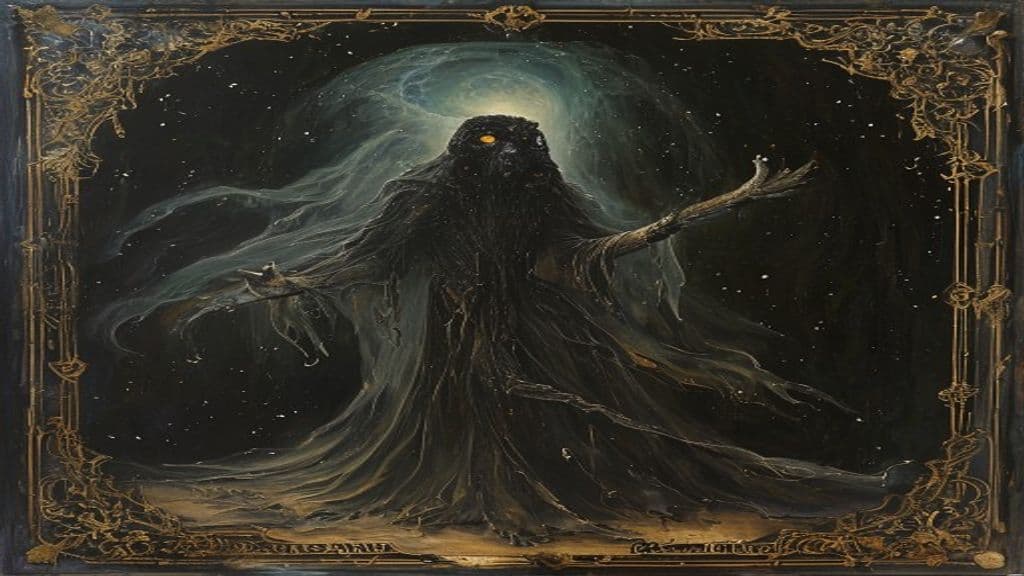
In Wolof mythology, Yumboes are supernatural beings referred to as 'good people' or Bakhna Rakhna.
Yomotsu-shikome
Yomotsu-shikome (literally 'Ugly Woman of the Underworld') is an ugly hag or hags of Yomi in early Japanese myth. In the Kojiki she pursues Izanagi as he flees the land of the dead; variant accounts in the Nihon Shoki present alternate names and numbers, sometimes suggesting multiple hags.
Youdu
Capital city of Hell or Diyu in Chinese mythology, surrounded by darkness. (Note: - The power tier should be Ancient (deity-level) instead of Primordial (cosmic), as Youdu is described as the capital of Hell, not a fundamental aspect of the universe. - The abilities listed are corr)
Yowie
Yowie is an Australian folkloric entity—recorded in some Aboriginal lexical records as a nocturnally roaming spirit and in colonial and modern accounts as a large, bipedal, hairy creature. The figure appears across eastern Australian traditions under many regional names and has been reinterpreted in settler literature and modern cryptozoology.
Ysätters-Kajsa
A localized Swedish wind-being from the province of Närke, presented in late 19th/early 20th-century sources (notably Selma Lagerlöf) as a singular, personified 'wind-troll' who delights in gales and whirlwinds and plays mischievous but sometimes protective roles in local life.
Yu Shi
Yu Shi (雨師; Yǔ Shī, "Master of Rain") is a named rain master in Chinese religion and mythology—an agent or deity associated with producing and governing rain. Yu Shi appears in mythic narratives (for example aiding Chiyou at the Battle of Zhuolu in alliance with wind and thunder deities) and is also a focus of ritual prayer ceremonies for rain among Han Chinese, Maonan, and other groups in southwest China.
Yuki-onna
The Snow Woman of Japanese folklore — a spirit born of blizzards who appears to travelers lost in snowstorms. Beautiful and lethal, she can show mercy or bring death depending on her mood.
Yunak İyesi
Yunak İyesi is a Turkic household İye (possessor/guardian spirit) associated specifically with the bathhouse or bathroom (yunak/hammam/caghlyk). It functions as the bath's guardian and may punish those who disturb it; it is also reported to have a divinatory role by giving tactile signs to a consulter.
Yuxa
Yuxa is a Turkic legendary serpent‑being: an aged snake that transforms into a sentient, shape‑changing creature which may appear as a reptilian dragonlike form or as beautiful human men and women, interacting socially and sexually with people.
Yōkai
Yōkai (妖怪) are a broad class of supernatural beings and spirits in Japanese folklore that encompass shapeshifters, tricksters, animal-spirits, possessed objects, humanoid apparitions, and formless uncanny phenomena. Rooted in Shinto and older animistic notions, the category functions as an umbrella term for many locally named entities and has been shaped by historical, artistic, and academic processes.
Yūrei
Yūrei (幽霊) are spirits of the dead in Japanese folklore who remain bound to the world of the living rather than having completed transition to an afterlife. They are a culturally specific category of ghost/spirits, often discussed alongside related terms such as bōrei and shiryō and appearing widely in literary, visual, and local legend contexts.
Zaarin / Zaar (reported string)
The supplied sources do not contain ethnographic information about a Mongolian possessing spirit called Zaarin or Zaar. The string "Zaarin" appears in the provided materials as a toponym in a technical CIA list and as a personal name in a Sindh Historical Society table of contents; no folkloric description, origin, appearance, abilities, or rituals for a spirit are present in the supplied documents.
Zababa
Zababa is a Mesopotamian war god and the tutelary deity of the city of Kish, invoked in contexts of warfare, royal legitimation, and civic protection. From the Early Dynastic period through the first millennium BCE he appears in god lists, royal inscriptions, kudurru (boundary stone) formulas, and astronomical texts; from the Old Babylonian/Middle Babylonian period onward he is commonly paired with the goddess Bau as his consort.
Community Record
- [1]