In Navadurga accounts Brahmacharini is an aspect of Parvati/Mahadevi who undertakes lengthy penance (tapas) to gain Shiva as husband. Sources describe that her tapas impressed the universe and drew Shiva's attention; in some versions Shiva tests her while disguised as a brahmachari before consenting to marriage. A legendary episode (as reported in the sources) recounts that during an attack by the asura Prakandasura and his army, a spill of her kamandalu produced a flood that washed away attackers and that, when she opened her eyes, flames consumed Prakandasura. The narratives place her penance and testing as the causal sequence leading to the goddess's union with Shiva and the subsequent cosmic outcomes in larger myths.
Brahmacharini is described as a quiet and beautiful form of Parvati, depicted wearing white clothes, holding a japamala (prayer-beads) in her right hand and a kamandalu (water-pot) in her left. The sources emphasize austerity and serenity over martial or opulent attributes.
Primary attributes attributed in the sources are prolonged devotion and ascetic discipline: Brahmacharini's defining action is sustained tapas (penance) and subsistence on simple fare (reported as bael leaves and river water in the legend). The severity of her penance is said to have impressed the universe and drawn Shiva's attention. The legend records an episode in which an accidental spill of her kamandalu produced a flood that drove off attacking asuras and in which Parvati's opened eyes emitted flames that consumed the asura Prakandasura; these narrative elements are presented as part of the legendary account rather than as routinely invoked powers.
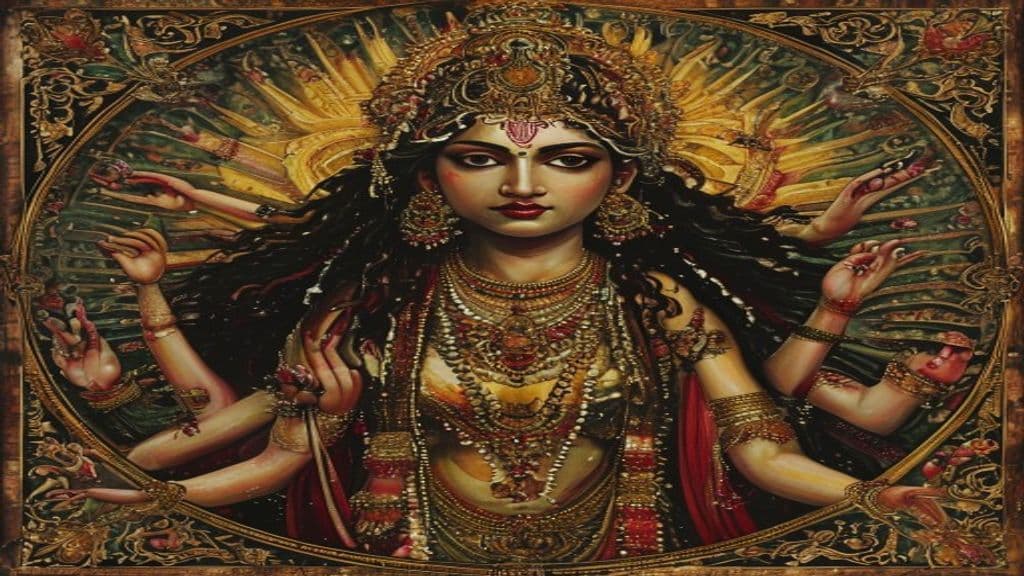
Parvati
Parvati is a principal goddess in Hindu tradition, worshipped as the consort of Shiva and as his shakti (divine power). She embodies a range of roles — devoted wife and mother, fertility and nourishment-giver, and in other manifestations a ferocious protector who destroys evil.
Navadurga
Navadurga (Sanskrit: नवदुर्गा, Navadurgā) denotes nine interrelated manifestations or stages of the goddess Durga worshipped together during Navaratri, Durga Puja, and in regional jatras and masked-dance traditions (notably in Nepal). They function as collective aspects of a single divine being tied to the nine-day contest with the demon-king Mahishasura and to communal rites of protection, victory, and renewal.

Shiva
Shiva (Sanskrit: Śiva) is one of the principal deities of Hinduism, central to Shaivism and pan-Hindu worship. Portrayed as a paradoxical figure—ascetic yogi, householder, warrior and cosmic agent—he is described as the auspicious One who creates, protects and transforms the universe and is commonly associated with dissolution within the Trimurti framework.
*Péh₂usōn (reconstructed)
Péh₂usōn is a hypothetical Proto‑Indo‑European pastoral guardian reconstructed by comparative scholars from parallels in Greek and Vedic traditions. Proposed as a Graeco‑Aryan ancestor‑figure, the reconstruction describes a protector of flocks, roads, and travellers rather than an attested historical cultic personality.
Abhimanyu
Abhimanyu is a youthful Kuru/Pandava warrior-hero in the Sanskrit epic Mahābhārata. Son of Arjuna and Subhadra, he is famed for entering the Chakravyuha battle formation on the thirteenth day of the Kurukshetra War and dying at age sixteen; his posthumous son Parikshit continues the Kuru line.
Achyuta
Achyuta (Sanskrit: अच्युत, acyuta) is primarily an epithet/theonym in Vaishnava Hindu tradition applied to Vishnu and Krishna, signifying the divine quality of being 'not fallen' — immutable, infallible, and imperishable. It functions as a devotional name in scripture, liturgy, and Pancharatra lists of divine emanations rather than as an autonomous folkloric spirit.
Acintya
Acintya is an Indonesian Hindu theological-symbolic representation of the ineffable supreme divine principle. In Balinese and Javanese practice it functions as a way to make ultimate reality present in ritual and art—often aniconically as an empty throne (padmasana) or anthropomorphically as a naked, flame-surrounded figure—rather than as a narrative, intervening deity.
Adi (asura)
Adi is attested in modern reference works as the name of an Asura who 'appears in the Matsya Purāṇa.' Beyond this single-line citation in secondary sources, no descriptive material about the figure is provided in the supplied research notes.
Adi Shakti
Adi Shakti (also Adi Parashakti, Mahadevi, Adya Shakti) is the primordial feminine power in Hindu/Shakta theology, regarded as the ultimate reality (Para Brahman) and the source from which all goddesses and gods manifest. She is both an impersonal cosmic principle (Mulaprakriti) and a focus of devotional invocation in temples, mantras, and pilgrimage sites such as Shakti Peethas.
Adi Vinayaka
Adi Vinayaka (Ādi Vināyaka; also called Nara Mukha Vinayaka) is a named iconographic and devotional form of the Hindu god Ganesha portraying the deity with a human head, described in sources as the form before the episode of decapitation by Shiva. It is rarely worshipped and appears in a small number of South Indian shrines and in devotional/musical repertoires.
Aditi
Aditi is a major Vedic goddess in Hindu tradition who personifies the boundless, infinite cosmic principle and functions as the maternal matrix from which many celestial deities (the Ādityas and other groups) are born. In the Vedic hymns she is invoked as a protective liberator who guards petitioners, provides wealth and safety, and frees devotees from hindrances such as sin and sickness.
Agastya
Agastya (also Agathiyar/Agasti) is a revered Vedic and later-period Indian rishi (sage) figure credited in textual traditions as an inspired seer, ascetic, teacher, culture-founder, and attributed author of Vedic, Puranic and Tamil works; in South Indian tradition he is associated with origins of Tamil grammar and Siddha medicine and is identified astronomically with the star Canopus.
Aghasura
Aghasura is an asura from the Vaishnava/Hindu narrative tradition (notably the Srimad‑Bhāgavatam) who, at the command of Kamsa, assumed the form of a vast serpent to ambush Kṛṣṇa and the cowherd boys in Vṛndāvana. The episode demonstrates Kṛṣṇa’s protective, divine power as he enters and destroys the demon from within.
Agiya Baital
The fire-form of the Vetala — a cremation ground spirit of UP and Bihar that manifests as a wandering flame rather than a corpse-inhabitor, leading night travellers off roads and into marshland or flames with a dancing fire that seems always just ahead.
Agneya / Āgneyī
Āgneyī (feminine) or Āgneya (masculine adjective) is a Vedic–Puranic divine figure and ritual principle tied to the fire-god Agni and the southeastern direction. In textual traditions she appears both as a personified daughter/shakti of Agni and as an adjectival/technical term applied to fire-consecrated things (direction, astra, etc.). She also occurs as the name Agneya (or Anala) among items revealed in a Shaiva-Agamic list associated with the Aghora face of Sadashiva.
Community Record
- [1]Brahmacharini - Wikipedia. Wikipedia, 'Brahmacharini' entrywiki
- [2]Brahmacāriṇī - Wikidata. Wikidata item Q2766571other
- [3]Archive: Photoshop Extension Image 2026 09 26 T 160447.653. Archive.org, Navaratri / Navadurga contextother
- [4]Archive: Samachar : DDNEWS : October 12, 2026 7:30am-8:01am IST. Archive.org, broadcast material referencing Navaratriother