Chthonicness is not a single origin myth but a descriptive status derived from the Greek adjective χθόνιος (from χθών, 'earth/soil') applied within Greek cosmology to deities whose domain, residence, or cultic orientation is 'in, under, or beneath the earth.' In the Greek corpus some deities (for example Hades, Persephone, and the Erinyes) are regularly identified with the chthonic sphere; others (Demeter, Hermes, even Zeus in certain aspects) may be described as chthonic when attention focuses on their subterranean, funerary, or fertility roles. Comparative Anatolian materials present analogous figures—e.g., a 'Sun-goddess of the earth' and other chthonic solar deities—whose local cults and magical uses represent a related regional manifestation of the chthonic mode.
The term 'chthonic' primarily denotes cultic and functional orientation rather than a uniform morphology. Individual chthonic beings possess their own traditional appearances in myth (for example Hades, Persephone, or mythic monsters associated with archaic underworld genealogies), but chthonic ascription itself does not imply a single canonical physical form; instead it signals association with subterranean spaces (soil, caves, pits, the netherworld).
Chthonic powers and behaviors described in the sources include governance or residence in the underworld (Hades), seasonal movement between underworld and earth linked to agricultural cycles (Persephone), and roles in vengeance or moral retribution located in subterranean realms (the Erinyes). Ritually, chthonic beings are contacted by offerings directed into or toward the earth (low altars, pits, burials, holocaust-type offerings) and appear in some Anatolian magical rites (e.g., chthonic solar deities prominent in Hittite magical texts), indicating invocation and technical ritual use beyond formal state worship.
Weaknesses
- ritualIncorrect ouranic sacrificial form
- conditionOffence through improper cultic orientation (mitigated by performing chthonic rites correctly)
Wards
- symbolapotropaic images (e.g., Gorgoneion used as a protective device against malign forces in some contexts)
- ritualCorrect chthonic sacrificial protocol (low altar or pit, holocaust/burial, black/dark-hided animal, honey libation, palms downward)
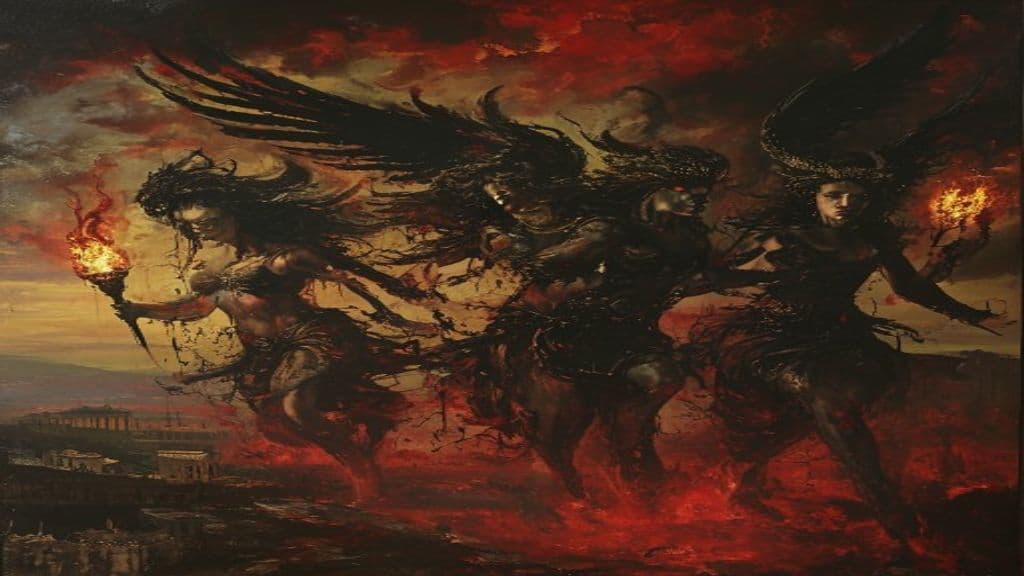
Erinyes
The three avenging Furies of Greek myth — Alecto, Megaera, and Tisiphone — who pursued and tormented those guilty of crimes against blood kin, especially murder of family members.

Hades
In ancient Greek religion and mythology, Hades is the god who rules the subterranean realm of the dead and presides over all things beneath the earth, including subterranean riches. He is a son of Cronus and Rhea and one of the generation of Olympian gods, allotted the underworld after the Titanomachy.

Persephone
Persephone is an ancient Greek goddess, daughter of Zeus and Demeter, who functions as both queen of the underworld and as the vegetation/spring deity Kore; her abduction by Hades and cyclical return symbolize the seasonal cycle of growth, decline, and renewal of crops and serve as the central narrative of the Eleusinian Mysteries.
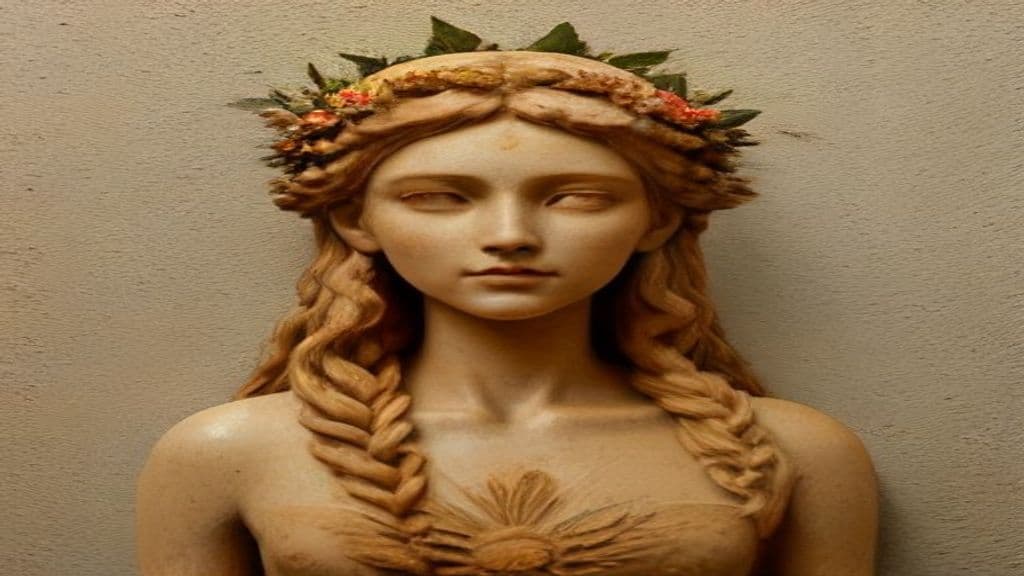
Demeter
Demeter is an Olympian goddess of ancient Greek religion who presides over agriculture, grain, and the fertility of the earth. She functions as a divine mother-figure and guardian of social customs, sacred law, and the cycle of life and death, and is central to the Eleusinian Mysteries alongside her daughter Persephone.
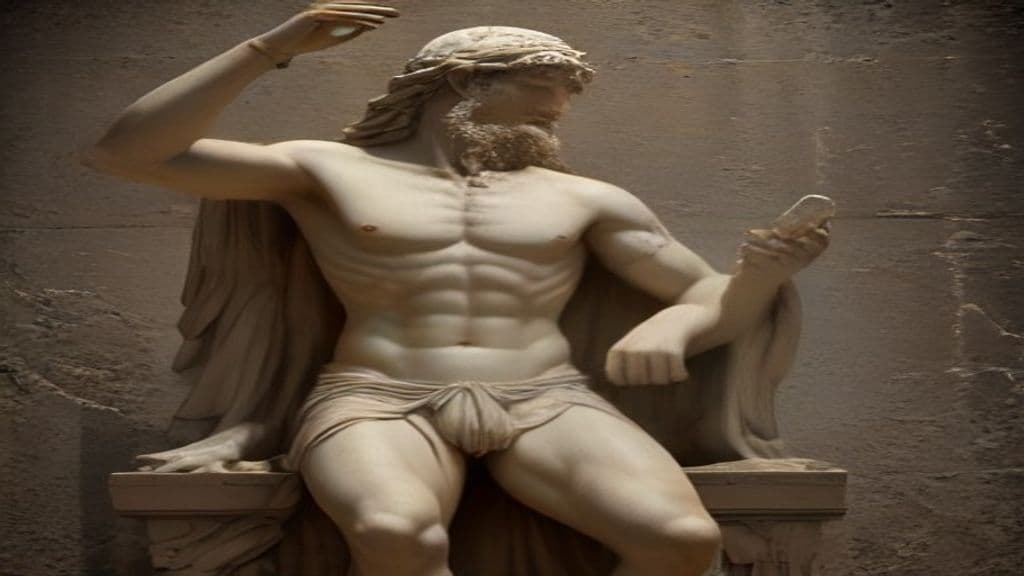
Hermes
Hermes is an Olympian god in ancient Greek religion who functions as the herald of the gods, an intermediary between mortal and divine realms, and a psychopomp guiding souls to the afterlife. He is associated with travel, boundaries, commerce, thieves, oratory, and liminality; in Hellenistic contexts he is syncretized with Egyptian Thoth as Hermes Trismegistus.
*Perkʷūnos
*Perkʷūnos is the reconstructed Proto-Indo-European thunder‑god hypothesized by comparative linguistics and mythology. Scholarly reconstructions portray him as a storm or thunder figure associated with fructifying rain and as the combatant who fights a multi‑headed water‑serpent to release life‑giving waters; no direct attestations from the Proto‑Indo‑European period survive and the figure is inferred from later Indo‑European traditions.
*Péh₂usōn (reconstructed)
Péh₂usōn is a hypothetical Proto‑Indo‑European pastoral guardian reconstructed by comparative scholars from parallels in Greek and Vedic traditions. Proposed as a Graeco‑Aryan ancestor‑figure, the reconstruction describes a protector of flocks, roads, and travellers rather than an attested historical cultic personality.
57 Mnemosyne
57 Mnemosyne is a large main-belt asteroid (S-type) discovered in 1859 and named after the Greek Titaness Mnemosyne. It is a non-sentient astronomical body studied for its orbital and rotational properties and has been used in dynamical measurements related to Jupiter.
Aba (disambiguation / name-form)
Aba is a polyvalent name-form attested across many unrelated contexts (place names, personal names, animal names, and brief mythological listings). The provided sources do not support a single, coherent supernatural entity called "Aba" and offer no descriptive or ritual material for such a being.
Abaddon
In Hebrew scripture Abaddon is primarily a noun meaning 'destruction' or a section/condition of the underworld paired with Sheol; in the New Testament Book of Revelation Abaddon is personified as an angelic figure (Greek Apollyon) described as the king of an army of locusts released from the abyss during the apocalypse.
Aban Yasht
The Aban Yasht is a hymn from the Persian tradition that praises Anahita, a goddess associated with water, fertility, and wisdom. It consists of 132 stanzas and is part of the 21 Yashts collection. (Note: - Power tier should be "Primordial" or possibly "Cosmic", given that it's a hymn of great spiritual significance and associated with a goddess. - The article incorrectly states that Anahita is associa)
Abarbarea
Abarbarea is a name attested in classical Greek and Roman sources for freshwater nymphs (naiads). The name appears for at least two individual mythic figures — a naiad wife of Bucolion and a naiad counted among ancestors of the Tyrians — and Hesychius records plural forms that may indicate the name was also used as a class-name (Abarbareai / Abarbalaiai).
Abas
Abas (Ancient Greek: Ἄβας, gen.: Ἄβαντος) is not a single mythic being but a recurring personal name borne by multiple mortals and minor mythic figures in Greek epic and genealogical traditions — kings, founders, seers, warriors, attendants, a centaur, and a youth transformed by a goddess. The name is glossed in the sources as 'guileless' or 'good-hearted' and appears across Argive, Theban, Trojan, Euboean, and other local cycles.
Abath
No corroborated folkloric entity named "Abath" is documented in the provided sources. The string appears in the supplied material only as a surname/personal name in Aruban/Dutch-Caribbean archival records and as an unrelated taxonomic or encyclopedic hit; no mythic attributes, origin stories, rituals, or apotropaic practices for an entity called Abath are present in the documents reviewed.
Abatur
Abatur is an uthra (celestial emanation) in Mandaeism described as the 'father of the Uthras' and called the Ancient (ʿattīqā). He resides on the boundary between the World of Light and lower regions, functions as a judge who weighs souls (Abatur Muzania), and supplies instructions and materials to the demiurgic uthra Ptahil in accounts from the Diwan (Scroll) of Abatur.
Abatwa (Twa / Batwa)
Abatwa (also recorded as Twa, Batwa, Mutwa; singular forms Barhwa or Murhwa in some transcriptions) are indigenous hunter‑gatherer peoples of the Great Lakes region of Central Africa, historically identified as some of the earliest inhabitants of the area. The available sources treat them as human ethnic groups whose livelihoods, lands, and populations have been severely affected by conservation policies and modern violence.
Abderus
Abderus (Ancient Greek: Ἄβδηρος, romanized Ábdēros) is a mortal heroic figure in Greek myth closely associated with Heracles, remembered as the youth left in charge of the Mares of Diomedes who was killed by them. He functions as an eponymous local/divine-hero ancestor for the city of Abdera and received funerary commemoration and athletic agones at his tomb.
Community Record
- [1]Chthonic deities. Wikipedia, 'Chthonic deities' entrywiki
- [2]Wikidata: chthonic deities. Wikidata item Q611361wiki
- [3]Xenotheogony (archive). Archive: Xenotheogony excerpt (medusa/gorgon material referencing archaic chthonic monsters)other
- [4]Solar and Chthonic Deities in Ancient Anatolia: The Evolution of the Chthonic Solar Deity in Hittite Religion. Archive: scholarly chapter on chthonic solar deities in Anatolia (Hittite/Luwian contexts)academic
- [5]Medusa (Gorgon) archive item. Archive material referencing Medusa as among archaic chthonic-associated monstersother