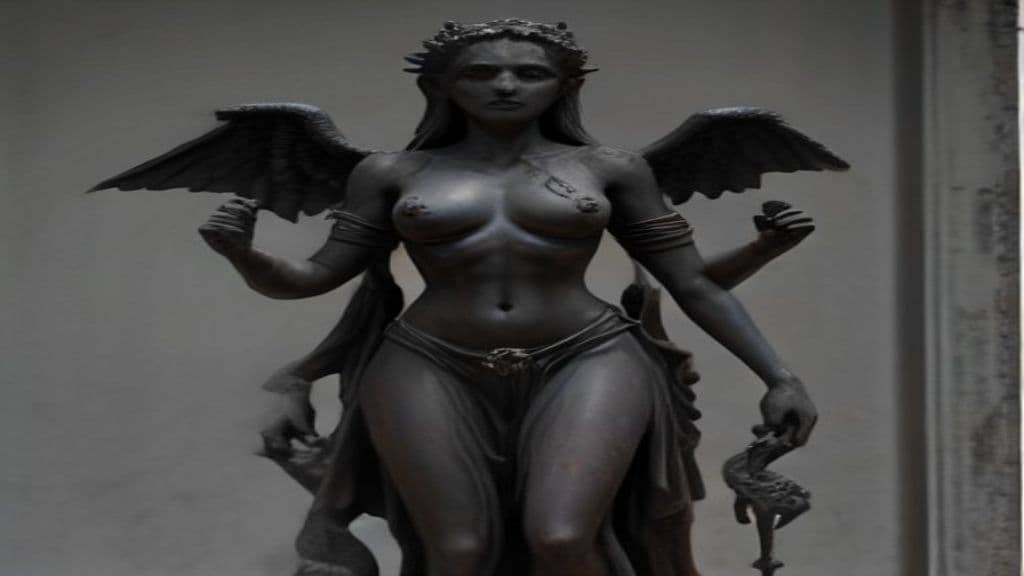
The compiled reference materials record two distinct attestations of the name Demonice. In genealogical listings she appears as the daughter of Agenor of Pleuron (a figure placed in the legendary genealogies of Aetolia). In a separate anecdotal account preserved in later Greek-derived reference traditions, a maiden called Demonice of Ephesus becomes involved with Brennus, the Gaulish leader described in the narrative of a foreign incursion into Asia Minor; in that tale she promises to betray her city for gold and is then buried alive. The modern summaries preserve these brief identifications without providing extended primary-text narrative in the supplied sources.
No physical description or iconographic attributes for Demonice survive in the provided reference materials. The sources preserve her only as a named figure in a genealogical entry (daughter of Agenor of Pleuron) and as the subject of a short anecdote (the maiden of Ephesus); they do not record dress, features, or other visual details.
The sources do not ascribe supernatural powers, magical abilities, or ontological status as a spirit to Demonice. Her recorded actions are wholly human and narrative: one attestation lists her parentage within a mythic genealogy; the other describes human choices motivated by greed (promising to yield/betray for gold) and the mortal consequence (being buried alive). No supernatural behaviors or capacities are described in the cited materials.
Pelasgus
Pelasgus (Πελασγός) is a mythic ancestral and eponymous founder figure in ancient Greek tradition credited in various local accounts with founding cities, teaching agriculture, receiving Demeter, and giving his name to the Pelasgians and regions such as Pelasgiotis. He appears across competing regional genealogies (Argive, Arcadian, Thessalian) rather than as a standardized supernatural being.
Porphyrion
Porphyrion (Ancient Greek: Πορφυρίων) is a Giant (one of the Gigantes) in ancient Greek myth who is repeatedly marked as one of the greatest of his kind and a principal combatant against the Olympian gods in the Gigantomachy. Ancient authors variously describe him as attacking gods (notably Hera and Heracles) and as being slain by divine force or a hero.
Demolition Team
The Demolition Team is a fictional mercenary crew in the DC Comics universe, assembled to perform large-scale destructive operations using specialized heavy-equipment. Introduced in Green Lantern #176 (May 1984), they operate as hired specialists who clash with superheroes and law enforcement in urban settings.
Demon (tradition)
A broadly attested category of harmful or malevolent supernatural beings found across many cultures, used to explain illness, death, misfortune, temptation, and social disruption. The concept is historically flexible, ranging from neutral intermediary spirits in ancient contexts to negatively valenced agents in many later religious traditions, and is the object of ritual responses such as exorcism or magical conjuration in some traditions.
Demon Cat
The Demon Cat (also called the D.C.) is a legendary ghostly feline in Washington, D.C. folklore said to haunt government buildings—most notably the United States Capitol and the White House. Tales describe ordinary cat-sized sightings that allegedly swell to enormous proportions and appear as omens before major political events; skeptical accounts attribute sightings to misperception or occupational prank culture among guards.
Demon Lord Dante
Demon Lord Dante (魔王ダンテ, Maō Dante) is a fictional primordial demon-leader from Go Nagai's manga/anime property. In the narratives Dante is an ancient combatant against autonomous 'gods', sealed in the past and later reborn or reawakened, alternating between human incarnations and fused demonic forms.
Demonassa
Demonassa (Ancient Greek: Δημώνασσα) is not a supernatural being in the supplied sources but a personal name attested to several mortal women in Greek mythographic and literary traditions and later reused in biological taxonomy. Attestations include multiple mythic genealogical figures, a rhetorical anecdote of a Cypriot lawgiver, and later literary stock-character uses (notably Corinthian sexualized roles). The same lexical form is also applied in modern zoological nomenclature (a beetle genus and insect species epithets).
Demonice of Aetolia
Demonice (Ancient Greek: Δημονίκη, also attested as Δημοδίκη / Demodoce) is a mythic Aetolian princess in Greek genealogical tradition. She is presented as a mortal daughter of King Agenor of Pleuron who consorted with the god Ares and bore sons whose names serve as eponyms for local rivers, cities, and peoples of Aetolia and neighbouring regions.
Demons in Mandaeism
In Mandaean cosmology, 'demons' are the hostile inhabitants of the World of Darkness, a structured underworld of kings, paired rulers, guards and lesser spirits that oppose the beings of Light. They appear throughout Mandaean scriptures (notably the Right Ginza and Diwan Abatur) as named personages, consorts, matarta (gate) guards, devourers and other functionaries encountered in mythic descent narratives.
Demophon of Athens
Demophon (Δημοφῶν / Δημοφόων) is a legendary Athenian hero and king of the heroic age whose narrative links the Theseus-cycle, the post‑Trojan War returns, and foundation stories for Athenian institutions. He appears in varied traditions as a Trojan War veteran, host to the Heracleidae, founder of the court of the Ephetae after an accidental homicide, and as party to the Phyllis/Acamas cycle of tragic return.
Demoptolemus
Demoptolemus (Ancient Greek: Δημοπτόλεμος) is a mortal figure named among the suitors of Penelope in the Homeric epic tradition. He is listed as one of the suitors present in Odysseus’s hall and is reported in the narrative tradition to have been killed during Odysseus’s slaughter of the suitors (Odyssey Book XXII).
Denethor II
Denethor II is the twenty-sixth Ruling Steward of Gondor in J. R. R. Tolkien's legendarium: a human political leader of great will and foresight whose secret use of a palantír and ensuing despair lead to his tragic self-destruction during the War of the Ring.
Community Record
- [1]Demonice — Wikipedia. Wikipedia, entry 'Demonice' (summary of two women named Demonice in Greek mythology).wiki
- [2]Demonice — Wikidata. Wikidata item Q1186488, identifies Demonice as a figure of Greek mythology.wiki
- [3]Who's Who in Classical Mythology (archival listing). Prosopographical compilation listing Demonice among named figures of classical mythology (archival reference edition).other
- [4]Cum se aplica Legea lui Dumnezeu astăzi? Iasmin și Paul (archive item noted in research notes). Archival audio item cited in source list; noted in research materials but not as a source about Demonice.other
- [5]Sfaturile Sfântului Porfirie pentru depresie (archive item noted in research notes). Archival item present among supplied materials but not relevant to Demonice; included in source list for completeness.other